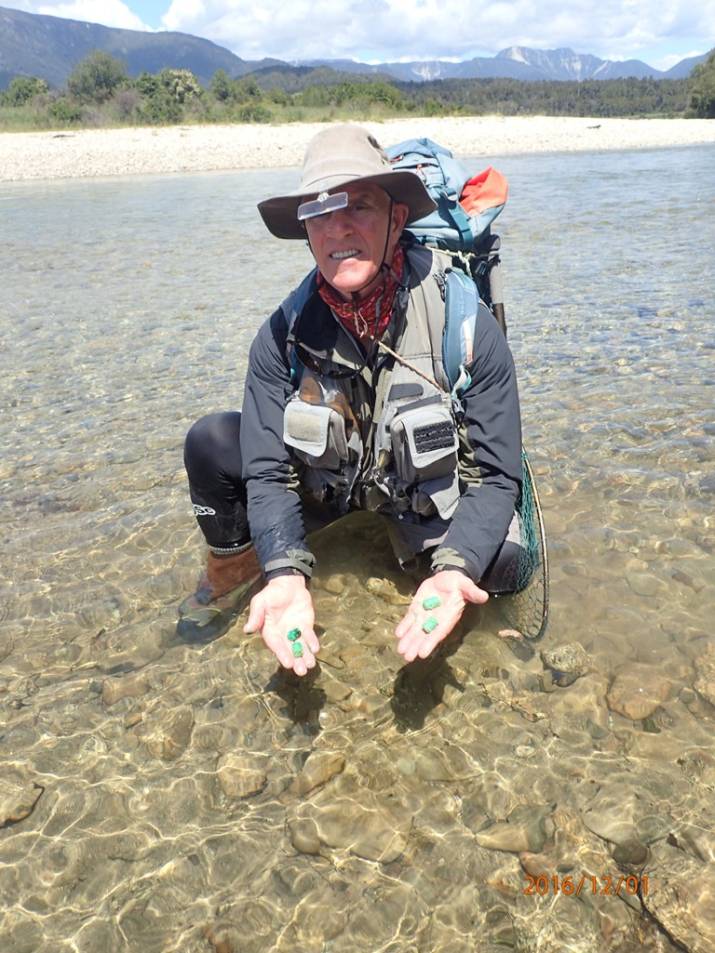
*Pic: Scott Murray in the Mokihinui River with 1080 pellets that fell from the sky on his American guests and him
“It was like big hail drops hitting the water around us,” said New Zealand trout fishing guide Scott Murray who is a co-owner of River Haven Lodge near Murchison.
It was no ordinary hail storm. The ‘big hail drops’ were toxic 1080 pellets.
The 1080 drop was a joint effort by Ospri for possum “control” and the Department of Conservation’s “Battle for Our Birds” predator control programme. It was December 2, 2016 when Scott and his two guests helicoptered into the Mokihinui River that enters the Tasman Sea north of Westport on the west coast of NZ’s South Island. The upper reaches in the river’s north and south branches are of wilderness character. Also in the area the same day was Zane Mirfin a Nelson guide and two guests. Zane Mirfin’s Californian client was incredulous when Zane explained what the aerial bombardment with 1080 pellets was about.
Meanwhile Scott Murray and a 91-year-old Californian client and nephew had just landed from their helicopter in the Mokihinui valley when they saw other choppers carrying buckets loaded with 1080 green pellets. Next moment poison-laced pellets started ‘plip-plopping’ into the water around them.
Emotions naturally ran high. Scott Murray was angry while his guests were shocked and incredulous at the helicopters indiscriminately dropping poisoned pellets around. The pellets landed in the water and over the river flats and ridges of the valley.
I talked to Scott Murray on the phone. Afterwards his shocked client debated whether he would ever return to New Zealand following the incident. The clients saw New Zealand’s much vaunted “clean and green” branding for exports and tourism as a farcical lie.
“It’s a bad, bad advertisement for New Zealand. Overseas New Zealand’s 1080 madness is becoming increasingly known and a growing number are shocked at New Zealand dangerous obsession and use of 1080 and poisons generally. It makes me quite angry just thinking about it.,” said Scott.
On that December 2 in the Mokihinui upper reaches, the spreading of poison continued throughout the day. Despite a strong north-westerly wind blowing and making any accuracy of drops impossible, the helicopters continued to operate.
Both Zane Mirfin and Scott Murray questioned the purpose for the massive drops of poison.
“It’s a waste of taxpayer money and ecologically damaging,” said Zane Mirfin.
“Birds will die but equally important is the sheer waste of taxpayer funds on a largely futile exercise, plus the damage done to New Zealand tourism and export branding of clean-and-green.”
He described the “Battle for the Birds” programme as “a bureaucratic exercise in state-funded rodent enhancement.”
Rat enhancement?
Landcare Research studies have shown that surviving rats after a 1080 drop explode in numbers. within a few short years. A female rat ovulates at 5 weeks of age and can have four litters of 8,10 or more in a year. and within 3 to 4 years sky-rocket to four times their pre-poison numbers – unlike the slow breeding possum which has usually just one “joey” a year.
Tb Possums – Zero
OSPRI claims possums spread bovine tuberculosis (Tb). But last year, NZ First MP Richard Prosser prised an answer in Parliament from Minister of Primary Industries Nathan Guy that last year 9838 possums were killed throughout New Zealand and then checked for tuberculosis. None had the disease. Other longer term figures showed negligible Tb infection in possums.
Besides New Zealand has been well under the international yardstick for being TbFree for a number of years. In a few words There is no reason to demonise the possum and spread 1080.
Returning to the latest Mohikinui 1080 bombardment of anglers, there was a comical side to the horrifying experience.
Zane Mirfin’s California client, was startled and shocked and then afterwards burst into a rendition of pop artist Prince’s 1984 song “Purple Rain” with the new lyrics being “poison rain, poison rain, I only wanted to see you bathing in the poison rain”.
Pellets lay in the stones and in the river and as the party in a ‘shell-shocked’ state ate lunch, pellets were clearly visible around them and in the river.
“All in all, it was not a great advertisement for the prudent management of public lands and for the credibility of NZ’s clean green – 100% pure boast and the enhancement of the New Zealand tourism industry,” said Zane Mirfin.
Scott Murray told me his clients, often affluent Americans and sometime celebrities such as film star Michael Keaton, just could not believe the stupidity of New Zealand’s 1080 programme. As the 1080 poison pellets dropped into the surrounding bush, native bird wekas started excitedly squawking as they went into a feeding frenzy on the toxic baits. They would die.
1080 kills slowly over a one or two or even three day period during which the bird or animal suffers a cruel death.