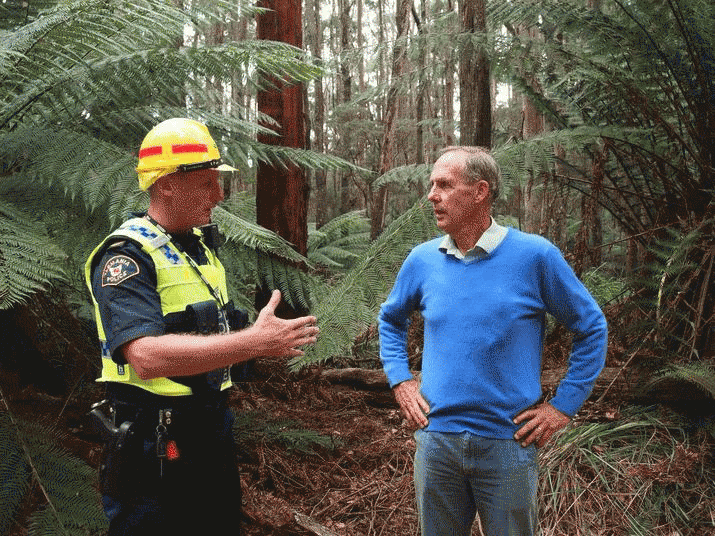
*Pic: The moment of conservation legend Bob Brown’s arrest at Lapoinya …
Dear Editor,
Pete Hay’s brilliant opinion piece (The Mercury, Home is Where the Heart is, 18/3; Mercury HERE ) is a must read. The article helps explain why people should retain the right to protest destruction of local environment. Hay calls for Government recognition of the profound importance of “deep communal place attachment”. He calls for this recognition to be reflected in planning and policy.
This is not a new idea. Hay quotes Canadian geographer Edward Relph who asserted in the 1970s that “a deep relationship with place(is) as necessary as, and perhaps as unavoidable, as close relationships with people. Without such relationships human existence is bereft of much significance”.
Hay’s uses as a case study of the clearfelling of the Lapoinya forest in the North West of Tasmania. The concerted campaign of the Lapoinya local community and the angst experienced as the destruction has proceeded has been exposed in The Mercury, The Sunday Tasmanian, and in online video documentary form. What has transpired at Lapoinya is effectively the violation of the needs of a small community- a rape of their home.
Solastalgia is a new word coined by the Australian philosopher Glenn Albrecht in 2003. Solastalgia refers to the distress induced by environmental degradation. It can be understood as the homesickness that occurs when a home environment is destroyed or severely degraded. Solastalgia has been documented in the presence of severe drought and in response to large-scale open cut coal mining in The Hunter Valley in NSW.
Solastalgia can be lethal. I am aware of at least one solastalgia affected individual who has committed suicide. This was in the face of destruction of his treasured home surrounds by industrial scale clearfelling and wildlife poisoning in the Roses Tiers in North Eastern Tasmania in 2004.
THE ARTICLE …
• Talking Point: Home is where our heart is
March 18, 2016 12:00am
PETE HAY MercuryWHEN a government, or a government instrumentality, makes a big call, a policy decision likely to prove controversial, the ultimate defence of their position is that it is in the public interest.
And rightly so. There can be no democratic politics without a concept of the public interest. It is the bedrock from which democracy proceeds.
Without the claim to be acting in the public interest, governments can claim no mandate for making decision a rather than decision b. It is what confers legitimacy on any and all acts of government and public authorities. Policy decisions that are in the public interest are legitimate; those that are not in the public interest are not legitimate.
Even the extreme individualism of neoliberalism, the values paradigm within which both major parties function, must have recourse to the concept of the public interest — without it no government or government instrumentality can claim legitimacy for its actions.
Nevertheless, in my view there are public interest claims that trump those of government. There are publics within publics. The public interest claims of government are generalised and diffuse. Within any political system there will also be intermediate public interests, and strong interests quite specific to smaller, more coherent publics. The smaller and more homogeneous these publics are — neighbourhoods in which there is a broad commonality of place values, for example — the more likely it is that this less diffuse public interest can, with confidence, be identified. There are cogent reasons why the interests of these publics should be accorded precedence over larger, more diffuse publics.
The interests of all publics within public are legitimate, but those of localised publics are systematically under-acknowledged by public authorities. This is understandable because such authorities, as agencies of the state, are inclined to assume that there is only one public interest — the public interest — that of the entire state.
But there is a persuasive case that the interests of local and regional publics constructed around a shared sense of place should be given precedence over other interests — not only the private interests of individuals, but also the state’s interest in promoting economic activity.
As we move from local articulations of a public interest to those that apply to a larger, more complex public — an entire political system, for example, or, in the case of a system such as ours, a subsystem as complex as a state — the public interest becomes smeared out and much more difficult, beyond the broadest of parameters, to determine. A public interest locally articulated should take precedence because its concentrated character makes for a stronger, more coherent public interest claim.
Strongly articulated local public interest claims will almost always cohere around a passionate commitment to place. Violation of places so affectionately regarded induces distress, even grief, in those who are forced to witness the defacement of a loved place. Planning regimes and government agencies are blind to this.
Deeply felt place attachment is, then, the big sleeper in government and agency policy determinations. It is mostly ignored, and this is why determinations made in Hobart that have consequences in, let us say, Lapoinya, typically generate so much political heat. Yet it is increasingly recognised that the construction of place identity and attachment is a fundamental human activity, and the need to belong within a shared geography, is the equivalent of such basic human needs as liberty, sustenance, and security from violence.
“A deep relationship with place,” American geographer Edward Relph asserted in the 1970s, is “as necessary, and perhaps as unavoidable, as close relationships with people. Without such relationships human existence is bereft of much of its significance”.
This means that any activity that harms or makes over a valued place, threatening the depth of a community’s relationship with it by degrading the qualities of that place, is against the public interest. Where a community can demonstrate a deep sense of a shared commitment to place, to a communally defined home, that should be respected. When it is not respected — when it is overridden by the actions of government or state authorities — an unwarranted, grief-inducing violation of an insufficiently acknowledged but basic human need has taken place.
Deeply felt place attachment is … the big sleeper in government and agency policy determinations.
This, then — the strong and tangible public interest of local and regional communities in the maintenance of the valued qualities associated with a treasured place — establishes a prior public interest, one that can be shown to be superior to the use-rights of individuals and to the “promoting economic activity” interests of governments, and it entitles local communities to have the prime say in determining the future and the evolving character of “their” place.
Which explains what is happening in Lapoinya, and why their interests should prevail. It matters not that the forest scheduled for logging is not oldgrowth. It matters that a government agency, with the government’s connivance, has chosen, we now know, to lose money in a logging operation undertaken, we have to conclude, with the aim of disturbing the peace in order to show off a brand-spanking new draconian law. And all this in violation of a public’s interest that merits precedence. Because the forest in contention is central to the Lapoinya people’s strong place meaning, and that should simply be that.
Until government acknowledges the prior rights that deep communal place attachment confers, we can expect more of these locally distressing confrontations.
To build the priority of place into planning and policy systems will be devilishly difficult, and it will be a significant constraint on economic development and government activity. It is just that the concentrated interest of local publics in preserving the integrity of deeply loved local place trumps the public interest claims of governments, and it is time that this was recognised.
Pete Hay is a Tasmanian writer and academic.