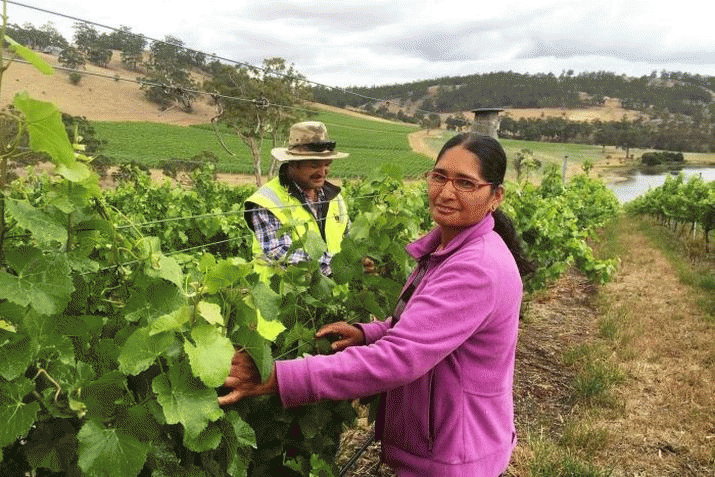
Bhutanese refugees Dilli Thapa and his wife Tulashi have been able to buy a house in Tasmania. (ABC Rural: Margot Foster)
In October 2015 Tasmania acceded to the Federal Government’s Safe Haven Enterprise Visa (SHEV) program, becoming only the second state to do so. Premier Hodgman proclaimed at the time that Tasmania was opening its hearts and doors to those in need. However, it seems that Tasmania’s generous spirit and the possibility for the State to derive significant long-term benefits from the SHEV program have been significantly undermined from the outset.
In December The Mercury reported ( HERE ): ‘The scheme offers asylum seekers a better chance to stay in Australia in return for moving to the country’.
However, the temporary nature of the SHEV and the limited pathway for its recipients to move on to permanent visas raises serious questions as to how many individuals will truly be able to settle and build a future in Tasmania. As the law and policy is currently framed it seems that for many, safe haven will actually be a perpetual legal limbo of subsequent temporary visas. This is a significant concern not only for the those refugees who are directly subject to these policies, but for the Tasmanian community as a whole which may be denied the significant opportunities that can follow when refugees are permitted to settle and prosper.
The SHEV is a five-year temporary visa available to persons found to be a refugee and therefore owed Australia’s protection as a matter of law. This new visa is part of a suite of measures implemented to address the backlog of approximately 25,000 asylum seekers who arrived in Australia after 13 August 2012 and have been waiting to have their refugee claims assessed. This visa replicates a pre-existing skilled migration program that provides an easier pathway to permanent residency if the holder works in regional Australia for a fixed period, however for asylum seekers who arrived by boat this is the only means of pursuing a permanent visa.
There are two significant hurdles to overcome in order to obtain a permanent visa. First, a SHEV holder must undertake regional employment while not accessing social security benefits, or full-time study paying international fees at a regional campus (or a combination of these activities) for a cumulative period of 42 months, they will become eligible to apply for certain other onshore visas. Second, a refugee who undertakes the prescribed regional activities must still meet all eligibility requirements for the subsequent visa they wish to apply for. Thus they are effectively placed in the same position as any prospective migrant seeking to obtain an Australian visa.
For example, obtain a skilled visa the refugee will need a high level of English language abilities, suitable qualifications and/or employment experience and possibly sponsorship by an Australian company.
Alternatively, family visas may be possible if the applicant is the spouse, child or parent of an Australian citizen or permanent resident.
It must be recalled that the refugees who receive SHEVs did not travel to Australia due to their exceptional skills, education or family ties, which a number may nonetheless possess. The Australian government has accepted that they face a real risk of persecution in their respective home countries and for this reason cannot lawfully be returned. Indeed, if they could have obtained a skilled or family visa through the general migration program there would have been no need to risk a journey by sea.
Notwithstanding the contributions and connections they may have made in regional Australia, If a SHEV holder cannot satisfy the criteria for grant of a visa in the general migration program the only option available at the end of their visa is to apply for a subsequent temporary protection visa. Until an individual is able to obtain one of the prescribed skilled or family visas they will remain in a perpetual cycle of needing to have their refugee claims reassessed. Cruelly, denying an obtainable pathway to permanent residency or citizenship also robs an individual of the ability to sponsor their family to come to Australia, without which it will be hard for most to build their future here.
If refugees are not able to settle and establish themselves, it is questionable whether Tasmania will be able to derive the anticipated benefits from this program. There are numerous examples of the positive outcomes from refugee settlement programs in various Australian communities. The town of Nhill in Victoria is one such example, where a program to settle Karen refugees has been touted as a lifeline for a regional community in decline. According to Deloitte Access Economics ( HERE ) the economic impact of the increased labour supply is estimated to be $41.5 million. The program redressed population decline, revitalised local services, attracted increased government funding and built social capital amongst both the host and refugee communities. The CEO of the Hindmarsh Shire Council surmised that in addition to economic benefits: “The social impact of the Karen settlement is extraordinary. Nhill, a very conservative community, has embraced and opened their minds and hearts to the Karen. This has made Nhill a better place to live.” ( HERE )
Recently commenting ( HERE ) on the success from a program to employ Bhutanese refugees in her Coal River vineyard, Manager of Jansz-Parish Vineyard Jen Doyle emphasised:
“It’s good to know that they are going to stay for the long term. It means that we don’t have to keep training people, that we build on the skills that they already have.”
While purporting to bestow safe haven and an opportunity for enterprise, currently the SHEV program, appears destined fail to provide a durable solution to many refugees and to also deny Tasmanian towns immense benefits. It is conceivable under the present framework that many individuals will join our community but may be relegated to being perpetually temporary Tasmanians.
*Michael Simmons is a Solicitor specialising in Migration and Refugee Law. The views in this article are entirely his own.
MEANWHILE …
• SMH Editorial: No need to trade off children’s rights for border protection So Australia’s offshore detention regime at Nauru and Manus Island is legal, a majority of the High Court has ruled. But is it moral?
• Urban Wronski in Comments: People smugglers are a no threat to our sovereignty postured Malcolm Turnbull in Question Time, Tuesday, as the beleaguered PM dug into the same dung-heap Tony Abbott once bucketed us with, in order to engender a sense of crisis, foster division and justify extreme measures. Operation Sovereign Ordure was up and running all over again. Or was it? Desperate to stop the rats in his ranks, Turnbull drops his pitch below rodent poop to win the support of his party’s rabid right and Abbott-government-in-exile, the Monkey Pod Bros, a rabble of unhappy nut-bags, deposed prime ministers and other trouble-makers. Top banana, former QLD copper Peter Dutton, claims to be in charge. He orders the Chinese takeaway and with Jamie Briggs helps set the table and the moral high ground …

• Liz Breen: Let Them Stay, says Amnesty International Launceston Action Group …
In response to the High Court decision on Wednesday the 3rd of February on the legality of offshore detention, we have called a snap rally in Launceston to support asylum seekers facing deportation to Nauru. We are horrified by the reports of serious mental-health issues and abuse suffered by adults and children in Australian detention centres. This High Court decision will result in around 260 vulnerable people, including over 80 children, being forcibly sent back to Nauru.
Amnesty International Australia reports that asylum seekers on Nauru “suffer the effects of harsh living conditions and their mental and physical wellbeing is being eroded each day, driving people to self-harm and attempted suicide.”
Seeking asylum and safety is a fundamental human right and we are standing together to let our elected representatives know that we do not accept this inhumane treatment of fellow human beings who need our protection.
This peaceful rally in support of asylum seekers will highlight that there are many people in our community who are disgusted by the human rights abuse that is occurring in Australian detention centres. We are calling on our elected representatives to show compassion towards asylum seeks and to say Let Them Stay, they must not be sent back to conditions that will harm their mental and physical wellbeing.
This snap rally, organised via social media, is one of many that will be staged around the county in the coming days including in Melbourne, Sydney and Hobart. We are joining with people and organisations across Australia to peacefully protest the return of asylum seekers, including babies and children, to utterly inhumane and cruel conditions on Nauru. We will stand together to send a strong message to our elected representatives that we do not accept this cruel treatment of asylum seekers, especially children, who need our protection.
The Amnesty International Launceston Action Group is a non-political and non-religious grassroots community group that raises awareness of human rights issues through peaceful actions and events. Our members are volunteers and come from diverse backgrounds across the Launceston community. We are united in defending human rights.
Let Them Stay: Snap Rally in Launceston
Friday 5th February 2016
5:30-6:30PM
Prince’s Square, 180 Charles St Launceston
RSVP: https://www.facebook.com/events/502717233244425/
Amnesty International is a worldwide movement of people campaigning to protect human rights. We have a vision of a world in which every person enjoys all of the rights stated in the Universal Declaration of Human Rights and other international human rights standards.
The Amnesty International Launceston Action Group (AILAG) meets monthly. All welcome. Please email [email protected]
• Learn more, Sign Amnesty’s Petition HERE
• Waleed Aly, Fairfax: Nauru: How long can we keep lying to ourselves? The history of asylum seeker policy in Australia will be remembered as a story of how successive governments legislated their lies to justify a world of make-believe borders and imaginary compliance.
• Fairfax: ‘These children are among the most traumatised we have ever seen’
• Carol Bristow (Tas Refugee Action Group), Alex Kline Community organizer/ Amnesty: “Let Them Stay” Honkathon Action …
Where: Corner of Murray and Macquarie St
When: Friday 5th of February 5p.m-6pm
Why: To voice our opposition to the threatened deportation to Nauru of 267 people seeking asylum including 80 children, 37 of whom are babies.
Groups Involved: Amnesty’s Tasmanian Refugee Rights Action Group and Denison action group, Get Up, Tasmanian Nannas Against Detention.
“This event is part of a nationwide protest following the High Court’s decision that Australia’s ‘offshore detention’ is lawful.”
“We hold great fears for the welfare of these people and the people already being imprisoned in Nauru and on Manus Island.”
“The fact that these centres are considered lawful does not make them right or ethical,” says convenor of the Tasmanian Refugee Rights Action Group, Carol Bristow
“ Although we hold these honkathons every month to highlight the human rights abuses involved in our Government’s Refugee Policy, tomorrow’s event is a snap action to allow the public to vent their disapproval and discontent.”
• The Age: Australia’s asylum seeker politics ‘toxic’ since 2001: Tanya Plibersek