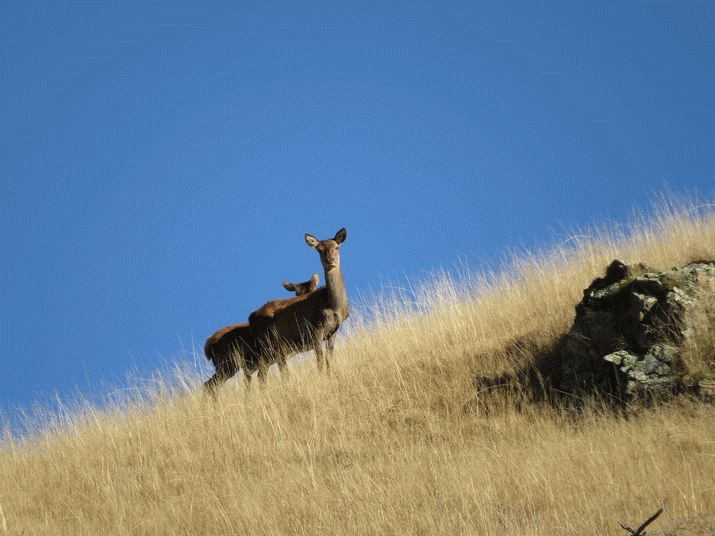
*Pic: Scottish red deer have been in New Zealand for 150 years and browse vegetation similar to moas did for 60 million years
A New Zealand conservationist and outdoorsman Lewis Hore has taken a swipe at New Zealand’s entrenched bias against introduced species.
Lewis Hore of Oamaru, an outdoorsman for over 50 years, said bias against introduced wildlife species such as deer, trout, even possums and other creatures liberated by the first European settlers needed burying.
He cited New Zealand government cabinet minister Nick Smith as an instance of past pleas to ditch the dogma.
“I recently chanced upon one by none other than former Conservation minister Nick Smith, now Minister for the Environment who in an address to the 1996 New Zealand Deerstalkers’ Association’s annual conference said was important to bury the dogma that existed about introduced species.”
Lewis Hore said Smith at the time, gave examples of strong feelings against deer and even sports fish such as trout in some quarters such as New Zealand’s Forest and Bird Society and within the New Zealand Department of Conservation.
“Dr Smith wisely pointed out the selective hypocrisy in the anti-introduced dogma, saying it was undeniable New Zealand had benefited from introduced species from farmed animals such as sheep, dairy cows, cattle and deer as well as fruit trees and vegetables. I could not agree more.”
Lewis Hore said even the possum introduced from Australia was accused of browsing vegetation. But he questioned whether browsing was harmful as the now extinct flightless birds moa had browsed vegetation for millions of years before being wiped out by Maori hunters and habitat destruction by fire.
“Do today’s browsers such as deer, chamois, tahr, possums and others deserve the sentence of death because they browse snow-grass or Griselinia littoralis, commonly known as broadleaf?”
New Zealand’s government aerially spreads 1080 and other poisons such as brodifacoum to kill possums with by-kills including deer, chamois, tahr and other wild animals. Also government employs cullers to “search and destroy” wild animals such as deer.
Possums are a number one target for extermination operations but Lewis Hore said he believed many scientists while forced to go along with the policies, underneath were concerned.
“Certainly, one of Landcare Research’s more experienced and senior scientists, did not think so when at a 1994 Department ‘Possum Pest” workshop, he dismissed the oft-quoted figure of 70million possums, as a ‘back-of-a-cigarette-packet’ calculation and told Doc managers, even accepting the highly exaggerated figure, 70million possums would browse only about a fifteenth (7%) of the new foliage produced every 24 hours by forests.”
Lewis Hore said the department, after peddling the fictitious 70million possum figure for decades, had recently reluctantly revised the 70 million figure to about 35million – “probably still far-fetched.” He added accepting the 35million figure, New Zealand’s possums would consume only 3.5 percent of new foliage.
“Is that a forest pest?” he asked.
The”bush” as New Zealanders affectionately know it, had been browsed not just since European settlement but for millions of years by several species of moa and birds such as takahe, kakapo, kokako and pigeon – all vegetarian browsers.
The moa extinction …
Following the moa extinction, New Zealand’s vegetation entered an “unnatural” phase (AD1400 to AD1850) as world-eminent New Zealand ecologist and former Australian CSIRO scientific leader the late Dr. Graeme Caughley described it. Dr Caughley said up to “about AD1400 the herbivore component of the plant-herbivore system was dominated by a large number of avian grazers and browsers’’.
Following the disappearance of moa, the plant composition would have changed markedly, but “plant-herbivore systems were again established after 1850, this time with mammals as the dominant herbivores’’. Dr Caughley then added, “the only safe guess … is that the pre-1400 plant-herbivore system was closer ecologically to the post-1850 system, than either was to that existing between those two dates”.
Lewis Hore questioned as to how New Zealand’s bush looked in 1642 when Abel Tasman sailed the coast or 1769 when Captain James Cook landed, or when in 1840 New Zealand’s Treaty of Waitangi was signed?
“Almost certainly it was unnaturally dense, because it was largely not browsed as several million moa had done so for more than 60 million years. It is very likely about AD1000 the forests with moas were open with trails and browsing by birds such as kakapo and moa opening them up.”
The restoration of browsing by early settlers liberating deer and other game animals plus possums for fur and meat, to some extent restored the ecosystem. Browsing was a necessity for the functioning of New Zealand’s natural ecosystem. He said scientists knew Nature over millions of years had evolved defensive mechanisms to browsing such divaricating “basket-weave” shrubs, thorns – for example bush lawyer, stinging nettle – and even toxins – for example tutu, native orchid, oxalis, dracophyllum, St John’s wort) and given vegetation the aggressive ability of “pruned” trees to re-sprout.
“All point to heavy browsing in pre-Maori (1350 AD)millenniums,” he said.
However New Zealand’s Department of Conservation, (DoC) urged by extreme green organisations such as Forest and Bird Society, dogmatically viewed introduced wild animals as ecological pests. Lewis Hore said it was hypocrisy in the extreme as humans were an “introduced” species by way of migration and brought exotic species such as sheep, cattle, vegetables, thrushes and honey bees.”
“Just as minister Nick Smith said in 1996,” he added.
Lewis Hore said at the same 1996 conference at which Nick Smith decried “introduced dogma”, Doc manager Keith Lewis said “deer by their browsing are a threat to forest health”.
“He thus revealed his and his department’s total ignorance of ecological evolution and ecological reality,” said Lewis Hore. “It sadly continues today.”
Editor’s Notes: (1) Ironically minister Nick Smith is now Environment minister in the New Zealand government, and an advocate for aerial topdressing with 1080 poison to kill possums. The broad-spectrum poison also kills deer and native species of insects and birds.
(2) Lewis Hore, a conservation advocate, is based in Oamaru, South Island, New Zealand and has about 50 years of back-country and wilderness experience.