The band seated in the venue
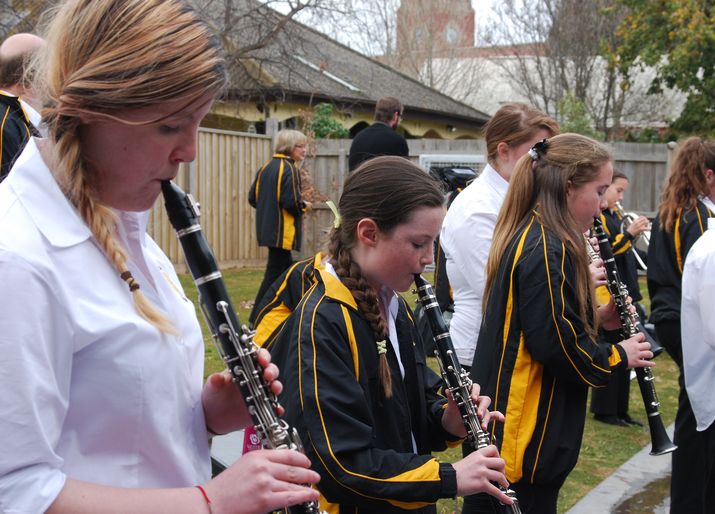
Band members warming up outside the Geelong Grammar performing arts centre
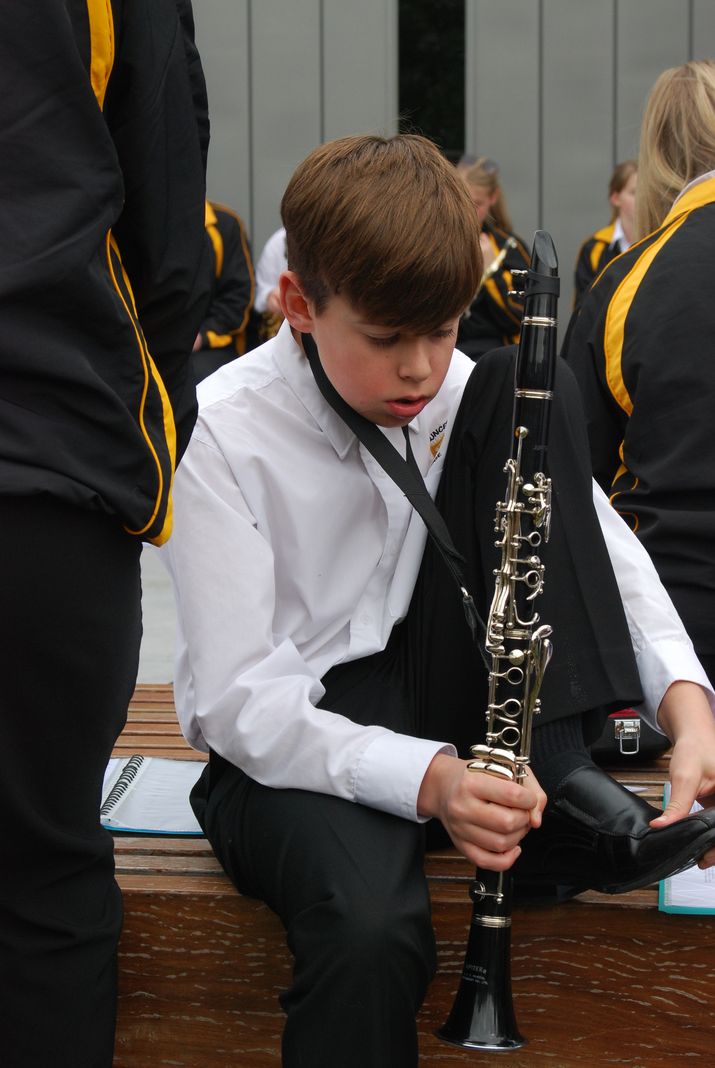
Band member warming up outside the Geelong Grammar performing arts centre
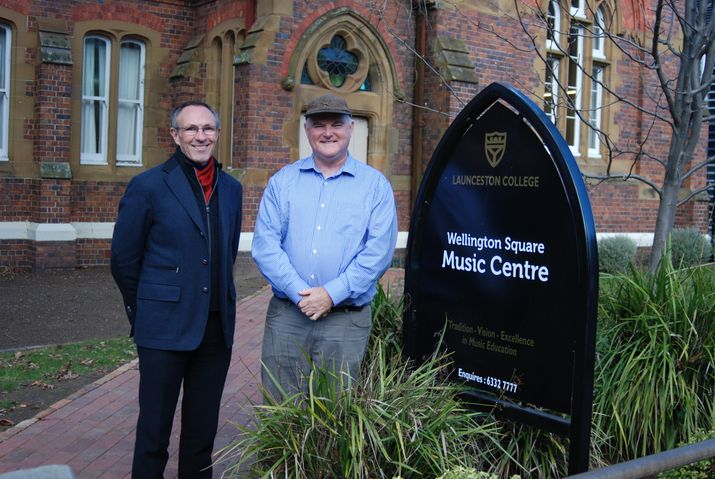
Visiting conductor Mark Eager, Director of the Welsh Sinfonia (left) and Peter Quigley, Director of Music at Launceston College (right)
Pass by the draughty old church serving as Launceston College’s music centre on a Sunday in August, and you’ll hear an impressive swell of band music, the ebb and flow of warbling flutes, the warmth of a woodwind section and the call of brass and the doughty march of drums and timpani.
Take a peep through the door and you’ll be astonished by what you see. The musicians diligently rehearsing are students and school children, some as young as year 4, drawn from schools in Launceston and surrounds, and forming the Launceston College Concert and Symphonic Bands.
Over the weekend the ensemble of sixty students took the three performance pieces they’ve been polishing to the Victorian School Music Festival in Geelong, as one of only two bands representing Tasmania.
And in an age where it seems uncertain whether the mining, logging, greening or international marketing of Tasmania will provide a future for or young people, it seems that music and the arts deserve the support and funding of government and leaders, as they clearly just might.
Despite being the youngest concert band drawn together during Peter Quigley’s fifteen years directing music programs at Launceston College, they won a Platinum Shield, the highest accolade, presented to them by a clearly impressed Chief Adjudicator Dr Rob McWilliams.
The sixty five students were accompanied on the trip by twenty teachers and parents, and were watched by many more at home on by live feed on the internet.
Heads nodded and feet jiggled as they made their way with the aplomb and musicality of seasoned professionals through the highs and lows of Encanto with its crisp clarinets and gathering flutes and stirring brass salutations. If Encanto is a chiffon blouse, Nettleton is a big lady’s handbag of a piece with pockets of complex harmonics and a fluid brass sound that make you think of Welsh miners walking home in snow. At the end of the final piece, Due North, a sweeping gallop over hill and dale and tinkly xylophone streams, the last notes burst into the air, bringing the accompanying parents cheering to their feet. Mere hand clapping just didn’t seem enough in saluting these young Tasmanians, who represented their state, their innate musicality and the diligence of their teachers with such conviction and poise.
It was a moment to feel proud of being Tasmanian, and of the things we are capable of here.
In a further testament to the band’s achievement, the other ensemble to receive Platinum was the Geelong Community Band, directed by Dr Kevin Cameron, Conductor of Middle School Curriculum and Instrumental Music at Geelong Grammar, their band drawn from significantly older students and members of the community.
Workshopping the Launceston musicians on stage after their performance, adjudicator Dr McWilliams said the fantastic energy they played with belied the range of their age and experience, and signified excellent teaching from their conductors, Peter Quigley and Matthew Dudfield of Launceston College.
He took the band through a few sections of Encanto and Nettleton, defining layers of sound, softening the brass to bring out the rich colour of the woodwind. ‘These are subtle nuances,’ he said. ‘And we can do that because you guys are so good.’
Putting the shine on the experience was the venue for this year’s festival – the brand new SPACE, Geelong Grammar School’s performing arts centre built at a cost of $25million. The band assembled in a quadrant at the back of the building to rehearse prior to the afternoon’s performance, where it became clear that the budget hadn’t stretched to a can of WD40 for the back door’s hinges. There may be draughts in Launceston’s Music Centre but the doors are well oiled.
Inside, it was a different story, and the venue was possibly the best acoustic space a Launceston College band has played in, lending an added zest to the performance with backdrop colour washes moving from lime green to sunset orange until those present felt they were swimming around in a Bali beach cocktail.
It’s the first time a Launceston band has won Platinum at the Victorian Bands Festival, which was over-subscribed within three days of opening for entries, the Launceston College band given a place on account of its exceptional standard of playing in previous years.
Credit for this goes, as alluded to by Dr McWilliams, to director and teachers Peter Quigley and Matthew Dudfield, and to Alida Quigley who organises rehearsals and tours using a shoestring, ingenuity and goodwill.
All three are motivated by a love of the band experience, an exceptional one for young people, giving them focus and a means of personal expression in the years when they often need it, developing brain plasticity, giving them the chance to integrate with students from different schools and of different ages, and an overwhelming sense of achievement and togetherness in performance, and rehearsal, which is quite different from solo performance and practice.
Mark Eager, Director of the Welsh Sinfonia and the BBC Welsh Symphony Orchestra and sought-after conductor and musical director visits Tasmania to work with the Launceston College bands every year, as part of his yearly tour working with student and professional orchestras worldwide.
His connection with Tasmania’s young musicians arose from a chance meeting with Peter Quigley at a Launceston Bands Competition in 2008. ‘Peter’s band really woke me up,’ he says. ‘The playing was detailed and precise, and there was obviously commitment and passion there.’
The value of a comprehensive music program which includes ensemble playing is beyond dispute, he says. ‘Everything you teach kids at this age impacts upon their whole life,’ he says. ‘it can impact on the way they approach future job prospects and interviews. If they know the detail in music, the chances are they’ll learn the detail in everything else in life.’
The win was vindication for the efforts of the contingent of eighty who travelled back from Victoria to northern Tasmania on Sunday night, tired but victorious, looking forward to the Tasmanian Band Championships in Hobart next month, to many more years building on a reputation now firmly established beyond state boundaries, and more of that most beautiful thing for a young Tasmanian to enjoy – the sweet sound not just of music, but of success.