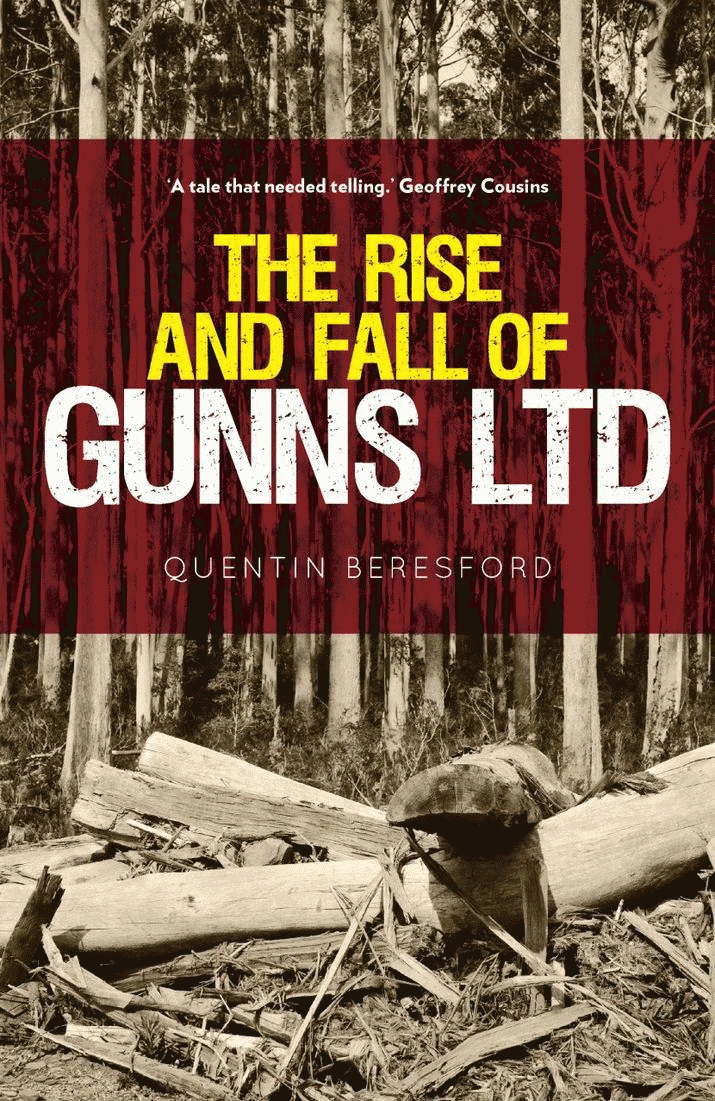
Senator WHISH-WILSON (Tasmania) (22:00): I rise to talk this evening on the recent release of an extraordinary book, the first of its kind, a book that needs to be read and debated by every Tasmanian, indeed, Australian, who cares for democracy and the future of this country’s wild places.
This book is The Rise and Fall of Gunns Ltd by Professor Quentin Beresford. The story of the rapid rise and the shocking corporate collapse of Gunns Ltd, a $2 billion timber company, and all that this entailed and revealed is one of Tasmania’s most notorious sagas, which has had significant national ramifications. But this book is about much more than that.
If you want to understand Tasmanian politics, read this book. If you want to understand why people such as me and Senator Milne joined the Greens and pursued a path into politics, look no further than this book. The epic struggle outlined in the pages for a healthy, democratic, clean and green Tasmania is my story and it is the story of thousands of other Tasmanians and Australians.
Quentin Beresford is a professor of politics at Edith Cowan University, where he has taught for more than 20 years. He is also an award-winning author of numerous books on Australian politics and public policy, including The Godfather: The Life of Brian Burke. His specialty has been researching institutional corruption or cronyism —the impact on democracy of the close and cosy relationships between businesspeople and governments or politicians.
Professor Beresford’s observation that Gunns Ltd was embedded in a power system that guaranteed unquestioning support from the two major parties, combined with the twist of a powerful, pushy and persuasive Gunns CEO, John Gay, has led to Tasmania’s own tale of cronyism—indeed, crony capitalism par excellence.
Quentin was born and educated in my home state of Tasmania and was previously a journalist at The Mercury, where he wrote extensively on Tasmanian political and environmental issues. Professor Beresford’s book’s exploration of the defining theme of anti-environmentalism in Tasmania’s political history is striking. He left Tasmania himself to live in Perth partly to seek new opportunities and partly because, to him, Tasmania ‘felt claustrophobic—captured by a clique of conservatives bent on a take-no-prisoners confrontation over the future of the state’.
Strong words indeed, but, for those with eyes wide open in Tasmania today, still very apt.
Tonight I want to personally thank Quentin Beresford for writing this book—the first attempt ever to tie together a narrative around the historical backdrop, political perspective and all the other myriad threads surrounding Tasmania’s biggest corruption of democracy and subsequent corporate collapse. And, to use the words of Geoffrey Cousins, it is indeed ‘a tale that needed telling’. I know it took a year of sabbatical to finish the book, after at least five years in preparation.
I know that the pile of information given to Quentin was extraordinary and that much material did not make it into the book—for many different reasons, including the threat of litigation.
I know that much of this information, which relates to personal corruption, is the reason Quentin Beresford so strongly advocated in the conclusion of his book for a royal commission into the collapse of Gunns. I also know that Quentin Beresford extensively interviewed numerous Tasmanians and that he immersed himself in many communities—including mine, in the Tamar Valley—to be able to better understand the political conflicts that undermine and divide Tasmanians.
It is by far the best synthesis of what is wrong with my state of Tasmania and of what is necessary to change this, for Tasmania to advance. As Quentin himself said at the book’s conclusion: ‘I knew at the outset that it would be impossible to defend the way things had been, rather it was important to explain why it was so.’ It is a simple, compelling read that will, I am confident, challenge and change every sensible reader who takes the time to pick up the book and take in its pages.
A predictable wall of silence …
It has been met by a predictable wall of silence from the Tasmanian establishment, the mainstream media in Tasmania and the two old political parties. That is a shame, considering those not willing to learn from the mistakes of the past are bound to repeat them. In fact, this seems to be the book’s overarching message—that history in Tasmania keeps repeating, and no-one learns or is the wiser for this.
Professor Beresford also warns that in many ways the rise and fall of Gunns Ltd is a modern warning about governments and political parties generally developing overly close relationships with big business.
Yet much of modern politics is built around such a model of government, both in Australia and overseas. I have spoken at length on this exact issue numerous times since I have been in the Senate.
Professor Beresford outlines in this book several important things: why the rise and fall of Gunns is a truly disturbing case study of cronyism, the corporate abuse of power, and why this is worthy of a broad audience; why Tasmania is especially prone to this corporate ‘crony capitalism’ model of government and how we need to fix this, by starting with a royal commission into the collapse of Gunns then building political institutions and community action to cover what he labels the ‘political deficit gap’ in the Tasmanian polity; why Tasmania’s decades-long adherence to the pro state-development model became a crippling drain on its economic development, which has cost the taxpayer billions; why the collapse of Gunns has bought into sharp focus the economic and political costs of this cronyism model; and why other institutions operating the same failed business model, such as Hydro Tasmania and Forestry Tasmania, have been driven into massive debt-induced restructuring.
Professor Beresford also highlights that no state or federal Labor or Liberal politician has ever attempted to explain, let alone atone for, these losses. Professor Beresford concludes his book by stating:
Now with the collapse of Gunns and the diminished power of Forestry Tasmania, the state stands at the crossroads. But its future direction depends on what lessons the public, politicians and business leaders draw from this conflict-driven past.
Beresford himself admits that ‘the alternative to genuine reform is a grim prospect’, with new rounds of what he labels as ‘politically inspired environmental conflict’ already taking Tasmania back to the ‘cronyism’ and the mistakes of the past. This is reflected in the current proposed logging of controversial coupes, such as Lapoinya— Mr President, in your North-west of Tasmania—or the secret, divisive and controversial drive to attack wilderness and World Heritage values under the smokescreen of new tourism development.
He also highlights ‘further resort to draconian curbs on civil liberties’ as another deliberate attempt to divide the state—such as the multitude of bills before Tasmanian parliament to silence protest or impede free speech—and, lastly, the current perpetuations of ‘failed economic strategies’—such as propping up Forestry Tasmania with Hydro’s millions in windfalls from the price on carbon and the losing of hundreds of thousands of taxpayer dollars by insisting on logging unprofitable coupes, such Lapoinya in the north-west.
These developments and the recent leaked information released by the Greens on serious potential environmental problems around fish farming in Macquarie Harbour—including industry accusations that the government is not providing the necessary checks and balances to growing corporate power in the salmon industry—does not auger well for a ‘new Tasmania’. But the Greens and many other Tasmanians will remember the tale of the rise and fall of Gunns, will learn from the mistakes of the past and make sure future generations of Tasmanians will prosper from this sorry saga.
I will conclude with the final word on this excellent and important book from my own father, Tony Whish-Wilson—words he used to help persuade Quentin to write the book many years ago: “This book needed to be written so that future generations of Tasmanians would understand what had gone on.”
• Watch Peter Whish-Wilson’s Speech on YouTube here
• John Powell, in Comments: Speechless. What a book and what a story of the failure of successive governments and their bureaucratic minions and institutions. I will let others comment on that as I do not have the history. However the example that the good Senator referenced, viz Lapoinya, I am familiar with. All in Government connected with this failure of process, consultation, environmental, endangered species, and indigenous history surveys,economic evaluation etc etc fit the bill of those referenced in the Beresford book. If the Shareholder Ministers, and the relevant CEO, and Board members, were true to their respective Corporate Directors code of ethics they should resign immediately. And a mission to China that contemplates promoting Forestry in Tasmania is a nail in the coffin of the FSC accreditation being undertaken by SCS Global. Time for a “Captains Call” Premier Hodgman and declare that Coupe FD053A is hereby annexed to the adjoining Flowerdale Reserve as was recommended in the 1997 Regional Forest Agreement. This post will be copied to SCS Global overnight.
• John Biggs, in Comments: Beresford is right: a Royal Commission should be called immediately, but as I understand it that has to be done by the government, and I can see no government Labor or Liberal would have the honesty or the guts to do that. However he also says the people power might work as it is in CSG mining but that requires massive publicity and a lot of work. Perhaps GetUp could take this on board? And keep plugging away at your Federal colleagues Peter. Meantime, if as Barns says the book is biased, then let Paul Lennon, Paul Harriss, Will Hodgman, Evan Rolley or Brian Green or anyone else who thinks that Beresford has got it wrong, come forward and tell us where, with chapter and verse.
• Kim Booth: Harriss Blows More Public Cash on Madcap Sawmill Scheme The Hodgman regime’s latest splash with public cash to prop up the native forest sawmilling industry is stupid and irresponsible, Greens Leader and Forestry spokesperson Kim Booth MP said today. “This is as close as you can get to a corrupt government process,” Mr Booth said. “On the one hand public money was paid to sawmillers to leave the industry because they were going broke and now the same people are receiving additional public money to stay in the industry.” “Sawmillers took payouts because they were financially unviable businesses in the first place.” “Now in an act of total stupidity, Minister Harriss is offering people two options, without there being any requirement to prove that a viable business plan is in place.” “The first option is for a sawmiller to pay back 10 per cent or less of a payout, keep the mill but be restricted to 100 cubic metres per year.” “That is a joke, its less volume necessary to run a viable portable mill, let alone a sawmill.” “The second option …
• Paul Harriss: Keeping sawmillers in Tasmania
• Examiner: Sawmillers’ new cash deal
• Kim Booth: Sawmill Subsidies Referred to Integrity Commission “I have referred this matter to the Integrity Commission because they are the only body capable of investigating independently this disgraceful affair,” Mr Booth said. “The Hodgman regime has taken money from hospitals and schools and handed it over to selected private sawmill businesses without any justification, and apparently without any performance requirements or conditions.” “To prop up a select few failing businesses with public money, is a dangerous precedent and a gross abuse of trust and power.” “The abusive response from Minister Harriss in parliament today leaves me in no doubt that the government is hiding something and that the Integrity commission should examine the matter.” … “Most Tasmanians expect better than this and regard this sort of behaviour as corrupt and a return to the bad old days when timber barons walked the corridors of power and parliament was their plaything.” “It is deeply disturbing that it looks like Mr Harriss and Mr Hodgman are dragging Tasmania back to those dark and corrupt days of the past where cronyism ran rife,”