Consistent with Tasmania’s Tourism Industry Council’s claim that woodchips and tourism can maybe co exist – the Tas Minerals and Energy Council has recently jumped on the same spin bandwagon to claim that mining and tourism in the Tarkine can also be compatible.
The whole concept about resource extraction and environment promotion for tourism seems to be caught up with the ‘Having your cake and eating it too ideology’.
The Savage River Mine was established long before the natural heritage values of the Tarkine were strongly identified, but that doesn’t mean that that in the modern era the rest of the Tarkine should be seen primarily as a mining playfield, dotted with scars and gapping wounds from resource extraction.
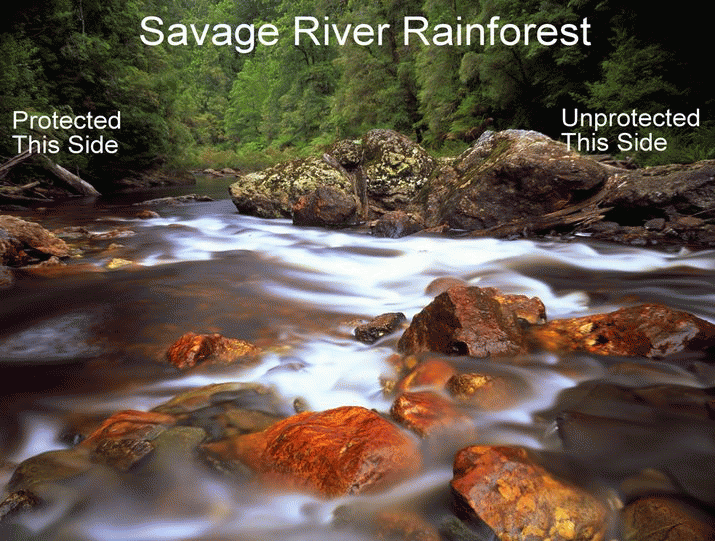
Unfortunately the Savage River iron deposits are located beneath the single largest tract of temperate rainforest in the nation. The unearthing of these forests and the effluent spillage into the lower Savage River has been one of Australia’s greatest environmental catastrophes, of which regardless of the mine’s lifespan will never see any form of realistic rehabilitation.
The Tarkine region contains approximately 200,00 hectares of rainforest of which only about 10% is within secure reserves. Most notably of these reserves is the Savage River national park at 17,980 hectares, which is essentially the upper Heazelwood River catchment bounded by the eastern slopes of the upper Savage River
Most of this national park is implicate/thamnic rainforest and scrub. The best representation of open mature rainforest, (callidendrous) dominated by grand myrtle trees, remains west of the Savage River expanding across the rich basaltic soils upon the plateau between the Savage and Donaldson rivers valleys, and north towards the Arthur River.
The Savage mine pipeline road dissects this region, and without question is obviously the reason why the finest representation of temperate rainforest has failed to be protected within a secure reserve. Ironically back in the 1990’s, the then, Forestry Commission even supported the reservation of this entire rainforest tract.
Southeast of the Savage River National Park the Tarkine rainforest extends beyond Mt Cleveland, Mt Ramsay and the Meredith range extending deep into the Wilson and Huskisson River catchments. Although most of this country is designated as regional reserves, all of it is subject to potential mining leases, and proposed future specialty timber logging.
Roads into the Tarkine have had a significant impact upon the region over the last few decades. In 1981 a fire that started near the Savage Mine area swept across the Meredith Range to the Pieman River which destroyed 15,000 hectares of primeval rainforest. Earlier this century another fire lit on the Western Explorer Road burnt most of the Lower Donaldson River corridor, and adjacent plains.
It has taken centuries for the Tarkine’s rainforest to develop with its ongoing evolutionary process, which beholds as a region highly worthy of World Heritage listing.
Further mining encroachment is a process of attrition upon the natural values of the Tarkine, and any addition access contributes a greater threat to its integrity through fire and human mismanagement.
2014 revealed a massive decline in world mineral prices, particularly iron-ore, which has closed or prevented many mine-sites from operating. Meanwhile the future for commodity ore extraction looks bleak.
The entire process and outcome of opening up the Tarkine through the failed and deceptive approval of the Nelson River quarry in 2014 should be a stark indicator that new mining operations at all costs is not the answer to the North-West’s poor economic development.
So mining more areas in the Tarkine appears a poorly thought-out fiscal strategy considering the growth of tourism throughout the region as a sound and viable alternative to subsidised resource extraction.