Alderman Marti Zucco wants to see the sand that was removed from Cornelian Bay during the Second World War replaced and Cornelian Bay beach reinstated to its former sandy beach days.
Alderman Zucco said that “Truckloads of sand were removed from Cornelian Bay during the Second World War for Civil defence purposes and the Federal Government should fund a program to reinstate the beach and replace the sand”
Alderman Zucco pointed out that “The History of Cornelian Bay provides the facts of what happened to the sand and that it is time that the sand was replaced”
With the Second World War, attention was given to protection of the Zinc Works. An anti-aircraft battery was established at Selfs Point. In November 1941, Dowsings Point and Selfs Point had been selected for the location of batteries with the primary role of protecting the Electrolytic Zinc Works at Risdon. The Zinc Works were of national importance as ‘munitions production in Australia [was] entirely dependent on the zinc produced at Risdon.
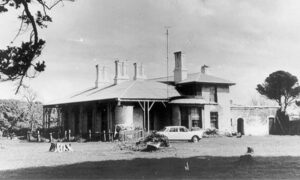
By 10 January 1942 the Public Works Department gang sent to build the concrete gun emplacements were able to vacate the old hospital buildings that they had occupied during the course of construction. The hospital was then taken over by the Defence Department and became part of the Selfs Point Anti-Aircraft Battery.
The hospital equipment and stores were removed and distributed to other institutions. The battery was armed with four 3.7-inch guns and manned by a mix of regular artillery forces and members of the Volunteer Defence Corps
The men from the battery were often seen on the beach collecting sand for the sandbags that were banked around each gun emplacement. In March 1942, the Hobart City Council’s Reserves Committee had decided to prohibit the removal of sand from city beaches for sand bagging purposes, leaving the Lord Mayor with the power to vary this decision in cases of emergency.
Alderman Zucco pointed out that “It appears that sand was removed from Cornelian Bay Beach on a regular basis, not only for the anti-aircraft battery but also for civil defence purposes”
A long-time local resident, recalls seeing one or two five-ton trucks at the beach almost daily for a period. Most of the sand was taken from the cemetery end of the beach since the road there provided easier access for the trucks. The sand, shovelled on to the trucks by hand, was taken out until eventually a layer of pebbles was reached. Southerly weather would subsequently see the remaining sand re-distributed across the beach.
Every household had a box of sand and a shovel for putting out incendiary devices and many people had air-raid shelters in their yards. The air raid shelters comprised a hole, say 1.8 metres square, roofed with timber and sheets of galvanised iron and sandbags on top.
In conclusion Alderman Zucco pointed out that “Even though the ecology of Cornelian Bay may have changed since the sand was removed as the ecology adapted with no sand the ecology could also readapt with sand.
He also said “I fully understand that the sand may have been needed for defence purposes at that time but that time has passed and Cornelian Bay now deserves to have its sand reinstated”
Alderman Marti Zucco wants the City of Hobart to write to the Prime Minister, the Minister for Defence and the Member for Denison Andrew Wilkie to seek funds for the replacement of sand to rehabilitate Cornelian Bay”.
Hobart Alderman Marti Zucco