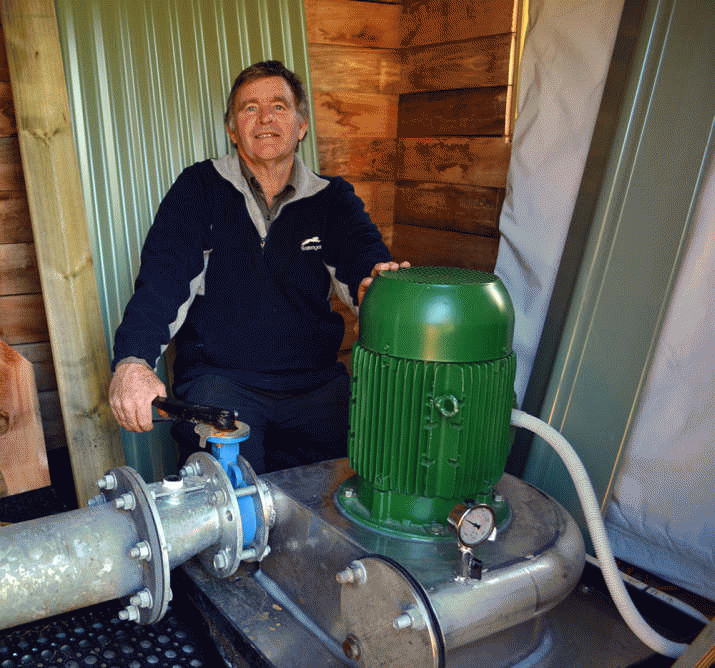


Christine Booth tells the incredible story of a mini-Hydro dream which confronted every form of bureaucratic challenge …
My husband Graham is very proud of the fact that as a young man in 1967 he was the Hydro Electric Commission’s apprentice of the year. He came to marvel at the power of water and the elegance of harnessing the strength of flowing water to produce electricity. So it was natural that his mind turned back to these days when we purchased our property on the Ringarooma River in 2001.
Our newly-purchased property had no council services–no water, no sewage, no garbage collection. So, not having drinking water, we went in search of a supply. At this point you might feel like pointing out the obvious; “Isn’t Tin Dragon Trail Cottages surrounded by a river?” Yes it is; but this water runs through productive agricultural land is not safe to drink without treatment. Anyway, in the hills above our property our searching revealed a small creek (Guiding Star) running over rock base which was ideal. For a short while we used this gravity-fed water as our drinking supply. Beautiful! We have since converted to using rainwater for all our domestic needs. Serious vandalism to our above-ground pipeline meant that we had to find an alternate domestic supply.
On a more positive note … Did I say hills? Water above our property? In fact this water source is about 100m (elevation) and 2.5km away from our property. Graham set his heart on harnessing this water for power. I thought he was crazy. At 2002 electricity prices I estimated it might take at least 20 years to recover the capital costs. In fact he was so set on the idea, he purchased 3km of 150mm galvanized steel pipes and fittings second-hand from a mining company and traded-in our old diesel Mercedes 300D with the transaction.
The bureaucracy
Take a deep breath for the bureaucratic rollercoaster. As if having our drinking water pipeline destroyed wasn’t bad enough, the local Council then raised the height of a diversion weir located above our intake point. This dried up the creek below the weir and our drinking water. We ended up taking our Council to a Tribunal. After all the adjournments it was two years before the matter was settled in 2011. This latter event is crucial background to the present story, because it was the final step in gaining access to our water licence.
We would need a State Government water licence to extract water from the Guiding Star Creek and a Forestry Tasmania lease for our pipeline. As a pre-condition for the water licence we completed an environmental impact study during the driest summer months of 2002-3. We did a lot of walking and exploring of the bush above our property, and on a few occasions met some unlikely bushwalkers. I still wonder whether these people were in any way linked to the “disappearing water” phenomenon we recorded at certain times of the day, or the vandalism to our pipeline—best not to speculate. So having been granted a low-priority non-consumptive water licence, it was another ten years before water started flowing through our pipeline.
After the hurdle of the Tribunal—and this was a huge emotional drain on us—we completed the preliminary paperwork for a Forestry Tasmania lease in 2011. After the nightmare of dealing with our local Council, this seemed easy. Paperwork completed, initial inspections approved, and we quickly started work. Hard work, too. Graham with assistance from a 70 year-old family friend and an excavator driver had the pipeline off our property and up the major hill within two weeks. This put us on track to be generating power over the entire winter period of 2013.
Another Hurdle
Then the phone call. “Stop work immediately.” Miraculously the guys at Forestry Tasmania (FT) discovered that their assessment, which had approved our pipeline was in error. Additional heritage values needed to be considered. F*@k it! What complete BS. We were very aware of the mining heritage and our pipeline was no where near any significant features. It took three weeks to get the Forestry officers to meet us on site for a discussion. Their body language was fascinating: one apologetic, one angry, another determined. A week later we were informed that our existing pipework would (reluctantly) be allowed, but we had to direct our pipeline from one side of a gravel road to the other, then back again—four 45 degree turns, effectively a U turn—in order to avoid a short section of an old water race on one side of the road. Of course this water race was flattened by the gravel road and exists on both sides of the road. Leaves me wondering why one side of the road is more important than the other?
We were informed that we could not recommence work till we had received the amended assessment. Oh yes, we were also told that the final length of the pipeline entering the creek had to be dug by hand (about 50m). So, we started the next day, completed the pipeline, purchased the generator and essentially completed the project—by the time the paperwork arrived 9 months later.
High Tech Calculations
Most important. We had a 150mm pipeline traversing 2.5 km up a 97m hill. Not straight up, but with some flat bits and some dips too; and a rotten big U turn! What capacity generator should we purchase? We made several enquiries of Chinese-based companies, but felt very uncomfortable about purchasing. They seemed too keen to give us the answer they thought we wanted.
We needed to determine the optimal flow rate for a winter season and the working head. That is, the actual head (97m) minus all the frictional losses. We met an engineer who had access to specialised software. He was kind enough to make a site visit and take some notes, leaving us with a promise to “put the data through his program”. Unfortunately for us, he left his company losing access to the software and without the software he could provide little advice. Oh! Should we purchase two 2 kW generators, a 4 kW? 6? Given the high cost, we couldn’t afford to get it wrong.
Engage brain—the practical brain. Graham dug out some old water flow charts. Vaguely reminded me of first-year physics. Yes folks I studied physics in 1st year uni. Long forgotten. About this time Graham contacted an Australian company who informed Graham that he could estimate the working head using water pressure and flow. Armed with a $40 pressure guage, a second-hand mechanical water meter, some welding gear and some old charts from our filing cabinet, Graham determined a working head of 88m.
We purchased a 7.5kW induction generator. Over the next few months Graham tested the pipeline and improved its performance with well-placed air bleeds and a gate valve. The generator and inverter were installed.
Sometimes all you need is good practical sense: All power to Graham!
Hopefully the last Hurdle
We engaged a young electrician who seemed experienced but keen. There were some minor hiccups that were easily resolved.
Unfortunately one major mistake was made. The electrician gave the power company, Aurora, the incorrect meter serial number for replacement with the new inport-export meter. Aurora gave us permission to flick the switch. All systems go.
The inverter started recording a maximum generation of 4 kW/hr. But? We had been expecting 6kW/hr. OK our supplier admitted they got it wrong and would replace the gear next time they were in Tasmania. That was 12 months ago. As I write this, we are still waiting.
Meanwhile we noticed that the import-export meter seemed to be doing nothing. We registered a fault with Aurora. We asked the meter-reading guy why the meter was so silent. He had no idea. Two days later another Aurora guy turned up. We thought he was here to fix the meter. No, just to read our meters again.
Then we received a bill from Aurora for about $1,500. Shocked disbelief. According to our inverter we had exported 3500kWhrs into the grid. The bill stated that Aurora had given us an estimated bill because the meter reader couldn’t access our meter. We registered a dispute with Aurora. The next series of events defies belief. “Calm down madam” I was told during one phone call.
It took some time to uncover the problem. The wrong meter had been replaced with the new import-export meter. Meanwhile the meter connected to our generator was happily turning backwards as it delivered power into the grid. The difference between this meter’s previous reading and the new reading was equal to the amount of power we had generated.
Great. So now Aurora could change the meter connection, and re-issue the bill with a substantial credit. Wrong. They refused. We went to the Ombudsman, who inexplicably agreed with Aurora. Aurora then threatened to cut us off from the grid. We ended up paying the $1,500 plus interest and fines. We didn’t have any fight left. The unfortunate electrician was left holding the can when we subsequently issued him an invoice. Just because we weren’t out of pocket, doesn’t mean that I don’t think Aurora acted in an unconscionable manner.
Buzzing Along
Almost uninterrupted power generation from August 2013 to mid January 2014 at which time we turned off our pipeline to maintain the environmental flow in the creek. 18MWhrs produced. Our next Aurora bill was a $1500 credit.
Dreaming of getting off the grid … well this may be too risky with a tourism business; but we should get the Aurora costs down to fixed charges only.
Post-script: We have now installed a 5kW solar system to cover the dry summer months. As of August 2014 we have generated 27Mwhrs.
[email protected]
www.tindragontrailcottages.com.au
www.facebook.com/TinDragonTrailCottages
http://www.youtube.com/user/TinDragonCottages