…
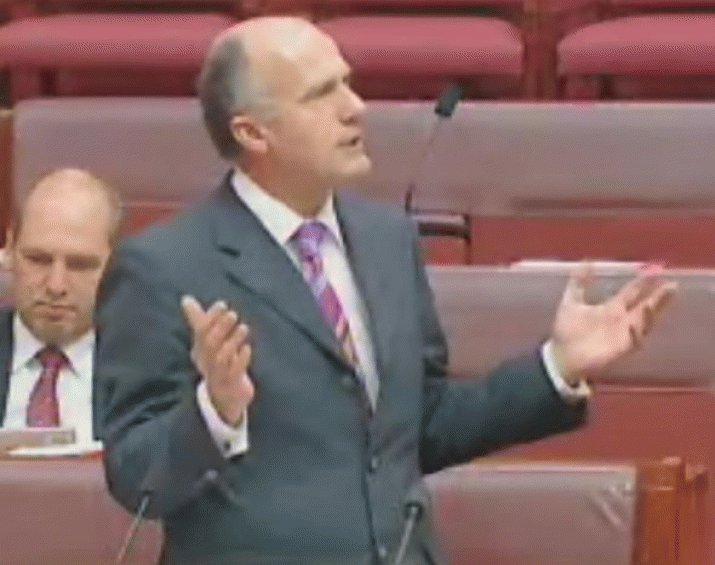
So why would a government return to such a scheme? (Employment Minister Eric Abetz’s hardline welfare reforms).
John Hewson (former Liberal leader) suggests a number of motivations, none of which relate to sincere efforts to improve the lot of Australia’s unemployed.
“First, this is more about prejudice than it is about policy,” he says.
“The underlying attitude to this is the prejudiced view that a lot of the unemployed, particularly the young unemployed, are basically bludgers who … are not interested in getting a job. And while there may be a percentage of people to whom that applies, I don’t think it’s a very significant percentage.”
Beyond that, Hewson sees a smokescreen intended to obscure budget cuts – “to save money wherever they think they can get away with it” – to jobseekers’ benefits and to other, more effective, training programs.
And beyond that, he suspects, some of the conservative ideologues who are driving the policy are “probably aiming to get out of traning altogether and push it back to the states.”
That they “don’t feel it’s a national responsibility” is a problem: “We don’t want eight separate training schemes, for Christ’s sake, with the states competing. We’re trying to build a nation, not eight nations.”
Whatever the motivation, the presentation of the new policy has not gone well, notwithstanding the fact that the government has devoted not one but two three-word slogans to the sales effort.
The one about encouraging people to be “lifters not leaners” encourages the perception that those not in the workforce are not trying. And the decision to cut unemployed people under the age of 30 of all benefits for the first six months was cloaked under the tough-love mantra that they should be “earning or learning”.
This was despite the fact that other budget decisions cut training opportunities and made learning more expensive, and the flat job market made earning harder, too.
But the government reckons cutting 100,000 young jobless people a year off the dole will save the budget an estimated $1.2 billion over four years.
It’s fair to say that the decision to cut benefits from the younger unemployed rated alongside the Medicare co-payment and radical changes to superannuation as among the main reasons the budget was popularly seen as unfair.
But that announcement at budget time was just a part of the plan …
…