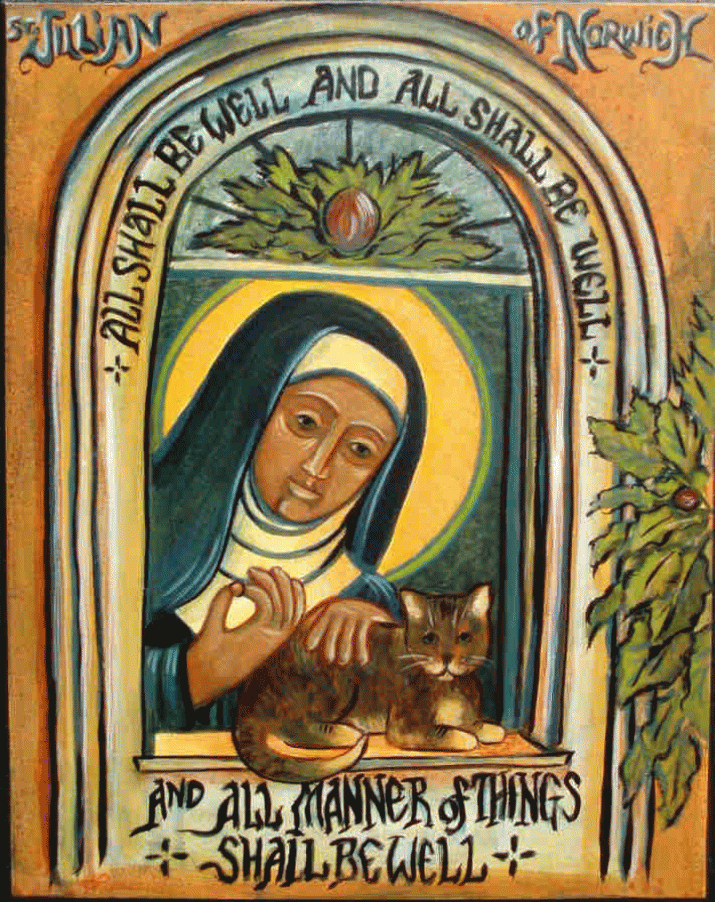
“All will be well and all will be well and every kind of thing shall be well.” (Julian of Norwich)
Sometimes I can hardly believe what I get to do for a living. As a translator of the mystics, I plunge into the wellspring of their wisdom and remain immersed, until they have told me all they have to say. In the Hindu tradition, this is known as darshan: sitting at the feet of a saint and receiving their transmission. It can be done whether the being is still in the body or has left it. It is not an exchange that is ruled by the common laws of time and space. This flow spills across the centuries and, in my case, across religious lines.
I am Jewish by birth, not-Jewish by upbringing, and Jewish-again by inclination. I have a lifelong Buddhist sitting practice and a Hindu guru. And I translate and write reflections on the teachings of the Christian mystics. My most recent encounter was with Julian of Norwich, the medieval English anchoress (1342-1416). My new translation of her masterwork, The Showings — an extravagant account of a series of visions Julian had during a near death experience — came out earlier this month (Hampton Roads 2013).
We do not know much about Julian’s life. In fact, that was not even her real name, but rather a reference to the Church of St. Julian in Norwich to which she attached herself — literally — cloistering herself forever inside a small stone anchorage built against the outer wall of the sanctuary. What we do know was that by the time Julian entered her cell she had already witnessed three rounds of Plague, had probably lost almost everyone she loved, and had nearly died herself. We also know that when she was very young she asked to bear witness to the passion of Christ. Her wish came true. The visions she had on her near-deathbed were of Christ’s crucifixion, which she endured in every cell of her own body.