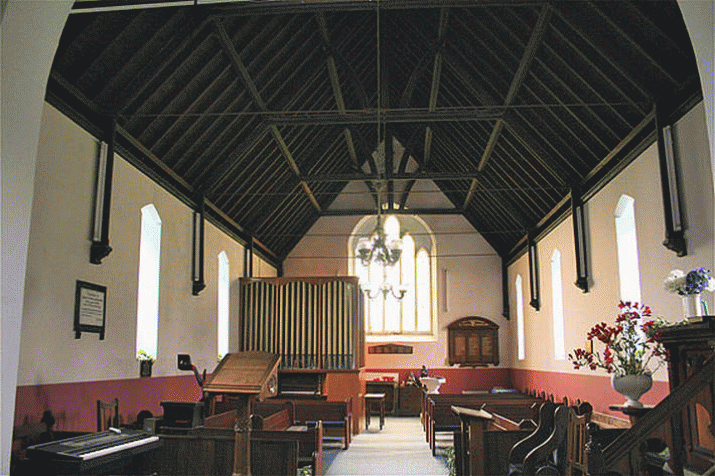
Not for the first time do I pose this question: what price for saving our heritage churches? So I’m asking it again because of the uncertain future faced by historic St John’s Anglican Church at Franklin.
This website has reported the Parish Council of the Huon (a council dominated it seems by St James at Ranelagh, here) deciding to sell St John’s in the face of Franklin people wanting it retained as a community asset. It’s the last church remaining in Franklin.
The significant heritage factor here is St John’s was designed by that major contributor to Tasmania’s historic architecture: Henry Hunter.
Just cast a glance around Hobart and you will see many a fine example of his creativity – Hobart Town Hall for starters.
But beyond the city he also did noble work. St John’s dates from 1863 and it’s very interesting to read that even on the Tasmanian Anglican Church website its heritage importance is recognised, the old stone building being described as “a gem of a small 19th Century gothic revival church and is heritage listed”.
A heritage gem indeed, with St John’s on the Tasmanian Heritage list and the Australian National Heritage register. I wonder if the worthies on these bodies have anything to say about St John’s uncertain fate, with a possible sale to a Queensland person for a home.
I’ve been told there has been no spending on St John’s by the Anglican Church for something like three decades. “Total neglect” as one resident put it.
I also recall that back in 2010 I wrote for this website that under an Anglican Church “rationalisation” plan many of its churches had already been closed and numerous others were “under review”. St John’s was one of these – but so was St James at Ranelagh.
Let’s ponder a bit more on Henry Hunter’s achievements.
The Australian Dictionary of Biography entry for him noted that he dominated the early architectural scene in Tasmania. He was a devoted disciple of Augustus Pugin, leader of the English gothic revival movement, and the dictionary said this influenced Hunter’s work “especially in churches he designed”.
It added: “His treatment of this style gave a pleasing effect to even the smallest church, while his use of local materials enabled him to blend a wide range of building stone in a delicate manner.”
So we look to a Henry Hunter church surviving today by dint of considerable local devotion and effort – All Saints in South Hobart. It is undergoing a fine building renewal.
At Jericho you can see what was Hunter’s St James Church of 1888, but this has been recycled as the Jericho Cultural and Heritage Centre.
After years of uncertainty over its future (its roof was damaged by a windstorm in 2002 but the Anglican Church was only prepared to pay for temporary repairs). Despite appeals, it was closed and deconsecrated in early 2008. Subsequently, however, Bishop John Harrower allowed the local community to take it over on a peppercorn rental leasehold, the community to look after and maintain it and the grounds (endowments to the church were retained and although not large would help meet maintenance).
Jericho is one of the oldest townships in Australia – it was founded in 1816. But as well as this, there is also a special significance to the St James graveyard.
This is where Tasmania’s first Victoria Cross winner is buried, Trooper John Hutton Bisdee. He won the VC at Warmbad, South Africa, on September 1, 1900, during the Boer War while serving with the 1st Tasmanian Bushmen, and he was wounded while with the Australian Light Horse in World War One.
When we think of our old churches we remember those soldiers who died in serving their country in that brutal war and their sacrifice being recognised by Roll of Honour boards. St John’s at Franklin has such a board.