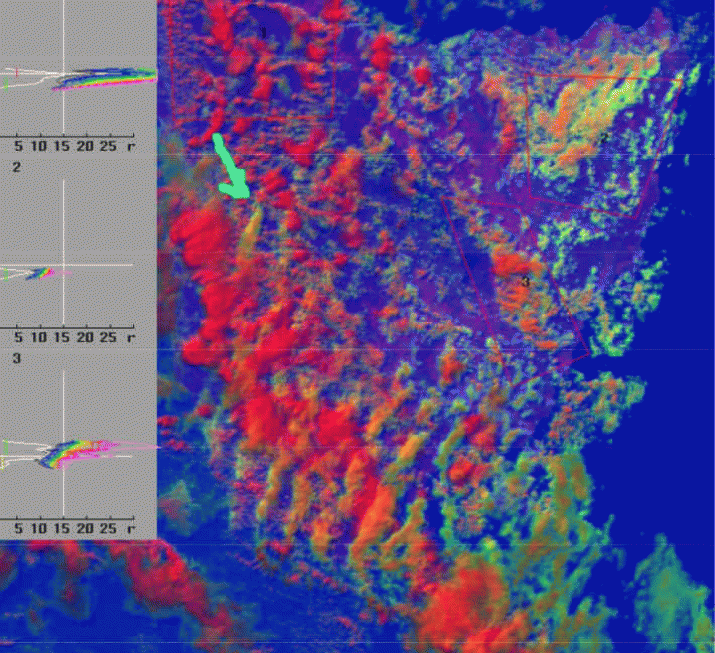
Satellite MODIS Aqua image – Green arrow points to dust particles from MMG Rosebery Mine and Bluestone Mine Tasmania Renison Bell emissions.
Professor Mark P Taylor, Environmental Science, Department of Environment and Geography, Faculty of Science, Macquarie University, Sydney, NSW 2109.
Response to comments on Bruce Mounster’s article 9th Dec 2013 “” Available at: http://www.themercury.com.au/news/tasmania/push-to-cut-rosebery-mines-metal-dust-emission-levels/story-fnj4f7k1-1226778326729 (accessed 11th December 2013).
I do not normally respond to blogs and comments but on this occasion I thought it necessary, to provide some factual information, balance and clarity to the commentary.
1. I have been to Rosebery, three times. The first (2009) and third (2011) times were self-funded to see the town for myself and then to deliver my results, respectively. The second time was in 2010. This trip was to sample of soil, attic dust, floor dust, vacuum bag dust and paint for heavy metals, including lead and arsenic for Slater and Gordon Lawyers.
2. While I have an office in Sydney (which is not that flash and the writer may come and visit me any time), I spend a significant amount of time out doing field work with my students and with community. For example on December 10, 2013 we were visiting several people across Sydney carrying out our VegeSafe program (soil metal testing of gardens and community veggie patches). See: https://www.facebook.com/pages/VegeSafe/571316076267515.
3. I take my work seriously and I am careful to rely on fact to substantiate any opinion(s) I might form – and I do not “pontificate about the theoretical pollution levels”. I don’t need to – I collect my own data or rely, where available on government or industry data.
4. The facts are that lead exposure (and arsenic) causes neurotoxicity at very low levels. Indeed, the scientific community cannot establish a lower level for safety, which is why the WHO removed any such guidance with respect to lead in food:http://www.who.int/foodsafety/publications/chem/summary73.pdf.
5. The risks and impacts associated with lead exposure, especially in early life, are well established and accepted by the international environmental and human health community – including scientists, medics and health practitioners, amongst others. A good summary of the toxic effects of low lead exposure can be found here: http://ntp.niehs.nih.gov/go/36443. A shorter, perhaps more accessible summary, can be found here: http://theconversation.com/time-to-rethink-blood-lead-goals-to-reduce-risk-to-childrens-health-10493.
6. Air quality standards in Australia were set and made legally binding in 1998 and were meant to be met in 2008. The standard for lead in air is set at 0.5 μg/m3 averaged over a year, with no allowed exceedences (see: http://www.environment.gov.au/topics/environment-protection/air-quality/air-quality-standards ). Mount Isa Mines had the same standard until January 1st 2012 that Rosebery MMG Mine currently has. That previous standard of 1.5 μg/m3 averaged over 90 days was revised when the 2008 Queensland air quality objectives were fully enforced, matching the national standard for lead and elements ( https://www.legislation.qld.gov.au/LEGISLTN/…/EEnvProtAirPo08.pdf ). Some anomalies exist (but not for lead) because of transition arrangements for Mount Isa Mines, but that is for another conversation.
7. Even if you disagree with these facts, then I refer readers to the following Intergovernmental Agreement on the Environment, in particular, Schedule 4, NATIONAL ENVIRONMENT PROTECTION MEASURES ( http://www.environment.gov.au/about/esd/publications/igae/index.html), which state the following:
General Purpose
1. The Commonwealth and the States acknowledge that there is benefit to the people of Australia in establishing national environment protection standards, guidelines, goals and associated protocols (hereinafter referred to as ‘measures’) with the objectives of ensuring:
1. that people enjoy the benefit of equivalent protection from air, water and soil pollution and from noise, wherever they live;
2. that decisions by business are not distorted and markets are not fragmented by variations between jurisdictions in relation to the adoption or implementation of major environment protection measures.
8. This National document makes it clear that all persons should be equally protected, which is not the case at Rosebery, hence my comment that the licence is out of step with national and international perspectives (in the USA it is 0.15 μg/m3 averaged over 90 days, a standard that was revised in 2008 from the previous value of 1.5 μg/m3 averaged over 90 days).
9. In regards to temporal dust metal measures – monthly deposition values or metal in air, the mine collect data on arsenic, cadmium and lead (amongst other elements) and provide that data to the EPA. That data is not readily available to the public. The EPA do not collect any equivalent data of its own in Rosebery and so the only data available is that belonging to MMG. I asked the EPA about access to industry data and the TAS EPA’s view is that any such data is the property of the industry that paid for the data to be collected and provided to the EPA as part of compliance arrangements. Requests for the data would go to industry or one could try the Right to Information Act (2009) to try to get access to that information.
10. My view is that the data should be made available to the public at the same time as submission to the EPA as part of the compliance arrangements. I hold this view because any such data relates to potential exposures affecting members of the public on public and private properties (and the environment more broadly), and the EPA are a publicly funded body, who do the following: “The EPA’s purpose is to regulate developments and activities that may impact on environmental quality and to promote best practice, sustainable environmental management. Its goals are clean air, clean water, clean land, acceptable noise levels and sustainable use of resources.” ( http://epa.tas.gov.au/epa/about-us ). Therefore, on the basis that the emissions from MMG may (or may not) impact the public and that the EPA is effectively representing the public in environmental matters, then it is not unreasonable that any data that is used to assess the performance of the mine against its operating licence (i.e. Environment Protection Notices) is freely available on either the organisation’s website (as is required in NSW) or on the EPA’s website.
11. The following comment in the news article does not capture fully what I said in my interview. It is a summary of a much longer and detailed conversation with Bruce Mounster, who has strict word limits in his article. The article stated: “Prof Taylor said he was unable to fault a 2009 study conducted by State Government agencies and MMG that found no unacceptable heavy metal hazards in or around Rosebery, which could be linked to dust blown from the adjacent mine site.”
12. My comments to Bruce Mounster were more wide ranging and along the lines of: My 2010 study did find elevated levels of lead and arsenic in the soil, but the exceedences relative to the national soil guidelines were not significant both in number and concentration. Indeed the results were similar to MMG’s results they presented in aggregate form at a community meeting in 2010 or so. However, my findings do not mean there is no risk, but when one compares the soil values to urban areas, the soil lead values, for example, were not anomalous with respect to values found in the older, inner city parts of Sydney. It is true as well, that lead levels in Broken Hill (mining only – smelting ceased in the late 19th century) are much, much higher than Rosebery. Having said all of that, it was clear that the metal levels found in surface soils in the town of Rosebery were elevated versus undisturbed (clean) soils at depth and also in surface soils away from the footprint of the town itself. Such data suggests that the operations are very likely to have impacted soils quality over the lifetime of the mine. Indeed, it really is foolhardy to contemplate that the operations have had zero effect on the adjacent environment. I have never seen a study that shows no impact from a mine on the adjoining environment.
13. The same comments were also made about dust metal levels measured in the samples that I collected during my 2010 study (data unpublished). I have recorded much higher values elsewhere but it would be fair to also say that the dust values were elevated when benchmarked against samples taken from non-industrial locations.
14. The report I referred to did not have temporal dust sampling values but I concurred with the conclusion that was drawn that there was no evidence of a link between environmental activities and human health impacts – based on the evidence available. That does not mean that the emissions have not had an effect, it means that the available evidence at the time does not provide sufficient evidence to show
causation. It might well turn out that with the provision of a full suite of contemporary and historical dust data different conclusions maybe derived, but that data was (is) not available. That does not mean any conclusions drawn are incorrect, but that there may be some limitations arising from the absence of certain useful datasets.
15. Any claims MUST be supported by facts that link the source of emissions to exposures in people or places and its consequent effects. There needs to be a clear demonstration of causation from both a scientific and legal perspective. Without being able to make these connections in a concrete way it will be challenging to show that damage has occurred.
16. Having said all of this, the absence of evidence of measurable impact is no excuse for not promulgating the best and most appropriate environmental standards. For far too long we have provided industry with de facto subsidies by not enforcing the best and most appropriate environmental regulations. In not doing so we provide industries with special arrangements to pollute an economic advantage. Aside of the human health or environmental responsibilities, this is simply not equitable or reasonable.
11th December 2013
• December 5 on Tasmanian Times: MMG Rosebery mine top toxic polluter in Tasmania