

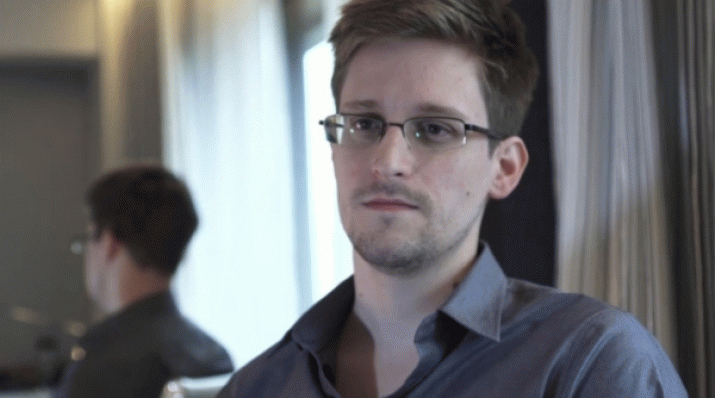
Big Brother is on the prowl … quite apart from Edward Snowden’s (and the Guardian’s) consistent whistle-blowing on surveillance comes a first-hand report to The Hag of how unsafe are personal details …
This one is from a friend who had a bizarre experience with the London Oz High Commission. He received an email ‘performance’ survey request – to everyone who had secured an Australian visa in the last 6+ months (open-copied to everyone in their files).
This was followed by a very formal email DFAT apology for breach of privacy … with a request “that we delete all copies & links to the Office of the Australian Information Commissioner for formal complaint”.
Mr Friend says: “The Australian High Commission seems to have privatised their visa application services … to no good result.
“And, it’s not the first time I’ve had a bad experience with them; I had a terribly frustrating time last July … and now this illegal breach of data privacy …”
• Matthew Taylor and Nick Hopkins ,The Guardian: World’s leading authors: state surveillance of personal data is theft
• 500 signatories include five Nobel prize winners
• Writers demand ‘digital bill of rights’ to curb abuses
More than 500 of the world’s leading authors, including five Nobel prize winners, have condemned the scale of state surveillance revealed by the whistleblower Edward Snowden and warned that spy agencies are undermining democracy and must be curbed by a new international charter.
The signatories, who come from 81 different countries and include Margaret Atwood, Don DeLillo, Orhan Pamuk, Günter Grass and Arundhati Roy, say the capacity of intelligence agencies to spy on millions of people’s digital communications is turning everyone into potential suspects, with worrying implications for the way societies work.
They have urged the United Nations to create an international bill of digital rights that would enshrine the protection of civil rights in the internet age.
Their call comes a day after the heads of the world’s leading technology companies demanded sweeping changes to surveillance laws to help preserve the public’s trust in the internet – reflecting the growing global momentum for a proper review of mass snooping capabilities in countries such as the US and UK, which have been the pioneers in the field.
The open letter to the US president, Barack Obama, from firms including Apple, Google, Microsoft and Facebook, will be followed by the petition, which has drawn together a remarkable list of the world’s most respected and widely-read authors, who have accused states of systematically abusing their powers by conducting intrusive mass surveillance.
Julian Barnes, Martin Amis, Ian McEwan, Irvine Welsh, Hari Kunzru, Jeanette Winterson and Kazuo Ishiguro are among the British authors on the list.
It also includes JM Coetzee, Yann Martel, Ariel Dorfman, Amit Chaudhuri, Roddy Doyle, Amos Oz, David Grossman, and the Russian Mikhail Shishkin.
Henning Mankell, Lionel Shriver, Hanif Kureishi and the antipodean writers CK Stead, Thomas Keneally and Anna Funder are other globally renowned signatories.
The Guardian has published a series of stories about the mass surveillance techniques of GCHQ and its US counterpart, the NSA, over the past six months; two of the most significant programmes uncovered in the Snowden files were Prism, run by the NSA, and Tempora, which was set up by GCHQ. Between them, they allow the agencies to harvest, store and analyse data about millions of phone calls, emails and search-engine queries.
Though Tuesday’s statement does not mention these programmes by name, it says the extent of surveillance revealed by Snowden has challenged and undermined the right of all humans to “remain unobserved and unmolested” in their thoughts, personal environments and communications. “This fundamental human right has been rendered null and void through abuse of technological developments by states and corporations for mass surveillance purposes,” the statement adds.










