The Syrian humanitarian crisis will dominate discussions when representatives of 87 nations meet in Geneva tomorrow (Monday 30 September) for the annual five-day meeting of the Executive Committee of the United Nations High Commissioner for Refugees (UNHCR).
Refugee Council of Australia (RCOA) chief executive officer Paul Power said the UNHCR Executive Committee meeting provided an opportunity for Australia to consider how it can play its part in providing better options for people requiring refugee protection.
Mr Power said that, while the Syrian crisis would be a main focus of the meeting, there were a number of issues which must be addressed at the Executive Committee meeting, including encouraging the world’s wealthiest nations not to turn their backs on refugees, cooperating on a regional level to protect refugees and developing alternatives to detention.
“In just 12 months, the number of refugees displaced by the Syrian conflict has grown by more than 1.9 million – from 170,569 registered in September 2012 to more than 2.1 million registered or awaiting registration today.
“Just five countries – Lebanon, Jordan, Turkey, Iraq and Egypt – host almost all of these Syrian refugees. With no apparent end to the conflict in sight, UNHCR fears that the number of Syrians displaced could reach 3 million within coming months.
“Wealthier countries need to demonstrate greater support for these countries but in recent years many countries have been increasing their restrictions on the entry of citizens of refugee-producing countries, through tougher visa laws, tighter regulation of entry by air and efforts to reduce entry by land and sea.”
Mr Power said providing prompt access to refugee status determination procedures was an urgent priority, particularly in the Asia-Pacific region where many people attempting to seek asylum struggle to get access to any form of refugee status determination process or face very lengthy delays in their asylum process.
“Bangladesh is preventing people from north-west Burma from accessing any refugee status determination process and in recent years has actively prevented the entry of refugees across its border.
“In Thailand, few of the refugees displaced from Burma since 2006 have had access to the registration process which applies in border provinces, while recent arrivals from countries such as Pakistan report that they are being excluded from applying for asylum through UNHCR’s process in Bangkok.
“In Malaysia, newly arrived asylum seekers are being given access to UNHCR’s process but are being required to wait more than two years for an initial interview.
“As fewer refugees are able to return home and local integration is unachievable in many countries of asylum, the number of refugees in protracted situations continues to remain high with UNHCR estimates that at the end of 2012, 6.4 million of the 10.5 million refugees under its mandate were in protracted refugee situations, with no durable solution in sight.
“This is a significant factor in the long-term increase in the onward movement of refugees and asylum seekers, including the movement of people towards Australia.”
Mr Power said Australia, as a major resettlement country, Refugee Convention signatory and current chair of the United Nations Security Council, should be well-positioned to provide leadership and support in finding better answers to global refugee challenges and ways of improving the lives of refugees and asylum seekers living in appalling conditions throughout the world.
“However, Australia cannot hope to make a useful contribution until it stops viewing the movement of asylum seekers as a border protection concern it can solve through unilateral deterrence measures. The challenges overwhelmingly are humanitarian and can only be better resolved when countries begin to work cooperatively on protecting those most at risk.
“For years, the Refugee Council of Australia has been saying that Australia could play a constructive role in the Asia-Pacific region if it was prepared to best-practice in refugee protection and encourage other countries to bolster refugee protection through providing some form of legal status, access to timely refugee status determination, the right to work and access to education and health services. Until these basic refugee protections are available in the Asia-Pacific region, asylum seekers and refugees will have little choice but to search further afield to find this security.”
• Guardian Australia: Java tragedy survivors claim Australian authorities ignored plight Up to 70 feared dead after boat with asylum seekers on board sinks off Java
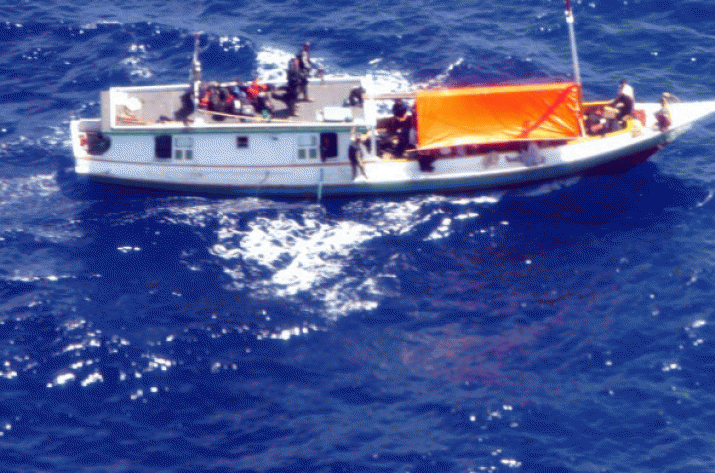
Survivors of a boat that sank off Java claim the Australian embassy ignored a distress call. Twenty-two asylum seekers have been confirmed as drowned but authorities in Indonesia fear that number may rise to more than 70.
“I called the Australian embassy; for 24 hours we were calling them. They told us just send us the position on GPS, where are you,” one survivor, Abdullah, a man from Jordan, was reported as saying by Fairfax media. “We did, and they told us, ‘OK, we know … where you are’. And they said, ‘We’ll come for you in two hours’.
“And we wait two hours; we wait 24 hours, and we kept calling them, ‘we don’t have food, we don’t have water for three days, we have children, just rescue us’. And nobody come. Sixty person dead now because of Australian government.”
One of the passengers, a Lebanese man, had reportedly lost his pregnant wife and eight children in the disaster.
Just 25 of those aboard had been rescued before efforts to locate survivors were postponed on Friday evening due to failing light.
It’s believed to be the first fatal attempted asylum-seeker crossing under the Abbott government, and comes after another group of 44 asylum seekers were rescued by an Australian navy vessel in the Sunda Strait on Thursday.
• TT earlier, ABC Fact Check: Is it illegal to turn back boats in international waters to Indonesia?