“At the very time when Tasmania most needs new jobs for a modern economy, the Government has slammed the door on job creation in renewable energy,” Jack Gilding, spokesperson for Save Solar Tasmania, declares today.
“In the rush to complete the sale of Aurora’s customers to private operators, the Government has refused a fair market return to solar owners. This will discourage new investment and jobs in an industry in which Tasmania could be a national leader. The Government has curtailed public debate and slashed the issues that need to be taken into account in setting the feed-in tariff (FiT) for next year and beyond,” Mr Gilding continues.
The draft report* from the Tasmanian Economic Regulator (TER) released this week suggests a feed-in tariff for new solar installations of 8.282c/kWh. The very low proposed FiT is a fraction of the price retailers will charge when they resell this power, typically to people in the same street.
“The profits won’t go to the Tassie families and small businesses that actually invest and generate the power but will instead go to big, but as yet unknown, mainland energy retailers,” Mr Gilding says.
Save Solar Tasmania calls on both the government and the opposition to recognise the role a vibrant solar industry can play in Tasmania’s future economic development and to support the industry by supporting a fair FiT.
Legislation to set the feed-in tariff process for next year is due to be tabled in Parliament in the next few weeks. But the Government has curtailed public debate and pre-judged the issue by:
• Setting a very low interim feed-in tariff of 8c/kWh.
• Dismissing the importance of the Tasmanian solar industry in generating jobs, creating a more efficient and robust electricity system and addressing climate change.
• Instructing the TER to calculate the new FiT based mainly on the “net financial benefit to retailers”.
• Instructing the TER to start working on setting the FiT before the terms of reference can be subjected to parliamentary debate.
• Encouraging the TER to produce a draft report before it has been supplied with terms of reference approved by parliament.
“The process is designed to deliver the result the Government wanted – cut-price solar paid for by Tassie solar investors to attract out-of-state private retailers,” Mr Gilding said.
Save Solar Tasmania and other groups made detailed submissions about how the FiT should be based on the long term interest of Tasmania and fair treatment of Tasmanian’s who want to install solar panels.
“While we welcome the fact that the TER has issued a draft report and called for public comment, the parameters of the debate set by the government and the TER are way too narrow.
Tasmania needs a robust public debate about the role of solar PV and other distributed generation in moving Tasmania to a more sustainable, efficient, decentralised and democratic energy system that maximises local employment and industry development,” Mr Gilding says.
Specific problems
The unfairness of using “net financial benefit to retailers” as the primary test is particularly evident in the TER’s arguments about the treatment of transmission and distribution charges.
Aurora residential customers are informed on their bill that transmission and distribution charges make up 47.7% of the cost of their electricity.
The TER report acknowledges that local generation of electricity reduces the need for transmission and distribution infrastructure. But, the TER argues that this benefit should not be recognised in the FiT because the way the cost of this infrastructure is currently recouped will not lead to a direct reduction in costs to retailers when solar electricity is fed into the grid.
“Solar owners who export electricity should be financially rewarded for generating electricity close to the point of use and avoiding the need for infrastructure that make up nearly half the cost of electricity,” Mr Gilding says.
The government instructed the TER to set a FiT only for distributed generation up to 10kW. A regulated FiT for projects up to 100kW (as is done in Victoria) would support the development of on-farm, commercial and community renewable energy projects, creating jobs and income in rural communities.
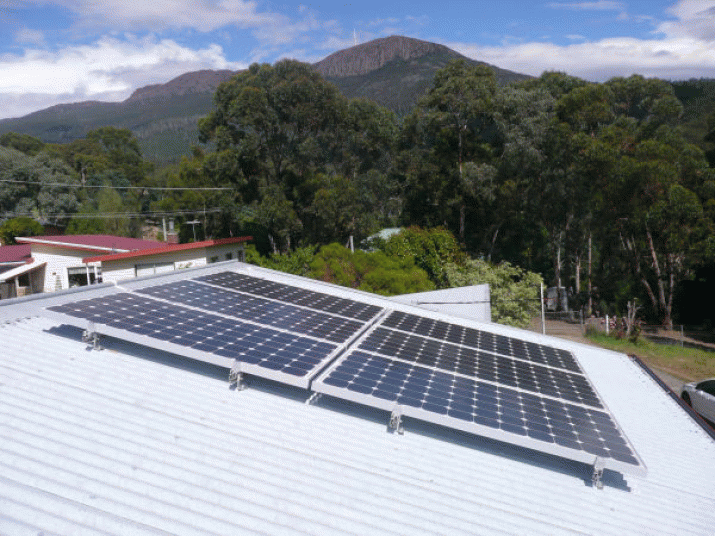
“The 16,000 Tasmanian households who have installed solar PV are making a real contribution to action on climate change, as well as reducing their own electricity bills,” Mr Gilding says.
“The government repeatedly relies on the argument that ‘the Commonwealth’s carbon pricing scheme provides the appropriate incentives for carbon reduction’ and that additional support is not justified. The intention of the incoming Federal government to abolish carbon pricing will make it more imperative that the state government accepts a greater responsibility for supporting action on climate change,” Mr Gilding continues.
Save Solar Tasmania calls on the state government and the opposition to broaden the terms of reference for the TER enquiry and to accept that the government’s responsibility in energy policy is broader than just running an ‘economically efficient’ market for the benefit of new retailers.
Website: Save Solar Tasmania solarcitizens.org.au/tas/
Twitter: https://twitter.com/SaveSolarTas @SaveSolarTas
Email: [email protected]
Public submissions in response to the TER’s draft report* are due by 2 October 2013.
*Draft report available here: http://bit.ly/ter-draft