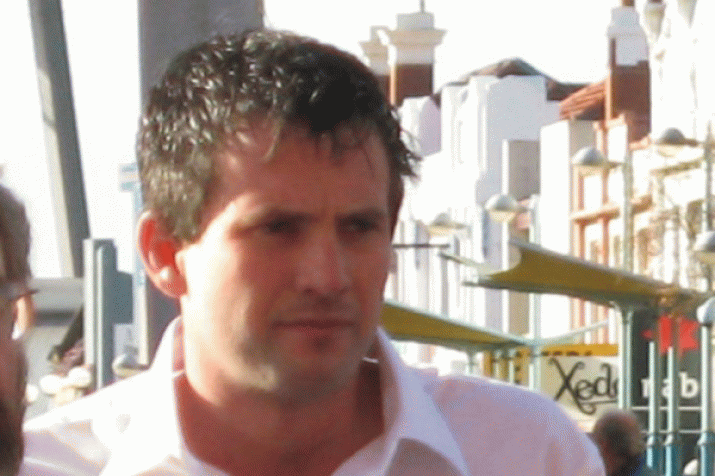


Last Wednesday, at the Magistrates’ Court in Launceston, sentencing proposals were put to Magistrate Reg Marron by Prosecutor Harry Virs in the case of Roderic Neil Mitchell. Mitchell is to be sentenced on Wednesday, August 14 at 9.45 a.m. in Launceston. ( The Advocate report here )
Suzanne Cass, from Stop Tasmanian Animal Cruelty was present at the court, and said: “The offences found proven by Mr Marron can carry significant terms of imprisonment.”
Magistrate Marron had found all but two of the almost 180 charges against Mitchell proven. According to a copy of the 70 page judgment provided to StopTAC by the court, the charges principally relate to ss7, 8 and 9 of the Animal Welfare Act 1993 (amended), as well as other offences such as intimidation and obstruction of officers under the Police Offences Act 1935, and other obstruction offences under the Animal Welfare Act. Most specifically ss7, 8 and 9 of the Animal Welfare Act relate to the ‘management’ of animals (s7), cruelty to animals (s8) and aggravated cruelty (s9).
The Prosecutor, Harry Virs advocated for an immediate custodial sentence, as well as substantial costs for the care of the dozens of animals Mitchell had abused, and a 10 year ban on Mitchell having care, control or custody of animals.
Ms Cass said the case had taken too long.
Mitchell’s defence counsel, Tom Moloney, also suggested that the charges, and the hearing, were ‘a spectacular and flagrant abuse of the resources of the state used to beat down a privately funded individual’ and described Mitchell as ‘an impecunious privately funded individual’, according to the judgment.
The primary defence, from the judgment were:
1. Assert that prosecution witnesses’ evidence was inadmissible.
2. That Mitchell didn’t know what was expected of him under the law and there were no prescribed standards for him to follow.
3. That the cows and calves may not really have experienced pain and suffering from the abuse, neglect and starvation.
4. That pain and suffering is not unreasonable or unjustifiable when commercial interests are involved – admitting that virtually all animals used in farming ‘suffer’ and any argument against this is anthropomorphism
5. That Mitchell had been treated for mental illness, that he was ‘overwhelmed’ and that he was socially isolated.
There were 32 witnesses called, including no less than 7 veterinarians, animal welfare officers, agricultural officers, police officers, and neighbouring farmers. Greg Tredinnick, the then CEO of RSPCA Tasmania, appeared for the defence, as did Alan Davenport, the Chair of the Dairy Council Commodity Council of the TFGA and subsequently the Chair of the Dairy Industry Animal Health and Welfare Action Group. Mitchell’s mother and sister also appeared for the defence, as did a psychiatrist, Dr David Topfler. Mr Marron described Mitchell as ‘cashed up’ when he arrived in Tasmania.
Mr Marron noted that in June 2009, Mitchell lifted a cow with a tractor equipped with hay tines, only to drop her from a height of approximately 3 metres onto a concrete floor, then put the tines on top of the cow in order to use the tractor to push her across the concrete floor, further noting that the cow was already in ‘poor body condition’. It was two charges of cruelty and aggravated cruelty in relation to this cow that were dismissed, in spite of compelling evidence from a neighbouring farmer, because Mr Marron ‘could not be satisfied beyond a reasonable doubt’ that this cow was still alive at the time. The evidence given by the farmer strongly suggested that she was.
Cows and calves were dying every day on Mitchell’s farm over a period of many months, with malnutrition being most prevalent cause, and it was noted that the majority of those found dead had been ‘down’ for a considerable time by the ‘paddle marks’ in the ground, and faeces around them indicating that they had been trying to rise. Others had to be shot by the authorities to end their suffering. The eyes of some had been pecked out by crows, which also attacked their udders and genitals. Other cows who were calving were put in steep, boggy terrain despite orders not to do so, and some were found dead after falling. Most ‘died where they fell with no sign of any assistance or of having been humanely destroyed’.
Mr Marron’s conclusions included that Mitchell was provided with substantial advice and instructions about what was expected of him, and chose to ignore all of that.
Prior to sentencing, Mr Marron has requested details of Mitchell’s financial circumstances. Mitchell has been working as a fencing contractor around Alice Springs. His defence counsel describes him as having ‘lost everything’ and as virtually destitute.
(Edited)
Suzanne Cass
Stop Tasmanian Animal Cruelty
PO Box 252
BRIDGEWATER TAS 7030
www.stoptac.org
www.liveexportshame.com
Pic: of Roderic Mitchell