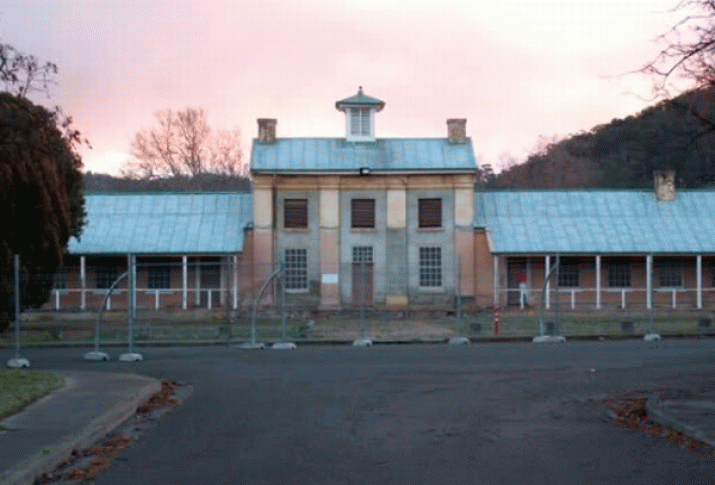
The real cost and loss to the Tasmanian Taxpayer: $100,000,000 and rising … ? For the sale of the State’s largest asset, the old Royal Derwent Hospital complex at New Norfolk … ? Eric Blair* reports
The Auditor-General’s report into the May 2001 sale of the Royal Derwent Hospital complex at New Norfolk – released on the 26th March 2013 – leaves more questions than answers.
The Auditor-General’s report states that “the sale agreement has not resulted in the purchaser delivering all specified outcomes”; “the sale proceeds ($350,000) were fair and reasonable”; “the terms and conditions of the Agreement for Sale were such that enforcement and monitoring were either non-binding or inconclusive”.
The Auditor-General also says in his report: “scope excluded any involvement of Crown Law in respect to the sale agreement”.
http://www.audit.tas.gov.au/publications/reports/specialreport/index.html
http://www.audit.tas.gov.au/publications/reports/specialreport/pdfs/2012-13-9_brochure.pdf
The special report confirms the whole complex had been valued in 1993 at a capital value of $45.58 million. What was not disclosed was that from 1993 to 2003, Tasmania experienced an unprecedented growth in property value – doubling most values. If those same statistics were applied to this complex, that would have made the site worth around $91.16 million by the time of sale.
Expression of Interest phase
The Minister went through an expensive Expression of Interest (EOI) phase, eliminating 14 proponents out of 19 as they did not offer a “whole of site” concept; the minister preferring one proponent’s concepts.
What is interesting is that on Pg. 1 of the EOI, it invites proposals for partial site proposals? You wonder if these proponents weren’t set up to fail?
The then-Minister, David Llewellyn, sold the site (except the small Millbrook Rise campus) for just $350,000 to a start-up company called Lachlan River Community Holdings.
Instant profits
Signing the contract in May 2001 the Minister sold everything including all the chattels that were quickly sold by the developer at auction for around $1.5 million; making the start-up company around 500% profit within months of purchase.
The size of the state owned asset
Place this massive State owned Tasmanian asset into perspective; the facilities were extensive, built on around 700 acres of land, over 52 liveable houses for staff, separate buildings used for nurses’ quarters, gymnasiums, swimming pools, a 300 seat lecture theatre, a refectory, many buildings used for patient wards and all the chattels.
The hospital site comprised three campuses. The main campus included the hospital wards, gyms, pools, lecture theatre, refectory; with hundreds of acres of prime virgin land.
The second campus was the extensive historic Willow Court campus that housed the administration and additional high security wards with buildings that predate those of Port Arthur and have historic links with Napoleon. The third small adjacent campus, Millbrook Rise campus, was part of the complex but not sold as part of this sale by the State.
Willow Court is recorded in the official historic register as a whole site of significant historical value to the Australian Nation.
Present day massive budget cutbacks to front line public services
During a time when the State Government is claiming to be cash strapped and demanding massive budget cuts in Health, Policing, Fire, Education, the people have every right to ask why the state’s finances are in such a disarray; and to seek transparency and accountability.
When a state-owned asset such as the old Royal Derwent Hospital complex at New Norfolk appears to have been gifted away by the government … questions arise.
These questions have more validity and credibility when the Auditor General’s report exposes major fundamental flaws and omissions in the sale process; and lack of delivery. The one major omission with the report is the lack of legal accountability.
No desire for transparency and accountability
The Derwent Valley Council appears to have no knowledge of the Conditions of Sale document … Shouldn’t there be a high degree of transparency and accountability in the sale of a publicly-owned asset?
The Auditor General’s report raises more relevant questions
The Auditor General’s report raises more questions.
1. Why did the Minister apparently fail in his duty of care to the State by opting for a start-up company, over 18 other proponents.
2. A due-diligence report into the sale; and the company’s offer has been done. But has not been publicly released.
3. The Auditor General’s report says the agreement failed to contain enforceable specific performance terms in the contract of sale; the terms were unenforceable and ambiguous. The Auditor General’s report recommends that next time anything is sold this process should be improved.
The sale contract was a very important document and terms and conditions of sale should have been central to any contract.
Specific performance is an essential element made more valid when it is placed into focus with the exhaustive and expensive Expression of Interest phase that weeded out proposals from other proponents the minister felt were unsuitable.
Why such an apparent massive oversight by the Minister and State Government on such an obvious requirement?
4. Why did the government go through the expensive process in selecting a proponent’s whole of site concepts over and above all other proponents’ submissions and concepts?
5. Why did the minister apparently turn a blind eye to the winning proponents’ carve-up of the whole site?
Conclusion
The Auditor General’s report says the Minister failed to execute proper due diligence processes to ensure the directors had the expertise and past financial background to finance and handle such a massive project. The Minister failed to ensure they had the necessary funds to deliver their project. The Minister failed to bind them to a contact to perform any specific outcomes.
The process was designed to weed out proponents unable to deliver whole of site concepts. 18 proponents and their concepts were eliminated?
Why did the Minister allow the winning proponent to carve up the whole site? Surely the Minister could have done this himself; in the process enriching the state.
Wouldn’t it have been far cheaper, far more effective, more profitable and beneficial for the state of Tasmania and its people not to go through such an elaborate Expression of Interest process.
He could have simply instructed a couple of local real estate agents to place for sale signs on every parcel available … and raised perhaps as much as $17 million.
Serious questions requiring solid answers in this age of cash-strapped austerity.
*Eric Blair is a pseudonym. The writer is known to the Editor. . The article is based on extensive FOI-obtained documents by a concerned citizen who believes ‘there should be a full investigation of many hidden facts’ surrounding the sale.
• Pete Godfrey, in Comments: Just another one in the long line of seemingly questionable or stupid decisions made by those members of parliament who were totally incompetent. The Brighton army base is another. The Ogilvie Park sale to Gunns ltd. The PMAA and fast track deal for the defunct pulp mill. The free highway to the defunct pulp mill. The free culvert under the road for the non existent pipeline to the non existent pulp mill. The sale of the Hospital in Hobart. The wasted money on looking at a new site for a hospital when the government knew that they would never be able to afford it. The $50 million to be spent on rehabilitating the old rail yard site in Hobart in preparation for selling it to a mate for a song. Does it ever end? Throw the lot of them out, and definitely never let Mr Llewellyn stand for parliament again.
• Anonymous, in Comments: Growth as we know it in the modern world is based on increasing population, increasing economic activity, increasing wealth leading to increasing demand which in turn leads to increasing economic activity and the cycle continues. My understanding is the Greens say this model is flawed and we are to return to the Year Zero. The Libs say this model is good but are in bed with the rape and pillage merchants. Labor seems to neither wholly subscribe or disavow; like being a little bit pregnant, and has no ideas for growth while it has introduced the disincentive of taxation and regrettably worse, has displayed little competence over successive goverments.
• Tom Bailey, in Comments: Llewellyn nominates for Lyons
• Mercury: Llewellyn nominates for Lyons FORMER deputy premier David Llewellyn has nominated for preselection as an endorsed Labor candidate for Lyons at the next State Election. Mr Llewellyn, 71, lost his seat in 2010 to Labor staffer Rebecca White. Mr Lewellyn received a $1.24 million payout, the biggest pension of any Tasmanian parliamentarian.
• Guy Barnett: David Llewellyn’s claims fanciful
• David Llewellyn, in Comments HERE: David Llewellyn State Lyons Candidate: Responding to the allegations contained in the recent release by Guy Barnett. ” I advised Premier Bartlett how he could form a minority Government following the last State election but at no time did I promote deals with the Green Party” Guy Barnett is correct in saying I was part of the Accord Government with the Greens during the Field Government and that is precisely why I do not support the current arrangement or any such arrangement in the future.