Extreme Melting On Greenland Ice Sheet, Team Reports; Glacial Melt Cycle Could Become Self-Amplifying
ScienceDaily (Oct. 25, 2011) — The Greenland ice sheet can experience extreme melting even when temperatures don’t hit record highs, according to a new analysis by Dr. Marco Tedesco, assistant professor in the Department of Earth and Atmospheric Sciences at The City College of New York. His findings suggest that glaciers could undergo a self-amplifying cycle of melting and warming that would be difficult to halt.
“We are finding that even if you don’t have record-breaking highs, as long as warm temperatures persist you can get record-breaking melting because of positive feedback mechanisms,” said Professor Tedesco, who directs CCNY’s Cryospheric Processes Laboratory and also serves on CUNY Graduate Center doctoral faculty.
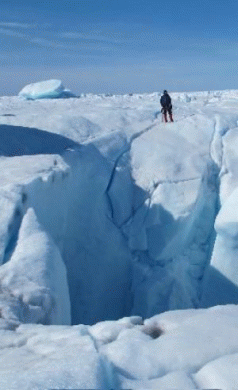
Professor Tedesco and his team collected data for the analysis this past summer during a four-week expedition to the Jakobshavn Isbræ glacier in western Greenland. Their arrival preceded the onset of the melt season.
Combining data gathered on the ground with microwave satellite recordings and the output from a model of the ice sheet, he and graduate student Patrick Alexander found a near-record loss of snow and ice this year. The extensive melting continued even without last year’s record highs.
The team recorded data on air temperatures, wind speed, exposed ice and its movement, the emergence of streams and lakes of melt water on the surface, and the water’s eventual draining away beneath the glacier. This lost melt water can accelerate the ice sheet’s slide toward the sea where it calves new icebergs. Eventually, melt water reaches the ocean, contributing to the rising sea levels associated with long-term climate change.
The model showed that melting between June and August was well above the average for 1979 to 2010. In fact, melting in 2011 was the third most extensive since 1979, lagging behind only 2010 and 2007. The “mass balance,” or amount of snow gained minus the snow and ice that melted away, ended up tying last year’s record values.
Temperatures and an albedo feedback mechanism accounted for the record losses, Professor Tedesco explained. “Albedo” describes the amount of solar energy absorbed by the surface (e.g. snow, slush, or patches of exposed ice). A white blanket of snow reflects much of the sun’s energy and thus has a high albedo. Bare ice — being darker and absorbing more light and energy — has a lower albedo.
But absorbing more energy from the sun also means that darker patches warm up faster, just like the blacktop of a road in the summer. The more they warm, the faster they melt.
And a year that follows one with record high temperatures can have more dark ice just below the surface, ready to warm and melt as soon as temperatures begin to rise. This also explains why more ice sheet melting can occur even though temperatures did not break records.
Professor Tedesco likens the melting process to a speeding steam locomotive. Higher temperatures act like coal shoveled into the boiler, increasing the pace of melting. In this scenario, “lower albedo is a downhill slope,” he says. The darker surfaces collect more heat. In this situation, even without more coal shoveled into the boiler, as a train heads downhill, it gains speed. In other words, melting accelerates.
Only new falling snow puts the brakes on the process, covering the darker ice in a reflective blanket, Professor Tedesco says. The model showed that this year’s snowfall couldn’t compensate for melting in previous years. “The process never slowed down as much as it had in the past,” he explained. “The brakes engaged only every now and again.”
The team’s observations indicate that the process was not limited to the glacier they visited; it is a large-scale effect. “It’s a sign that not only do albedo and other variables play a role in acceleration of melting, but that this acceleration is happening in many places all over Greenland,” he cautioned. “We are currently trying to understand if this is a trend or will become one. This will help us to improve models projecting future melting scenarios and predict how they might evolve.”
Additional expedition team members included Christine Foreman of Montana State University, and Ian Willis and Alison Banwell of the Scott Polar Research Institute, Cambridge, UK.
Professor Tedesco and his team provide their preliminary results on the Cryospheric Processes Laboratory webpage (http://greenland2011.cryocity.org/). They will will be presenting further results at the American Geophysical Union Society (AGU) meeting in San Francisco on December 5 at 9 a.m. and December 6 at 11:35 a.m.
The research was supported by the National Science Foundation and the NASA Cryosphere Program. The World Wildlife Fund is acknowledged for supporting fieldwork activities.
And,
New Study Shows No Simultaneous Warming of Northern and Southern Hemispheres as a Result of Climate Change for 20,000 Years
ScienceDaily (Oct. 21, 2011) — A common argument against global warming is that the climate has always varied. “Temperatures rise sometimes and this is perfectly natural,” is the usual line.
However, Svante Björck, a climate researcher at Lund University in Sweden, has now shown that global warming, i.e. simultaneous warming events in the northern and southern hemispheres, have not occurred in the past 20 000 years, which is as far back as it is possible to analyse with sufficient precision to compare with modern developments.
Svante Björck’s study thus goes 14 000 years further back in time than previous studies have done. “What is happening today is unique from a historical geological perspective,” he says.
Svante Björck has gone through the global climate archives, which are presented in a large number of research publications, and looked for evidence that any of the climate events that have occurred since the end of the last Ice Age 20 000 years ago could have generated similar effects on both the northern and southern hemispheres simultaneously. It has not, however, been possible to verify this. Instead, he has found that when, for example, the temperature rises in one hemisphere, it falls or remains unchanged in the other.
“My study shows that, apart from the larger-scale developments, such as the general change into warm periods and ice ages, climate change has previously only produced similar effects on local or regional level,” says Svante Björck.
As an example, let us take the last clear climate change, which took place between the years 1600 and 1900 and which many know as the Little Ice Age. Europe experienced some of its coldest centuries. While the extreme cold had serious consequences for agriculture, state economies and transport in the north, there is no evidence of corresponding simultaneous temperature changes and effects in the southern hemisphere. The climate archives, in the form of core samples taken from marine and lake sediments and glacier ice, serve as a record of how temperature, precipitation and concentration of atmospheric gases and particles have varied over the course of history, and are full of similar examples.
Instead it is during ‘calmer’ climatic periods, when the climate system is influenced by external processes, that the researchers can see that the climate signals in the archives show similar trends in both the northern and southern hemispheres.
“This could be, for example, at the time of a meteorite crash, when an asteroid hits the Earth or after a violent volcanic eruption when ash is spread across the globe. In these cases we can see similar effects around the world simultaneously,” says Svante Björck.
Professor Björck draws parallels to today’s situation. The levels of greenhouse gases in the atmosphere are currently changing very rapidly. At the same time, global warming is occurring.
“As long as we don’t find any evidence for earlier climate changes leading to similar simultaneous effects on a global scale, we must see today’s global warming as an exception caused by human influence on the Earth’s carbon cycle,” says Svante Björck, continuing: “this is a good example of how geological knowledge can be used to understand our world. It offers perspectives on how the Earth functions without our direct influence and thus how and to what extent human activity affects the system.