The discussion on urban densification and green space on TT so far is too abstract and increasingly focuses on personalities and sophistry.
It seems clear that urban sprawl is not desirable. It’s unsustainable in all respects.
It’s also clear that green spaces are an absolute must in urban environments. Even more so as coming fuel shortages force people to travel less in search for soothing environments.
Relaxing and healthy outdoor environments have to be provided for the community. Such environments begin as you step out of your house, block of flat, office, factory.
Open space includes streets, parking lots, school and hospital grounds and of course parks big and small as well as green corridors.
All these areas combine as a large network of opportunities to form green spaces in which humans and at least some animals feel good.
Widespread avenue street tree planting for dappled summer shade, intelligent traffic calming as part of modern mobility concepts which include ALL traffic participants along with other liveability measures decisively change urban dreariness into invigorated, healthy liveable space.
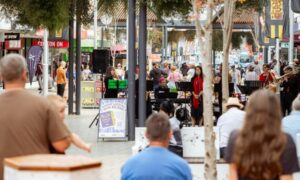
Observe people when they travel. They unfailingly stream to the highest density urban spaces and/or congregate in the DAPPLED shade under trees.
Planting and maintaining proper street trees is the most effective and easiest single measure towards achieving healthy and pleasant urban environments. Urban densification will be successful on all fronts only if accompanied by mass street tree planting.
Street trees also help softening the numerous architectural aberrations with which humanity has been blessed over time. (When will the men in black polo necks stop being enamored by their design and start focusing on the social needs of the population?)
But a word of warning: What passes for street trees in Tasmania in most cases has nothing to do with best practice elsewhere.
A street tree is a tree with a minimum of a 2.5 meter clean trunk at planting and engineered in a specialised nursery in a way that allows further stem pruning upwards to 4 and more meters as the tree matures. It has a canopy under which life and vehicle traffic takes place in dappled shade in summer and sunshine in winter.
Avenues are created by spacing trees of the same kind no further apart than 7 to 20 meters.
Varieties can change from street to street, but not within the same street for proven psychological reasons.
Street trees are to be planted out in a space of minimum 4×4 meters and rooted in a specially mixed substrate, consisting of 50% humus, 25% gravel and 25% “Perlite” to facilitate the all important airing of the ground.
With this knowledge under the belt it will be much easier to conceive, implement and accept the inevitable urban densification we are (understandably) so worried about because we see no satisfying examples as of yet around here.
So, in a nutshell, it’s imperative that those in charge of planning recognise that proper street trees are an integral part of the magic formula. This formula is used to interlink public health, social and economic wellbeing, comfortable microclimates, visitor attraction and multi-mobility needs.
People should demand loud and clear that all urban environments be comprehensively treed and traffic calmed as part of liveability infrastructure (not as optional embellishments). Together with much improved comprehensive public transport this will alleviate the fears about inappropriate densification.
Here (and above) are some pix showing how medium density urban street environments can be made liveable and green with proper street trees: