

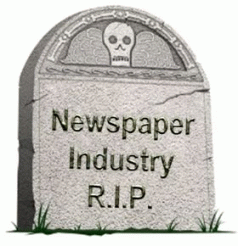
When a media proprietor such as Seven Network chairman Kerry Stokes describes newspapers as a “sunset industry”, it goes without saying that the future of the newspaper does not involve paper.
Mr Stokes has been reported as saying he believes newspapers will need to merge their news services with social media and other technologies to survive the next 15 years.
Digitisation has shattered the need for production and distribution costs that so dominated newspaper costs of an earlier age and redrawn the boundaries for media.
On London Review of Books, John Lanchester reported on a calculation demonstrating that you could give every subscriber to the physical New York Times a Kindle every year and it would be cheaper than printing and getting it to them. So, while some may lament not being able to hold paper, if you want that in the future you are going to have to use your own printer.
But if the recent launch of The Daily (News Corp’s iPad only newspaper) tells us one thing, it is that the newspaper is more than just a printed set of news. The Daily represents what you might do if you took the traditional newspaper, could realise colour production values with high definition photos and embedded videos, add some features such as quick polls, commenting and sharing and then update it every day with news, gossip, sports and even a crossword and Sudoku built right in.
The image is of a person sitting down to breakfast or on their morning train commute reading their newspaper on a tablet (in this case, an iPad) just as they would have read their newspaper. To be sure, as I flipped through The Daily, I felt that the experience was much more pleasant than I had in flipping through a paper but the main thing was that that experience had been digitised.
It should not be a surprise that old media would stick close to tried and true formulae when moving into new media.
The newspaper is a platform for keeping a reader’s attention for around 20 to 30 minutes every day. If you can do that, then you can demonstrate to those same consumers that they should pay for that content (for The Daily that is an easy $1 per week). Moreover, you can go to advertisers and say that these consumers (who are paying) won’t likely have time to read anywhere else and so if you want to access them, you’ll have to pay for it. It is almost like you are a small town monopolist seller of advertising space after that point.
So if News Corp succeed, then what they have done is translate the old physical newspaper straight into the new digital medium but with the ultimate business model – grab attention and on-sell it for a premium – intact.
However, in the old days, we read newspapers like this because that was all there was. The internet and specifically, the browser changed all of that for many people. In my own case, I cannot imagine consuming news from one outlet. To be sure, I like to read the news over my Weet-Bix but I sit at a computer and open my ‘morning tabs’ to CNN, NYT, and ABC news. On the train to work, I then browse through hundreds of RSS feeds on my iPhone. Then throughout the day, the Twitter feed lets me know what is going on. I spent my 30 minutes reading the news but there is no cover to cover experience. In fact, there are no covers at all.
To consumers like me, my behaviour is a disaster with respect to the old media business model. To be sure, if all of these sites charged, I would be forced to make some choices but as they don’t I fly from site to site with abandon. But even that should not be a problem. My attention is there and could be sold to the highest bidder. However, these outlets are all playing their own advertising game.
The NYT might want to sell my attention to Starbucks as might CNN but if I am switching between the two, Starbucks does not know where to bid. In that world, it should be no surprise that online ad rates are a fraction of offline ones. Advertisers just don’t know what they are paying for.
The newspaper – that provider of daily content that can keep attention for 30 minutes – cannot survive all of this. But news can precisely because attention is being grabbed and someone will be able to work out how to sell that. One possibility is that technology could save the …
What Mark Day in The Australians says:
The Conversation is funded with $6 million from the Group of Eight universities and other partners – enough to support 20-odd staff for three years. The hope is that, in that time, the site can be made self-supporting through advertising and business partnerships. Jaspan’s approach is to turn the university into a giant newsroom. Hundreds of academics are beavering away on all manner of research projects. Many, if not most, of them have no idea of how to turn their research into something practical. Much of their writing is impenetrable to anyone but other academics. Andrew Jaspan’s new site offers something to talk about










