Dear Premier,
The problems with the eastern seaboard as described below includes Tasmania.
Action re the regulatory control and use of agrichemicals to prevent on-going harm to environmental and human health needs to be urgently taken – Australia is continuing to lag well behind countries in the EU.
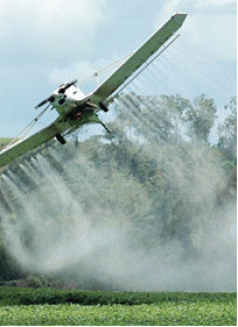
The review of aerial spraying practices of agrichemicals is now into its sixth year with no changes made as yet to protect water catchments and ecosystems.
What action is Tasmania taking in regard to these issues?
Yours sincerely,
Alison
Dear Hon Minister Ludwig, Jim, former taskforce people, NSW DII and DAFF,
Through the Noosa Fish Health Investigation Taskforce I clearly highlighted the risks that the reproductive losses being experienced at Sunland Fish Hatchery, were occurring with exposures to a mixture of chemicals. There remains considerable disagreement over this conclusion. I also highlighted that these mixtures were unassessed from an experimental and regulatory standpoint.
See attached another important paper, making the links between mixtures of chemicals in estuaries and declines in wild fisheries. Agrichemicals were not used in the paper, however the endocrine effects of many of them are well described.
From environmentalhealthnews.org
The complete paper is available at http://ehp03.niehs.nih.gov/article/fetchArticle.action?articleURI=info%3Adoi%2F10.1289%2Fehp.1002895
New tests reveal many pesticides block male hormones. Thirty out of 37 pesticides tested by the University of London blocked male hormones, including 16 that had no known hormonal activity until now. Most are fungicides applied to fruit and vegetable crops, including strawberries and lettuce. Environmental Health News
http://bit.ly/gRwaP5
Critically it highlights that mixtures, acting through different mechanistic pathways are linked to population declines.
The implications for inshore species which use estuaries as breeding grounds is profoundly negative.
Bass in Noosa River are declining, Snapper in SE Qld are declining, Mullet numbers have declined, Snub nosed garfish have declined, mulloway have declined, Sydney rock oysters are disappearing… the list is v long.
The reconsideration of the Noosa R bass decline, and all east coast estuarine fisheries, in light of this paper seems warranted. Note the lack of predictability of the outcome, when impacts on behavioural factors are included in the assessment.
The regulatory system (APVMA, NICNAS, TGA) does not currently account for these endocrine system impacts as these chemicals enter the waterways in complex mixtures.
Urgent changes are needed. Marine parks will not stop the declines from these causes.
With declining dairy cattle fertility, declining human fertility, it seems unlikely to me that this problem will be confined to the waterways.
Best
Matt
Dr Matt Landos BVSc(HonsI)MACVS
Director, Future Fisheries Veterinary Service Pty Ltd
PO Box 364, Lennox Head NSW 2478
Download: EDCs_mixtures_pipefish_2011.pdf
Study links pesticides to Parkinson’s
Monday, 14 February 2011 Darren Osborne
ABC/AFP
US researchers say they have found people who used two specific varieties of pesticide were more likely to develop Parkinson’s disease.
The study, which appears in the journal Environmental Health Perspectives, shows people who used either rotenone or paraquat are about two-and-a-half times more likely to develop Parkinson’s than people who never used either pesticide.
“Rotenone directly inhibits the function of the mitochondria, the structure responsible for making energy in the cell,” says study co-author Dr Freya Kamel, a researcher at the US National Institute of Environmental Health Sciences .
“Paraquat increases production of certain oxygen derivatives that may harm cellular structures. People who used these pesticides or others with a similar mechanism of action were more likely to develop Parkinson’s disease,” says Kamel.
The study examined 110 people with Parkinson’s disease and 358 people who served as a control group from the Farming and Movement Evaluation (FAME) Study. FAME is part of the larger Agricultural Health Study looking at the health of approximately 90,000 licensed pesticide applicators and their spouses.
Link suspected for a while
Associate Professor Kay Double of Neuroscience Research Australia, say the study
Read the rest of the story HERE, with full links
EPA floats the idea of legalizing drift; CropLife thinks it doesn’t go far enough
Thu, 2011-02-10 16:47
Karl Tupper
“Spray drift” is the name given to droplets of pesticides that land anywhere they are not supposed to — like on people’s heads, in lakes and streams, or on crops in neighboring fields. It can cause illness, damage crops, and harm ecosystems. And so in 2007 the EPA began trying to figure out how to do better job of keeping it from happening.
EPA regulates spray drift by making pesticide companies put statements on product labels that say things like, “Do not apply this product in a way that will contact workers or other persons, either directly or through drift,” or “Do not apply when weather conditions favor drift from treated areas.” But not all products carry such prohibitions and different variations are in circulation. Few labels explicitly mention protecting bystanders or residents’ yards from drift. All this inconsistency makes it hard for state agencies to enforce these rules. In fact, most states are reluctant to even investigate spray drift complaints from residents.
Most states are reluctant to even investigate spray drift complaints from residents.
Late in 2009, the EPA proposed standardizing spray drift labeling, putting the same statement on the labels of all pesticides. Their proposed language was a step in the right direction but it wasn’t great, and we told them so. The pesticide industry didn’t like it either, though for different reasons: they didn’t want to be on the hook for chemicals drifting out of fields.
Stuck in the middle, the EPA floated a more industry-friendly proposal on a call with industry and environmental groups last week:
Do not apply this product in a manner that will contact workers or other persons, either directly or through drift. In addition, do not apply this product in a manner that results in spray drift that harms people or any other non-target organism or site.
Burden of proof
This statement may look innocuous at first glance, but it essentially legalizes drift as long as it doesn’t hurt anyone or anything. The EPA’s previous proposal also proscribed drift that “could cause an adverse affect.”
And the burden of proving harm? That falls to the victim, who is usually a farmworker. Despite the fact that they have the third most dangerous job in the country, farmworkers are not covered by U.S. labor laws and are reluctant to say anything that might put their jobs in jeopardy. Having to prove harm also means only acute sickness will be considered; repeated and prolonged exposure to drifting carcinogens and endocrine disruptors will basically get a pass as long as the chronic drift exposures are not accompanied by acute illness.
As an activist from “our side” noted on the call, EPA shouldn’t be legalizing the exposure of people to toxic chemicals without their knowledge or consent. Meanwhile, a representative from CropLife, the pesticide industry’s trade group, thought that holding sprayers responsible for drift even when harm can be proven was still more liability than they ought to have to shoulder.
We’ll keep you posted with how this plays out.
And, from the True Food Network:
http://news.greenpeace.org.au/rp//1238/process.clsp?EmailId=1000025129&Token=281EA5788F3B831904057497B730C798F
And, from PAN: