PREVIOUS climate change issues have caused societal collapse around the world but as the only proof is in archaeology and science, not human records, it is often disregarded. Currently, climate change is occurring faster than those scientific records of previous examples demonstrate; yet our response is slow, making failure a possibility.
The increased speed of change is being blamed on human causes, particularly greenhouse gas emissions. Our failure to deal with a known environmental threat is driven by resistance to change and inability to adapt our values, in spite of overwhelming evidence for the need. Such is the way that many societies have perished. Easter Island is the most extreme example, with deforestation due to “religious veneration” and “lust for power” (1) apparently superseding common sense in spite of drastic man-made change being evident in such a small area.
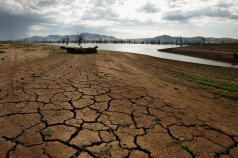
In one demonstration of the diverse effects of climate change, “the two year period to the end of November 2007 is the lowest Murray System two year inflow period on record” (2). As “the Basin produces one third of Australia’s food supply” (3) Australia can consider itself fortunate to have had a reprieve due to the massive floods in Queensland. Farmers expect to be able to capitalise on that water and ignore the fact that historically, another prolonged drought is guaranteed.
Australia’s relatively infertile soils, salinisation, erosion and introduced pests mean that our environment is in serious trouble with our environmental problems increasing exponentially, at a rate faster than the solutions are found to fix them. (1) Yet we are still reluctant to act, because acting is politically unpopular, with the burden of action perceived as being unfairly placed on a small sector of the population.
As the Murray-Darling Basin is considered the heart of mainland Australia’s food production and ecology, failure of this system will be detrimental for all of us. According to the Australian Conservation Foundation (4) “Between 2001 and 2007 dry conditions (in the Murray-Darling Basin) meant irrigation industries used about 70% less water, (yet) the economic value of irrigation production fell by only 0.12%.” This suggests that water conservation, and changing farm practices such as reducing broadscale watering, will help reduce impact on the river.
Escalating fear campaigns in communities on the Murray River area are increasing resistance to change, and to fixing the problem. The ACF states that “a healthy river will support strong communities, agriculture and tourism in the long-term”, which the recent drought clearly demonstrated is difficult to maintain. By 2008 water consumption caused the Murray to cease to flow 40% of the time, a massive increase from the traditional 1%. Due to the reduced flow, acidification of the Lower Lakes was a very real threat, with the potential for permanent damage. The significant loss of wetlands, fish and bird species and vegetation was also of concern. (5)
Success in mitigating environmental damage is never guaranteed, even to “those who have the courage to take difficult decisions”; luck also plays a part, as demonstrated by the floods which provided drought relief to a large percentage of Australia’s population. But using the easy excuse that it’s “someone else’s problem” (3) is no longer true, as one problem causes another, particularly with climate change.
The common excuse of not acting on climate change due to expense of the solution often leads only to increased expense, but the problems being experienced on Tasmania’s coastline due to rising sea levels are not able to be fixed individually. “Scientists say there is evidence sea levels around the island state have risen 14 centimetres over the past 100 years.” (6)
Sea level rise is highlighted at Hellyer Beach, where a recent report “has concluded mitigation measures such as a rock wall are not likely to solve the problem”, so “residents were told to leave homes threatened by erosion.” (7) This is a problem that can only get worse, with many communities threatened, unless major changes in human behaviour are made world wide and soon.
But we have a proposal for safeguarding the Murray-Darling Basin for the foreseeable future: having been rescued from our failure to perceive the problem, and having been fortunate enough to be provided with the opportunity to solve it, will we now choose to fail?
References:
(1). Collapse: How Societies Choose to Fail or Survive: Jared Diamond
(2). Murray-Darling Basin dry inflow contingency planning
http://www.environment.gov.au/water/publications/mdb/dry-inflow-planning-feb08.html
(3). Basin info | Murray-Darling Basin Authority
http://www.mdba.gov.au/services/education-resources/basin-info
(4). Australian Conservation Foundation: A once in a lifetime opportunity – returning the Murray-Darling to health
http://www.acfonline.org.au/articles/news.asp?news_id=3180
(5). Coorong and Lakes Alexandrina and Albert Ramsar Wetland – Fact sheet (PDF – 204 KB)
http://www.environment.gov.au/water/publications/environmental/wetlands/pubs/coorong-factsheet.pdf
(6). Rising seas erode Tasmanian shoreline
http://www.abc.net.au/rural/content/2010/s2809320.htm
(7). Residents told to leave homes threatened by erosion
http://www.abc.net.au/news/stories/2010/10/11/3034825.htm