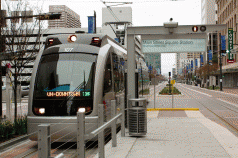
The proposed electric light rail for Hobart’s northern suburbs would be vital if we wanted to prosper economically and compete with the rest of the world, an expert has said.
Peter Newman, the Professor of Sustainability at Curtin University and board member of the national funding body, Infrastructure Australia, said light rail acted as an economic development tool. It increased surrounding property values and reduced residents’ transport costs – money that’s re-invested into the local community’s goods and services.
“Hobart should be modelling its plans on the Gold Coast light rail, as the cities are of similar size,” he said, adding that the only real obstacle Hobart faced in making this a reality was “purely a political one.”
Nearly every Australian capital city is implementing Transit Orientated Developments (TODs), centred around light rail, which is directly correlated to a decline in car use and a rise in economic prosperity.
Residents of TODs used cars 50 per cent less and consequently saved around 20 per cent more of their income, which equated to average superannuation saving of $750,000 over a lifetime, Professor Newman said.
However, Hobart’s per capita car use is on the rise and could result in the city becoming one of the country’s least desirable to live in.
Professor Newman has been involved with sustainable urban development and revitalizing Perth’s rail system since 1979. He has served as a local government councillor in Perth and acted as an advisor for numerous state and federal governments as well as having written several books on the subject.
Claims that Hobart was too small to make a light rail economically viable were unfounded. “This is used as an excuse, in Perth we were told we had to reach the magic million. Then we were told we were not dense enough,” he said.
Professor Newman said light rail developments could transform Hobart’s northern suburbs as economic centres grew around the route, similar to the route planned for Subiaco, the suburb of western Perth.
“It brings jobs, life and interest to an area and in fact working class suburbs are often easier to re-develop as they are mixed with industry and already quite dense,” said Professor Newman.
“The route needs to function as a land development mechanism, as a way of building a city that is denser and less car dependent. Developers love light rail, it has an appeal to it that you cannot get in any other way,” he said.
He said that light rail also helped redevelop areas into those favored by ‘New Urbanists’ – the new demographic of young, internet-savvy, business professionals.
These New Urbanists can’t afford to lose time commuting and want suburbs that are highly populated, mixed and walkable.
The New Urbanists are driving the emerging ‘Knowledge Economy.’ This 21st century way of doing business is a mix of face to face and internet interactions and has been identified by the Rudd Government as a vital economic growth area.
“Light rail is not just about re-jigging commuting; it’s re-jigging the way we live. It’s enabling the knowledge economy, which is attracted to these dense urban spaces,” said Professor Newman.
The emergence of electric light rail in cities is a mega trend, as cities rush to capitalise on this new globally digital, knowledge economy.
China has shifted from road building to rail, committed to making a superfast, nationwide rail system with a 120,000 km of track, spending a $143US billion per year and employing 6 million people.
India is spending $41US billion over the next decade as it ramps up its rail system, especially in New Delhi, Bangalore, Mumbai and Chennai – the cities popular with the silicon-savvy, Indian New Urbanists.
Over 100 American cities are also following suit.
The halt to further urban sprawl may well be inevitable, with an emphasis more on re-development. Could this be the beginning of the end of Australia’s love affair with the automobile and the iconic suburban landscape?
“The tipping point happened five years ago, where car use per capita started declining and public transport started booming. A positive spin on it is that it’s happening everywhere anyway, so we just need to help facilitate it,” he said.
And,
RELIABLE TRANSPORT CRITICAL TO VIABILITY OF REGIONAL COMMUNITIES
Time for Debate on Transit Centre for Hobart
Tim Morris MP
Greens Infrastructure spokesperson
Monday, 31 May 2010
mps.tas.greens.org.au
The Tasmanian Greens today called on the State Government to increase investment in bus services for regional areas of Tasmania as a critical part of the State’s response to the challenges that will come with climate change and Peak Oil.
Greens Infrastructure spokesperson Tim Morris MP, who addressed the Bus Industry Association annual conference today in Hobart, said a lot more work and some investment is required to bring the standard of public transport in regional areas up to a level that will attract new and retain existing passengers, and debate is also required about the costs and benefits involved in establishing a transit centre for Hobart.
Mr Morris also praised the Derwent Valley-based O’Driscoll bus service for its commitment to using high quality vehicles, as well as the new attitude that the company has brought to the provision of public transport around the region.
“I regard the provision of improved bus transport as one of the key ways in which government can help ensure the viability of regional communities facing the ramifications of climate change and Peak Oil, so we must ensure that our public transport networks are supported and extended in regional areas around Tasmania,” said Mr Morris.
“Hobart is currently lacking a central transit centre in or near the CBD, and it is high time that a debate was held about the costs and benefits of establishing a new transit centre for central Hobart.”
“The better the bus service, the more passengers it will attract, and investments in more comfortable and efficient vehicles, bike racks, wi-fi, and a single website for all bookings, are certain to attract a whole new generation of commuters to our regional bus networks.”
“If the government wants a good example of how to run a regional service they should look no further than the O’Driscoll service in the Derwent Valley. I was initially critical of the decision by Metro to sell the Derwent Valley service without any local consultation, but I am now totally impressed with the enthusiasm, attitude and service being provided to the Derwent Valley community by O’Driscolls.”
“The future viability of many regional communities will be under threat if the government cannot provide support for a regular, reliable public transport service, and the Greens are calling on this government to prioritise investment into improving and extending bus services in regional areas around Tasmania, now,” said Mr Morris.