John Coverdale is perhaps best remembered as the last commandant of Port Arthur, but his career spanned approximately 50 years and included roles as a surgeon, medical practitioner, magistrate, asylum administrator, and senior public servant.
He was born on 4 August 1814* in British India, the only son of John Coverdale Senior, head of the Bengal Postal Department, and Julia Coverdale (née Speak), daughter of Captain Samuel Speak of the Bombay Marines.
Coverdale was educated in Britain before going on to study medicine, eventually qualifying as a surgeon. He migrated to Van Diemen’s Land in the late 1830s and initially entered private medical practice, where he established a reputation as a capable physician.
Coverdale’s early public service
In 1840, Coverdale was appointed District Surgeon at Richmond. In this role, he treated both free settlers and convicts while also undertaking government medical administration and public health duties.
Four years later, he was appointed to several additional roles in Richmond, including medical officer, registrar, coroner, and magistrate. His responsibilities expanded significantly, and he soon became deeply involved in the civil administration of the district.
By the 1850s, Coverdale was one of Richmond’s leading citizens. Alongside his official duties, he participated actively in civic life and even chaired public meetings.
In August 1861, when Richmond officially became a rural municipality, Coverdale was elected as its first warden, a position equivalent to mayor. Two years later, he was appointed to the Board of Medical Examiners.
Fixing a troubled asylum
Coverdale left Richmond in 1865 to take up the position of superintendent at the Queen’s Asylum for Orphans at New Town.
At the time, the asylum had a bad reputation due to previous mismanagement and high operating costs. During his tenure, Coverdale managed to turn it around by improving administrative processes and reducing expenditure.
Turning out the lights at Port Arthur
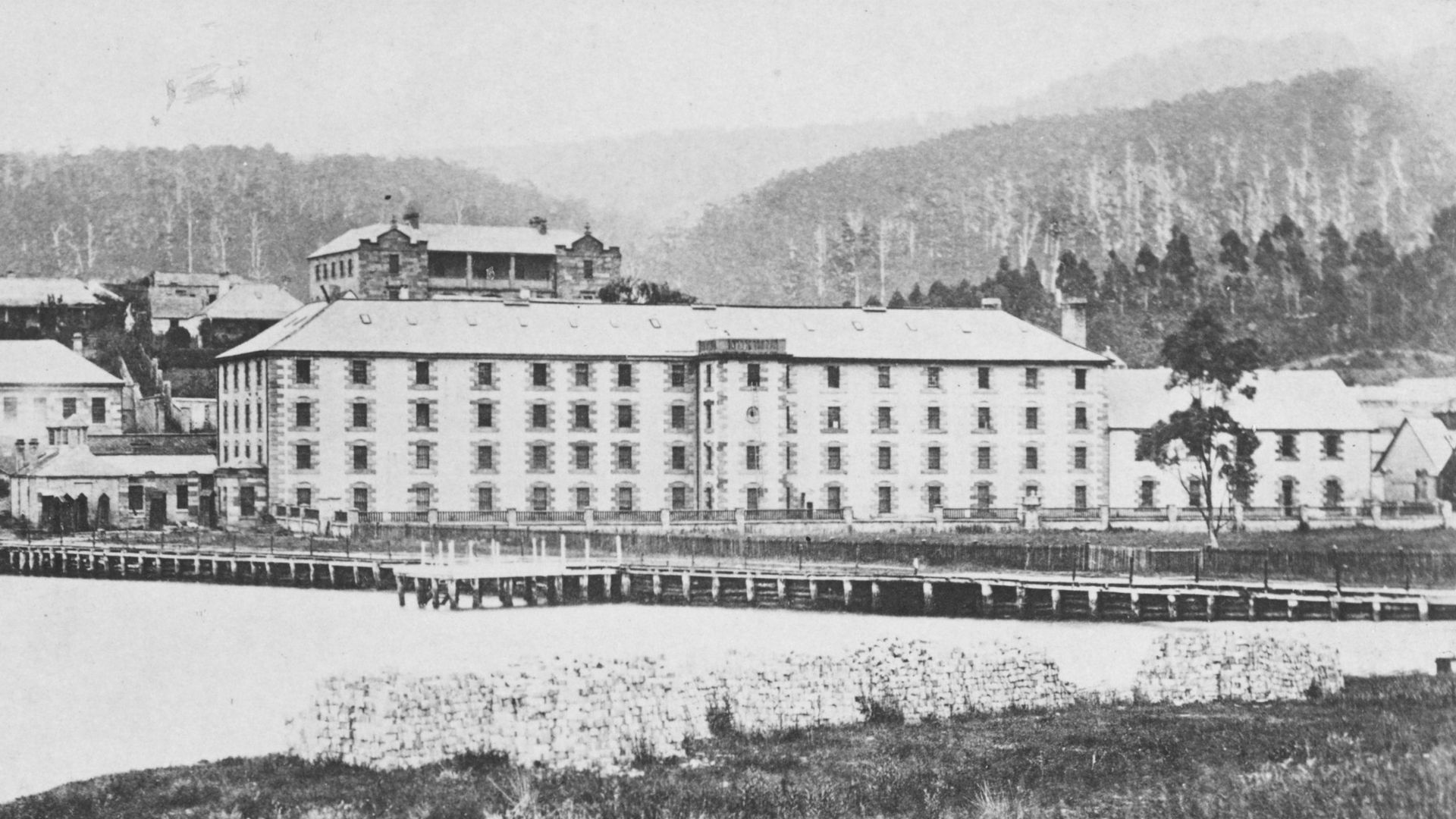
In 1874, following his work at the Queen’s Asylum for Orphans, Coverdale was appointed medical officer and civil commandant of the Port Arthur penal settlement, succeeding a long line of military and civilian officers.
By this stage, Port Arthur was no longer the bustling penal settlement it had once been. It had entered its ‘welfare phase’ a few years earlier and mainly housed elderly, infirm, or mentally ill prisoners. In fact, the colonial government had already decided to close the settlement when it appointed Coverdale as its medical officer and commandant, so he was tasked with winding the settlement down as economically as possible and overseeing the transfer of prisoners to Hobart. He carried out these responsibilities efficiently and earned the nickname ‘Black Jack’ because of his dark hair and beard.
The last group of convicts was removed by ship in September 1877, marking the end of Port Arthur’s nearly half-century as a penal settlement. The site was later subdivided and sold at a series of auctions, and a township called Carnarvon emerged among the convict buildings despite devastating bushfires in 1895 and 1897.
Today, Port Arthur is a UNESCO World Heritage-listed convict site.
Later life and career
Following the closure of Port Arthur, Coverdale became superintendent of the Hospital for the Insane at the Cascades, near the centre of Hobart.
In 1887, after approximately 50 years of public service in Tasmania, Coverdale was asked to retire – and he soon did so. The government awarded him an annual pension of £150, which is equivalent to $33,048 in modern Australian money.
Coverdale spent his retirement in Moonah, where he died on 23 June 1896 at the age of 81. At the time of his death, he was regarded as Tasmania’s oldest medical practitioner, as well as the second-oldest Justice of the Peace.
On the day of his passing, the Launceston Examiner reported:
“As a citizen he enjoyed the esteem of all with whom he was brought in contact, and his kindly manner and medical skill endeared him to his patients. His family are all grown up, and two of his sons hold important executive appointments in the Government service.”
* This was the same day that American forces launched an unsuccessful attempt to retake Fort Mackinac during the War of 1812.
References & bibliography
- ‘Port Arthur’, The Mercury, Wednesday 25 February 1874, page 3
- ‘Port Arthur in its Last Days’, The Mercury, Monday 26 February 1877, pages 2-3
- ‘Port Arthur in its Last Days’, The Mercury, Monday 19 March 1877, pages 3-4
- ‘Obituary: Dr. John Coverdale’, Launceston Examiner, Wednesday 24 June 1896, page 7
- ‘John Coverdale (1814-1896)’ by G. F. Sorell, Australian Dictionary of Biography
- John Coverdale (University of Tasmania)
- Reference to index of obituary of Dr. John Coverdale (1814-1896) (University of Tasmania)
- History Timeline (Port Arthur Historic Site)
- ‘Convict Health at Port Arthur & Tasman Peninsula 1830-1877: The Relationships Between Diet, Work, Medical Care & Health’ (National Parks & Wildlife Service Tasmania)
- Collection X8 – John Coverdale: Obituary (University of Tasmania)
- Convict-Era Port Arthur: Misery of the Deepest Dye by David W. Cameron
- Port Arthur Convicts & Commandants by Walter B. Pridmore
Callum J. Jones is passionate about telling stories. He studied English, History, and Journalism at the University of Tasmania and lived in Western Sydney from 2022 to 2024 while working as a journalist for Professional Planner, a leading online publication for financial planners. Callum has written for Tasmanian Times since 2018 and has also been published in a range of other outlets, including Quadrant and the BAD Western Sydney anthologies.
If you’re interested in this article, please join our mailing list. It’s all free … and we won’t share your information with anyone!
If you have any comments you’d like to add to this article, please contribute via this form. We’re trialling this while we work through replacing our comments section.
Truly independent media is a cornerstone of democracy.
Remember: once they gain power the first action of every despot in modern history is to take control of the media, so please consider supporting us.
Your kids will thank you and so will your Granny, but the aspiring despots won’t…