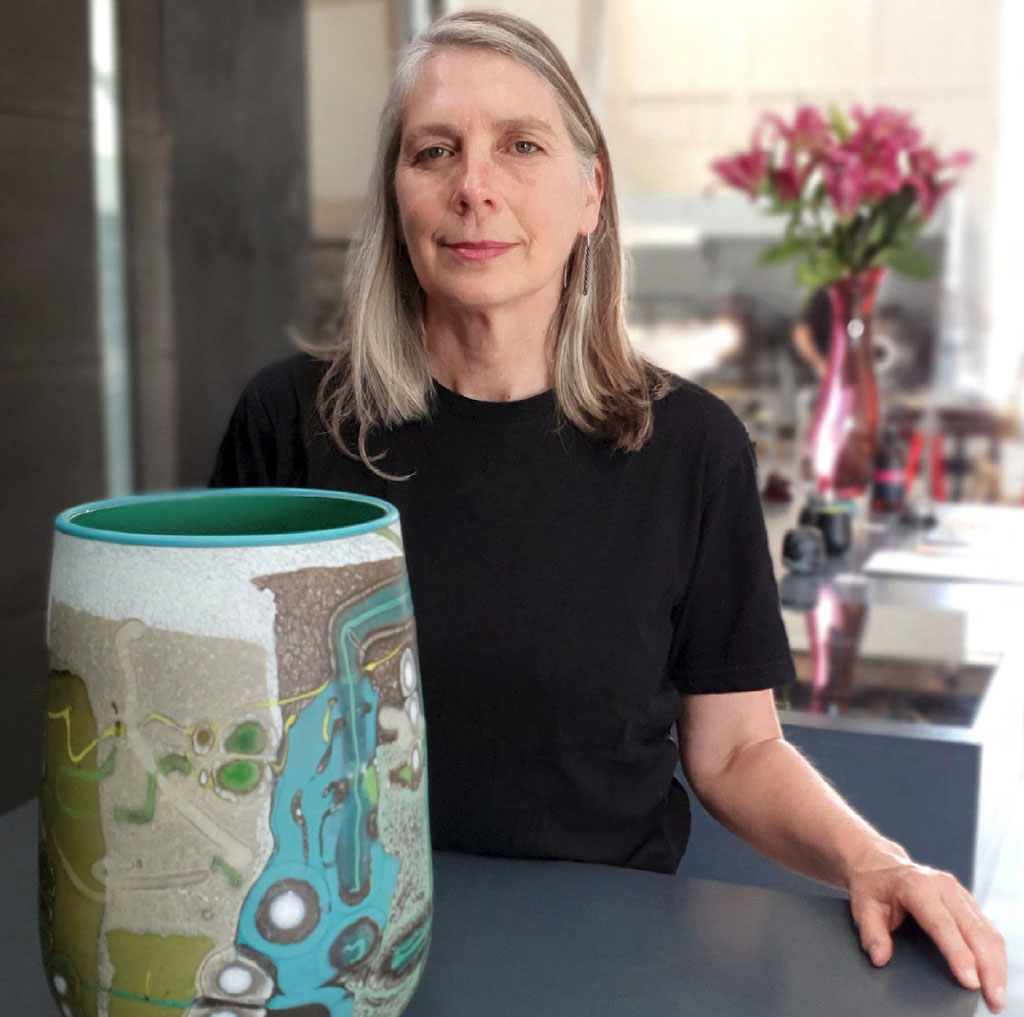
Tasmanian glass artist Anne Clifton is experiencing a landmark year on the international stage, marked by the historic acquisition of her work by the prestigious Victoria and Albert Museum* (V&A) in London.
This significant achievement, coupled with a series of high-profile exhibitions and sales, firmly establishes Clifton as a leading voice in contemporary craft.
In June 2025, Clifton’s ‘Vetrograph: Rubinda’ was acquired by the V&A, the world’s leading museum of art, design, and performance.
‘Rubinda,’ a piece born from her unique fusion of ceramic technology and contemporary glass practice, is now a part of the V&A’s permanent collection. This wasn’t just another acquisition; it was a testament to Anne’s singular vision, marking the first time a contemporary Tasmanian craft object had found its place in the world’s leading art and design museum since the distant 1870s. The quiet diligence of years has culminated in an international milestone, transforming Anne Clifton into the sole contemporary Tasmanian craft practitioner represented in such an esteemed collection.
For those readers interested to learn more about Clifton’s craft, below is her step by step process to create ‘Rubinda’.
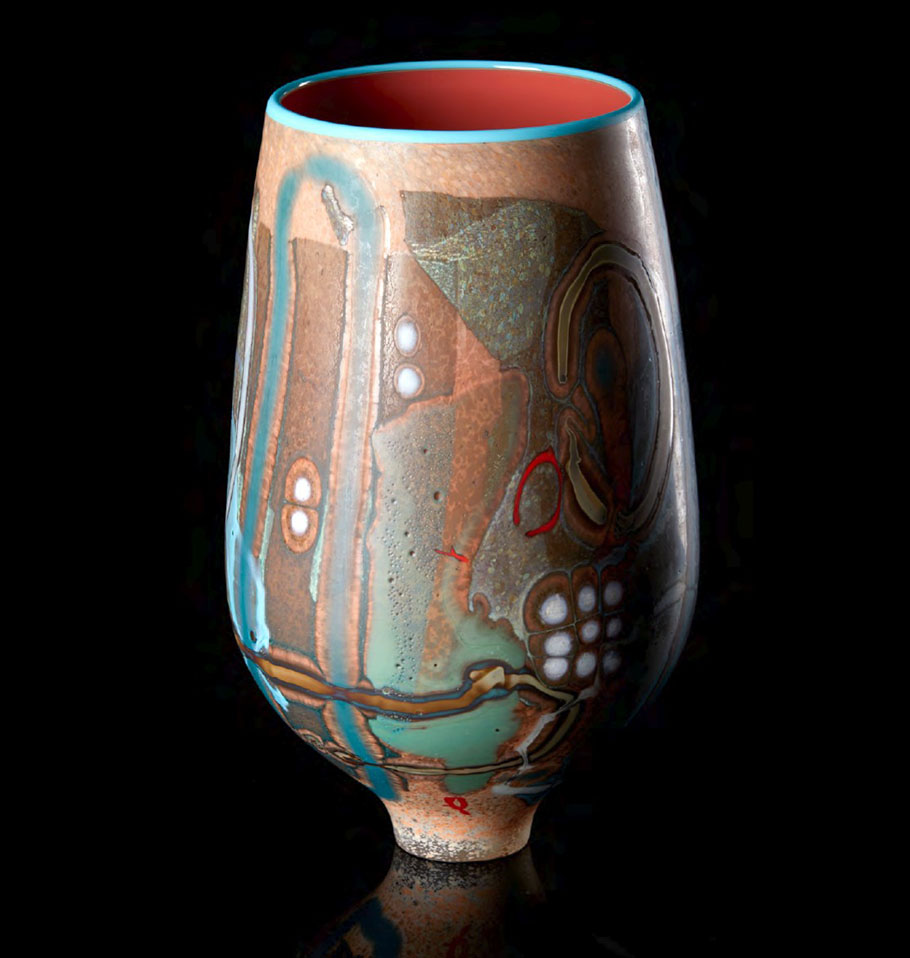
Vetrograph Rubinda
Process
1 Starter bubble
The work is made inside out. A clear ‘gather’ of glass is picked up on the pipe. This forms the basis of the piece, builds bulk and protects that very inside colour from ash. In short, a ‘starter bubble’ is created.
2 Layers of colour
The first layer of colour is placed on top of this clear bubble. This colour is the inside colour (for Vetrograph Rubinda, I used a fleshy colour, as if it were my insides) layered onto this is a ‘support’ colour, sometimes it can be the same as the final colour (as in Rubinda) or one that will light up that final layer.
3 Building bulk
Three gathers of clear glass is then built on top of this to create bulk. Because we are using our biggest blowing iron, the gathers of glass are exponentially larger each time. The final gather causes the total weight of the piece to become 9kgs with the softness adding a torque effect – creating difficulty in manageability of the whole.
4 Applying the outside colour
On this final molten surface we layer powdered opaque glass. We start with rolling through the fine grains and then moving onwards to coarser granules to create pattern. Most pieces have 16 layers of these powdered glasses.
(Conceptual note: I use powdered glass colour rather than solid ‘bar’ colour because of the texture but also because chips and powders are considered student methods of building colour. This work has its genesis about breaking all the self-imposed rules I had about being a glassmaker with 27+ years of experience).
5 Metal leaf applied
On this soft speckled surface I pick up layers of precious metal leafs (my secret is copper leaf on top of silver – the other way around creates gassing and bubbles – so I can do that on purpose if I choose). Because the work is heavy and unmanageable I allow the layers of metal leaf to be picked up in any fashion (later pieces have had the benefit of practice and they do get picked up in a more precise fashion, much to my dismay – but it does make it easier to blow at a later stage).
6 Colour shards applied
From here the skin is allowed to cool – I use a soft torch to heat up the blown shards of glass to create blocks of colour. These are adhered to the surface with heat from the torch. Lately I have been choosing the thinnest of shards so that I can allow the colour to show what is happening underneath it creating ghostly patterns.
7 Stringers used to draw on the surface
On this surface I can bring my library of thinly pulled colours, called stringers, in use. I am using a torch with direct heat applied to the tip of the stringer and the surface of the glass at the same time to ‘draw’ on the surface (it can look like dragging rather than drawing at times). It is hot even with leather gloves on and often the glass stringer breaks and has its own idea of where it is going. I do allow this to happen – because it is happening. Sometimes I set my gloves alight with the radiant temperature of the glass but often the design is more important than mycomfort.
8 Glass is heated up to create movement on the surface
At this stage I do not know how the piece will look so we ‘cook’ it in a prolonged heat to get the different viscosities to create a surface tension that pulls the design apart. I can, but rarely do, add more elements at this stage. So far this has taken 90 – 100 minutes.
9 Blowing starts
Only now do we begin to blow the glass up in stages. We choose to put the surface design on a small initial bubble rather than a blown piece (as some other arts do). The different colours in the work create a technical difficulty; viscosity differences can blow out the piece and it will resemble an oriental goldfish.
10 Working on the other end
The work is transferred onto a punti on a new iron and the colour trail is added to the lip and we are able to inflate it to our desired shape.
11 Cooling
When the piece is finished it is put away on a ‘donut’ shape to hold it upright in a lehr, while it anneals for over 30 hours.
12 Working on the exterior
Once cooled it is then given an archival acid treatment to take the gloss from the surface, giving it the illusion of stone or ceramic material (often the copper comes off completely too – depending on the colour).
13 Finishing touches
The work is then cold worked to flatten and polish the base revealing its ‘glassiness’. When viewed from below, a small window is revealed, serving as confirmation that each Vetrograph is indeed created from glass.
*The Victoria and Albert Museum, often simply called the V&A, began its life with an ambitious vision, sparked by the monumental Great Exhibition of 1851. Prince Albert and Henry Cole, recognizing the need to elevate British industry and design, championed its establishment in 1852 as the Museum of Manufactures.
It was conceived as a ‘schoolroom for everyone,’ a place where designers, manufacturers, and the public could be inspired and educated in the realms of art and science. Over the decades, it evolved, eventually being christened the Victoria and Albert Museum in 1899, a lasting tribute to the royal couple who championed its creation.
Today, the V&A stands as the world’s largest museum of decorative arts and design, a sprawling treasure trove housing over 4.5 million objects. Its vast collections span 5,000 years of human creativity, from ancient artifacts to contemporary masterpieces, encompassing cultures from across the globe. From ceramics and fashion to furniture, glass, and photography, the museum’s holdings are unparalleled.
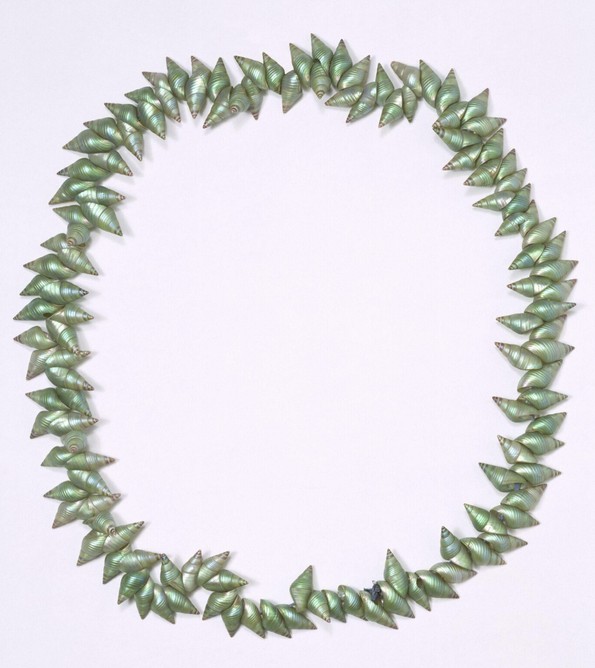 The previous Tasmanian V&A acquisition was this shell necklace along with three loose unpolished shells on 18th December 1876. It was bought from a naturalist agent, called Mr Cutter.
In 2009 necklaces like this one, were listed as a Tasmanian Heritage Icon by the National Trust of Australia. Necklace making remains an unbroken tradition for Tasmanian Aboriginal women.
Shell necklaces were originally made as an adornment, as gifts and tokens of honour, and as objects to be traded with other sea and land peoples for tools or for ochre used in important ceremonies.
Tasmanian Times (TT) is a community-based news and current affairs service covering the island state of Tasmania. It exists to provide a diverse view of Tasmanian issues. TT creates and supports independent media content utilising the best of modern technologies and tried-and-true practices of public-interest journalism.
Support us in expanding our coverage and developing new content by and for Tasmanians.
New initiatives on the way include:
- a weekly podcast covering current affairs
- a revamped website
- a monthly cartoon competition
- a user-friendly app for both Android and Apple devices
- a weekly roundup of key stories