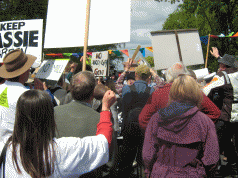
I was one of the participants in the TAP rally at Beaconsfield two Sundays ago. On the street, not in the schoolyard. The media predictably concentrated on those from the new group Pulp The Mill, who had deliberately offered themselves for arrest, and they (the media) almost universally described the whole action as being “just” another anti-mill rally. Which of course it was for many participants, locals whose amenity and livelihood is on the line and for whom the mill is THE issue.
But that wasn’t really why I was there. Not that I like that pulp mill – or any pulp mill. It has been a dominant driver of most of our public woes in Tasmania for years now. But TAP publicity had suggested that the time had come to show more broadly to this Bartlett/Lennon government (and whoever are the real power brokers behind it) that many of the people are UTTERLY SICK of them. Sick of virtually everything they do and have done. And absolutely convinced that nothing they might do in the future has any chance of being any better.
From the TCC scandal, to Kons lying to Parliament, to the giving to Federal Hotels a 20-year monopoly on poker machines for free. The botching of changes to senior secondary education, and toughing it out pretending that it’s all good. The parlous state of the health system, and all the money and time wasted on planning a grandiose hospital in the wrong place, since scrapped. An infrastructure Minister who doesn’t bother applying for available federal funding. Huge new water bills. A grandiose “food bowl” irrigation scheme – on naturally dry land subject to salinity problems – while the best food growing land keeps on going under weedy little trees. The line in the sand which washed away. Kow-towing to everything Forestry. The continued trashing of our iconic forest ecosystems. The environment department abolished. Concessions to “corporate bookmakers” to make Tasmania the gambling capital of the world – a useless parasitic industry, and not even a return to the people via taxes.
But more than anything, allowing Gunns to withdraw from the above-board RPDC assessment process, and gifting them that iniquitous PMAA, drafted by with and for them, and its hideously unfair section 11 – which would be unconstitutional if it were in the federal jurisdiction.
In my little 2 minutes on the soapbox I cited Peter Henning’s warning recently on TT that the PMAA was the “prototype” – who knows what sort of legislation might find its way onto the books now they have become so emboldened. Maybe we are starting to see it in Planning Directive no 2. This government rules arbitrarily, just like a military junta.
We are sick of them. Absolutely. The days of seeking an audience with a minister to put our concerns are over. It doesn’t work. And here they were seeking to have a chat with the “community”. The arrogant swine. The big sign on the truck at Beaky said it best – “You take away our rights, and then you pretend to listen”. All that we have left is to try to throw them out at the next election, and meanwhile make sure they know how much we DESPISE them. We have no quarrel with the forms of Australian parliamentary democracy, but we have plenty with the kinds of perversion some of the incumbents have brought to it.
Which brings me to the pots and pans. It was a great display. The way the noise intensified as each minister arrived, cowering in his or her limousine with its tinted windows wound shut. So darkened I couldn’t tell which one was Sturges, let alone tell if he gave anyone the finger or not. But I bet each one heard that hideous “music” and felt a little sinking feeling in the descending colon. Representative democracy may be mortally wounded in Tasmania, but the expression of the people’s feeling that day, via the bang! bang! crash! was quite unequivocal!
As an inveterate cheapskate, I used an empty paint tin. I didn’t want to dent a decent stew pot. Nor did I want to have it confiscated in the event Bartlett might have panicked and ordered some overly picky police behaviour. But at least I hit it with a genuine kitchen wooden spoon. Maybe next time I will be a bit more genuine.
I got to thinking – this is such an excellent form of expression, it surely must have a long history of being used against abhorrent governments around the world. Maybe it goes back to the Corn Laws in England 1815-49, or even to Wat Tyler and the Peasants’ Revolt of 1381. Or the French Revolution. After all, the tools of the trade are available to everyone. Even the poorest housewife can find a pan and a spoon.
Most of the references I could find by Googling “pots and pans” + “government” are much more modern. But there are certainly a lot of them! Not many in English-speaking countries, I might say. Surely we are not inhibited, are we, by some streak in our makeup which asserts that the landed gentry and the moneyed movers and shakers really are our superiors and deserve our respect no matter how unjustly they behave? I do hope not.
Several of the best-known pots-and-pans exercises occurred when people were at the end of their tether. And often corruption was at the root of it. They didn’t any longer want consultation with their oppressors. Nothing short of resignation of the main players was enough.
Argentina – December 2001. After a worsening economic crisis involving bribes, frenetic privatisation, the economics minister forcing wave after wave of IMF structural adjustment on an unwilling people and a universal freeze of bank accounts, people power (symbolised by the banging of pots and pans) forced the resignation of the economy minister and the president, and secured an announcement by a new president that the country would default on its foreign debt.
In Ecuador in 2005, President Gutierrez (initially popular as an anti-neo-liberal reformer) went to meet George Dubya Bush and came back proclaiming a free trade agreement with the US and big concessions for the petroleum companies. By April 20, a pot-clanging multitude had forced his resignation and he fled by helicopter.
Pot-clanging was a feature of the “revolt of the hungry” in Bulgaria in 1997, and pot-clanging protests at 3pm on successive days were used in the former Yugoslavia in 1996 and 1997, after the government of Slobodan Milosevic had annulled the results of elections in which the opposition had won majorities in most cities. Over 200, 000 marched repeatedly in Belgrade, in a non-violent, good-humoured but determined protest.
It isn’t only the downtrodden who resort to the form. In Salvador Allende’s Chile of 1971, harassed unrelentingly by the CIA and the government of US president Nixon, hyperinflation and gross shortages of goods plagued the middle classes. Housewives were readily mobilised by the right wing to protest with their utensils in order to destabilise the government.
In early 2003, 90% of Spaniards were opposed to a war in Iraq, but their Prime Minister Jose Maria Aznar was one of the most ardent supporters of the “coalition of the willing”. Both Madrid and Barcelona were alive with protesters banging pots and pans from upstairs windows. We in Australia were unduly well-behaved towards GWB’s other slavish supporter as he prepared to invade Iraq – John Howard. But 400 New Zealanders gave him a serve – complete with banging of pots and pans (and the burning of an Australian flag) outside the Parliament in Wellington on the last day of his visit.
And just this year there is Iceland, where in an event dubbed “the kitchenware revolution” the people succeeded in removing the government who had aided and abetted the Viking cowboy bankers in running up a debt that will take Icelandic taxpayers generations to repay.
Cacerolazo
The Spanish speakers, and the Argentinians in particular, have a very nice word to describe the banging of pots as a protest action – cacerolazo.
At first I thought of it as “Kakker-o-larzo” and considered it a wonderfully onomatopoeic word which really caught the spirit of the atrocious din we made at Beaconsfield. Something like “cacophony”, maybe, but less academic and more street-grounded. But reflecting back on my adult-ed Spanish of a few years ago I realised that the letter c in Spanish has the soft pronunciation when it occurs before e or i – so the word would be pronounced as “Kassero-larzo”, and in fact comes from cacerola, a saucepan (or casserole if you like), and azotar, to beat or to whip.
Cacerolazo is seriously big in Argentina, and seems to be the preferred technique to adopt when it comes to public protest. Check out www.cacerolazo.com , a site listing no fewer than 580 separate protest actions, variously described as compleja (finished), intensa (intense) and candente (red-hot). You can download a 30 second sample of the sound made by the beating of large numbers of pots, as an mp3 file.
As you might expect from those artistic Latinos, the sound is rather more musical than the one we made at Beaky – faster in tempo, and quite high-pitched and almost bell-like, as though they choose rather small saucepans and use metal spoons as drumsticks. I don’t think my empty paint tin would cut the mostaza in beautiful downtown Buenos Aires.
As to whether a horrible dissonant cacophony might better express the sense of utter derision for the characters who are the object of our feelings, I don’t know. I suppose I do tend to think so, but then again I’d have to be wary about asserting that millions of passionate Argentinians could be wrong! What’s going to happen anyway is that individuals will express themselves in the way that fits them and their culture best.
When, where, for how long and how often should we practice our own pan-bashing in Tasmania? We should certainly do so if “they” are arrogant enough to suggest another cynical “community consultation”. They had better know that each time they will need to bring their ear-plugs.
But one of the not-so-good aspects of the Beaconsfield action was that directly across the street from the school was a row of ordinary houses, with real people in them. After tolerating us for upwards of two hours someone made representations to the organiser that maybe enough was enough. Forcing non-target people to put up with it for too long is definitely a no-no. I did apologise to one woman resident afterwards for all the noise. It turned out that she had her own bones to pick over some aspects of government policy – so maybe she might take up cacerolazo herself some day!
I do suggest that, except when it might be done in conjunction with a major street march or something, that this sort of action is kept to 10 or 15 minutes. It’s enough to make a splash, but not enough to cause a serious nuisance to innocent locals. And maybe it’s short enough that the participants can melt away before the police get interested!
The lack of duration could be made up for by doing it frequently. Perhaps 10 minutes on a certain city street corner one day, and 10 on another corner tomorrow. With one sign reading “corrupt government” or the like. It could really make an impression on city workers who may be lagging behind a little in the realisation of what our elected “representatives” are really doing to them. And little actions like this only need a few people. Perhaps we should have a roster! The mainstream media might even pay some attention to this novel phenomenon, particularly if they didn’t have to go any further than out their own doors! How about synchronised actions at 1 pm around the state?
Of course some will object that pot-banging will never take off anywhere in Australia, most people are far too apathetic. And while this is a valid criticism, it is also amazing how infectious this action really is. An anti-corruption drive in Turkey (1997), which started with people turning their lights out at 9pm each night – not horribly exciting – began to include also the banging of pans at the windows, and eventually there were thirteen million participants!
In Tasmania the impact – and the communication of outright derision – will be most effective if the bods in the government are made to hear it themselves. The more frequent those feelings in the descending colon, the less they will be able to concentrate on their nefarious agenda. So lie in wait for them. As in, “there’s Llewellyn coming down to get into his limo – quick, cacerolazo”! Or, “hey look, it’s Aird. He’s going to sneak in the door at the Lego end. Quick, cacerolazo!”
Surely it’s time to give the pots and pans art form a bit of play in Tasmania. “They” can always legislate for multi-thousand dollar penalties for the act of touching spoon to pot in a public street, but let’s cross that bridge when we come to it. And how silly would they look!