he fantasy that our rampant forestry industries will be happy to convert to plantations was promoted by academic Judith Ajani in her book ‘Forest Wars’. As with so many academic ideas, the theory sounds fine – it’s reality that gets in the way.
In the real world, uneconomic, unsustainable enterprises can only survive when in receipt of large taxpayer subsidies. Gunns gets over $200 million per year in cheap or free resources and cash grants. Even with those payments their ‘sustainable’ operations only returned a profit of $55 million last year.
Who couldn’t take $200 million worth of resources and return $55 million in ‘profits’?
The result of this stupidity is to lose our land and resources to overseas interests –
Some 92,000ha of Timbercorp forestry land has been sold to US funds manager Global Forest Partners for just $345 million, or $3750/ha. Tens of thousands of hectares of those timber crops are almost ready for harvest, which inflates the asset’s real value… Timbercorp is still to sell 4000ha of almonds, 1300ha of citrus, 5177ha of olives and 412ha of table grapes, plus associated water. Great Southern must sell 240,000ha of forestry land; 6200ha of horticulture projects including winegrapes and water, and 1.5 million ha of cattle properties. WeeklyTimesNow here:
That’s over 1,800,000 ha of land up for cheap sale to foreign corporations – equivalent to 18,000 sq kms of Australia, much of it valued farmland.
Can ordinary farmers get in on the deal?
Nationals Senate leader Barnaby Joyce said the tax advantage MIS had received had been handed to foreign companies. That advantage excluded family farmers from buying the failed MIS assets because the size and price of the properties ruled them out, he said. WeeklyTimesNow here:
WilSoc failure
If we explore the evidence in Tasmania’s wilderness areas, we note that forestry interests have never been more powerful.
Today they are threatening to control forestry roads here: that have been created and maintained at public expense, a publicly funded road is to be put through the Tarkine here: wilderness to please Forestry Tasmania, and the Florentine is being logged .
This evidence shows that no matter what their claimed intentions, environmental organizations like the Wilderness Society (WilSoc) have failed to protect our forests which is their main mission in life.
They may have slowed the rate of destruction by some increment, but overall their performance could be described as a fighting retreat although it’s starting to look more and more like a series of negotiated surrenders.
It’s a victory for the forces of self interest over naïve dreams and New Ageism.
I really feel for WilSoc members who genuinely hope that their subscriptions will somehow lead to the protection of our wilderness areas.
Instead of effective protection of our forests, WilSoc is putting out false messages in an attempt to support plantation development and the establishment of a totally chlorine free (TCF) pulp mill. Why?
WilSoc’s spokesperson says –
With the right political leadership, the divisions over forestry that have been the hallmark of Tasmanian society for years could be healed. TasmanianTimes here:
Right. Robin Gray sits down to break bread with Vica Bailey over a glass of bubbly.
Dogs and cats, living together in peace and harmony…another toke anyone?
The Wilderness Society believes that a transition away from logging native forests and into reliance on existing plantations is possible with minimal disruption and massive environmental, social and economic benefits. TasmanianTimes here:
Have these people ever left Hobart and looked at the plantations? They’re fencepoles! What planet are these people living on?
Here are 3 solid reasons that this is all fantasy.
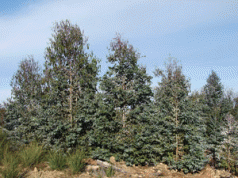
Our plantations are bug riddled, fast growing E. Nitens softwood suitable only for pulping
It’s uneconomic – forestry can buy public timber $20 cheaper per tonne than plantation wood
WilSoc cannot enforce any agreements – forestry can ‘have it all’ and there’s nothing WilSoc can do.
Here’s what WilSoc has to say –
Existing plantations, while needing significant improvement, give Tasmania the opportunity to move beyond the decades long conflict over native-forest logging, to protect our forests for the climate, water and biodiversity values they provide and to establish much needed stability in the timber industry by creating resource security and a social license. TasmanianTimes here:
Resource security – with bug riddled E. Nitens gateposts?
And what about the future when our exhausted soils cannot support a second crop of junk pulp wood?
Plus why do these dreamers imagine that forestry will give up its $200 million annual subsidies to keep removing our forests?
Why would forestry want what these people are offering?
Answer – they don’t.
They want to own Tasmania’s farmland at our expense AND control the forests and they’re close to getting both!
They can have it all – we get nix.
Of course, they do want the public to perceive that forestry is gaining the support of environmental groups – witness Gunns Green Book for example.
The world’s a stage
In today’s Australia, it isn’t the people whose voice is heard by governments. It is the voice of organizations – political parties, representative organizations and environmental groups.
Any reader of these pages knows that both Liberal and Labor parties (LibLabs) rely upon corporations for their funding. In addition, corporations provide a career path for politicians and bureaucrats who are ‘reliable’. Of course they need ‘flexible’ beliefs so that they can engage in fast turnarounds to accommodate new circumstances. For evidence of this we need only to look at Brendan Nelson’s flip from Liberal believer to Labor representative, or Peter Garrett’s justifications for his new role in development approvals.
Unfortunately supposedly ‘independent’ organizations like WilSoc are effectively supporting the various ‘cozy arrangements’ that are resulting in the foreign control of our resources, the constant plundering of the public purse and the rising dominance of forestry interests.
WilSoc requires funding and regular subscribers have no protection from WilSoc suiting its policies and priorities to undisclosed donors.
There’s a difference between intention and ability
I’ve listened to many of WilSoc’s supporters and I don’t doubt their sincerity or their intentions. I have no argument with them.
I do seriously doubt WilSoc’s competence, experience and judgement – and I do so on the basis of the evidence.
Look at the recent nonsense when WilSoc lifted the skirts and showed us that they supported a ‘jobs rich plantation forestry industry’ and Gunns operating a pulp mill.
When challenged they fluttered around like startled chooks putting up every kind of excuse coupled with constant retreads of forest industry fallacious claims.
Fallacy #1 – For years the forestry industry has been pushing the fantasy that monoculture plantations are like forests. Now WilSoc has added credence to this by describing a ‘jobs rich plantation forestry industry’.
Inconvenient Fact – forests are complex multi-cultures that are self sustaining. Plantations are NOT forests.
Fallacy #2 – Existing plantations can replace forests for timber to correct import imbalances.
Inconvenient Fact – Most tree plantations in Tasmania are insect riddled Nitens that are near useless for timber and can only be used for pulp. Useful timber takes many decades to grow and cannot be produced in the 10 -15 year cycles proposed for plantations.
Fallacy #3 – Existing plantations… give Tasmania the opportunity to move beyond the decades long conflict over native-forest logging, to protect our forests.
Inconvenient Fact – totally the wrong timber and not enough of it even to feed Gunns proposed pulp mill.
There’s plenty more but I’ll rather save it for later.
Look at the facts.
It’s time for the dreamers to put down their pipes, take deep breaths of real air and recognize that they are being manipulated to support forest industry growth.
To remain faithful to their members WilSoc should focus its energies on protecting our remaining wilderness areas instead of using fallacious messages to push plantations and pulp mills.
They could work to remove the subsidies that are making ‘industrial forestry’ possible.
And what about this from WilSoc –
Protecting native forests is the fastest, cheapest and easiest way to address climate change. TasmanianTimes here:
If this were true, how is it possible that the climate has been getting worse while we’ve had all that native forest growing?
It’s time for WilSoc to wake up, grow up and open their eyes.
Until they do, their naïve support of failed policies is simply adding to the threats to us all and diverting them from their claimed role – protecting our wilderness areas.
Submitted by L. Richards
Totally Against Plantations