
A new interactive exhibition at the Port Arthur Historic Site, Little Depraved Felons, explores the history of Point Puer – the first purpose-built juvenile prison in the British Empire.
Established in 1834 across the bay from Port Arthur, Point Puer was designed to separate juvenile convicts (who were all boys) from the influence of the adult convicts and reform them through discipline, religious instruction, basic schooling, and trade training. In practice, conditions were harsh and tightly controlled. Although the decision to close Point Puer was made in 1844 due to declining numbers and changing social and legal attitudes in Britain, it was not officially shut down until March 1849. Around 200 boys who were still there were transferred elsewhere. Nature has since reclaimed the site.
More than 2,000 boys passed through Point Puer during its operation. Approximately 87 per cent were convicted of theft, while violent crime and arson accounted for less than three per cent of sentences. Most boys were transported for seven, 10, or 14 years, though some received life sentences. Many had prior offences, typically for minor offences. Their experiences reflected the harsh realities of poverty and a justice system that treated children very differently from today – where even young children from poor families were expected to ‘earn their keep’.
Little Depraved Felons focuses on the stories of three of the boys who passed through Point Puer:
- William Timothy Driscoll was 14 years old when he arrived in Van Diemen’s Land in 1835. He had been transported for stealing a book from another child, and had previously been charged with stealing a handkerchief. While at Point Puer, Driscoll was punished 26 times for offences including absconding, insolence, and violence. His punishments included eight beatings (totalling 182 ‘stripes’) and 16 periods of solitary confinement amounting to 156 days. He was also frequently assigned to hard labour, working as a top sawyer at the Point Puer sawpits. Later in life, Driscoll briefly became a bushranger before being captured and sent to Norfolk Island. He soon transferred to Port Arthur, where he spent time in the Separate Prison. In 1856, he was charged with assault and narrowly avoided the death penalty, instead being returned to Port Arthur. In 1857, at the age of 36, he was granted a Ticket of Leave and appeared to stabilise his life. He married Rebecca Robertson, a free woman, and they had at least one child together. After being fined for public drunkenness in 1858, Driscoll disappears from the historical record.
- William Pearson was 12-years-old when he arrived in Van Diemen’s Land in 1837, having been sentenced to seven years’ transportation for shopbreaking and stealing knives. He already had 24 prior convictions, had spent three years in gaol, and had also been flogged on several occasions. At Point Puer, Pearson became one of its most heavily punished boys, receiving 94 recorded punishments. These included multiple ‘stripes’ across the breech, 144 days in solitary confinement, and frequent time in chains. His offences included assault, absconding, refusing to work, stealing rations, and destroying government property. Pearson was eventually transferred to Port Arthur, where he continued to offend and be punished. He was sentenced to death after attacking a constable, but this was commuted to transportation for life on Norfolk Island. While he was there, Pearson took part in a violent riot involving around 60 convicts, during which four officers were killed. He was later found with blood on his clothing, charged with murder, and executed by hanging. He was 22-years-old.
- Humphrey Sherriff was 16-years-old upon arrival in Van Diemen’s Land in 1841. He had been sentenced to 10 years’ transportation after a fifth conviction for theft. Unlike many other boys of his age, Sheriff was literate – an uncommon skill that likely saw him helping teach the other boys during their school time. He would spend three and a half years at Point Puer, working at his assigned trade of coopering and keeping out of trouble – or at least not getting caught. When he left at age 19, he was assigned to work on a farm in Hamilton, where he was described as “troublesome and indifferent”. He was caught absconding from his accommodation, which earned him one month in chains on a road gang. Later, he was sentenced to eight months of hard labour in the Tasman Peninsula coal mines for receiving stolen goods. Despite this, Sherrif also showed moments of initiative. While working at the Hamilton farm, he helped put out a nearby fire. For this act, he received a formal commendation and had three months struck off his sentence. He received a Ticket of Leave in May 1849, aged 24, and settled near Deloraine, where he worked as a farmer. He later married twice and had 19 children. In 1852, he briefly visited the Victorian goldfields with his brothers, both former convicts as well. Aside from two minor instances of not paying railway fares, Sheriff lived a largely stable adult life and became a respected member of his community in later years.
How young is too young?
Many people feel sympathy for the boys at Point Puer, but youth breaking the law and being ‘locked up’ is not just something from the past – it still happens today.
Little Depraved Felons encourages visitors to reflect on whether the age of criminal responsibility should be changed.
In the 19th century, when Point Puer was operating, children as young as 10 could be held criminally responsible. The legal rule of doli incapax applied: children under seven were considered incapable of understanding right from wrong, while those aged seven to 10 were presumed incapable unless the prosecution could prove they understood their actions were seriously wrong. From the age of 10, children were treated as criminally responsible in the same way as adults within the justice system.
Today, international guidance from the United Nations recommends a minimum age of criminal responsibility of 14. In Australia, however, the age of criminal responsibility is generally set at 10. Children under 10 cannot be charged with a crime, while those aged 10 to 13 are presumed not to be criminally responsible unless the prosecution can rebut the presumption of doli incapax. Individuals are fully criminally responsible from the age of 14, although most young people are usually processed through youth justice systems until they turn 18.
In recent times, there has been ongoing debate about whether Australia should raise the age of criminal responsibility. This has been shaped in part by the overrepresentation of First Nations children in youth justice systems, as well as broader concerns about child development and incarceration outcomes. As a result, some states and territories have already begun adjusting their laws.
The Australian Capital Territory raised the age to 12 and then to 14, with exceptions for some serious offences. Victoria was going to raise the age to 14 as well, but later revised its position and only raised it to 12. The Northern Territory also raised the age to 12, but later lowered it back to 10 due to political pressure regarding youth crime. Several other states, including Tasmania, still retain 10 as the formal age of criminal responsibility.
In Tasmania, youth justice reform has been discussed in recent years. In 2022, the state government announced it would raise the minimum age of detention to 14, while maintaining the age of criminal responsibility at 10.
Supporters of raising the age argue that children’s brains are still developing, that early criminalising can increase trauma and future offending, and that prevention and support services are more effective than detention.
Opponents argue that raising the age will reduce accountability, may limit the justice system’s ability to respond to serious offending by younger people, and could leave safety gaps in community responses.
Some also support ‘Adult Crime, Adult Time’ approaches, arguing that serious violent offences committed by young people should face adult-level penalties. Queensland is currently the only state to have introduced such laws, with reforms beginning in 2024 and expanding in 2025.
What do you think? How young is too young?
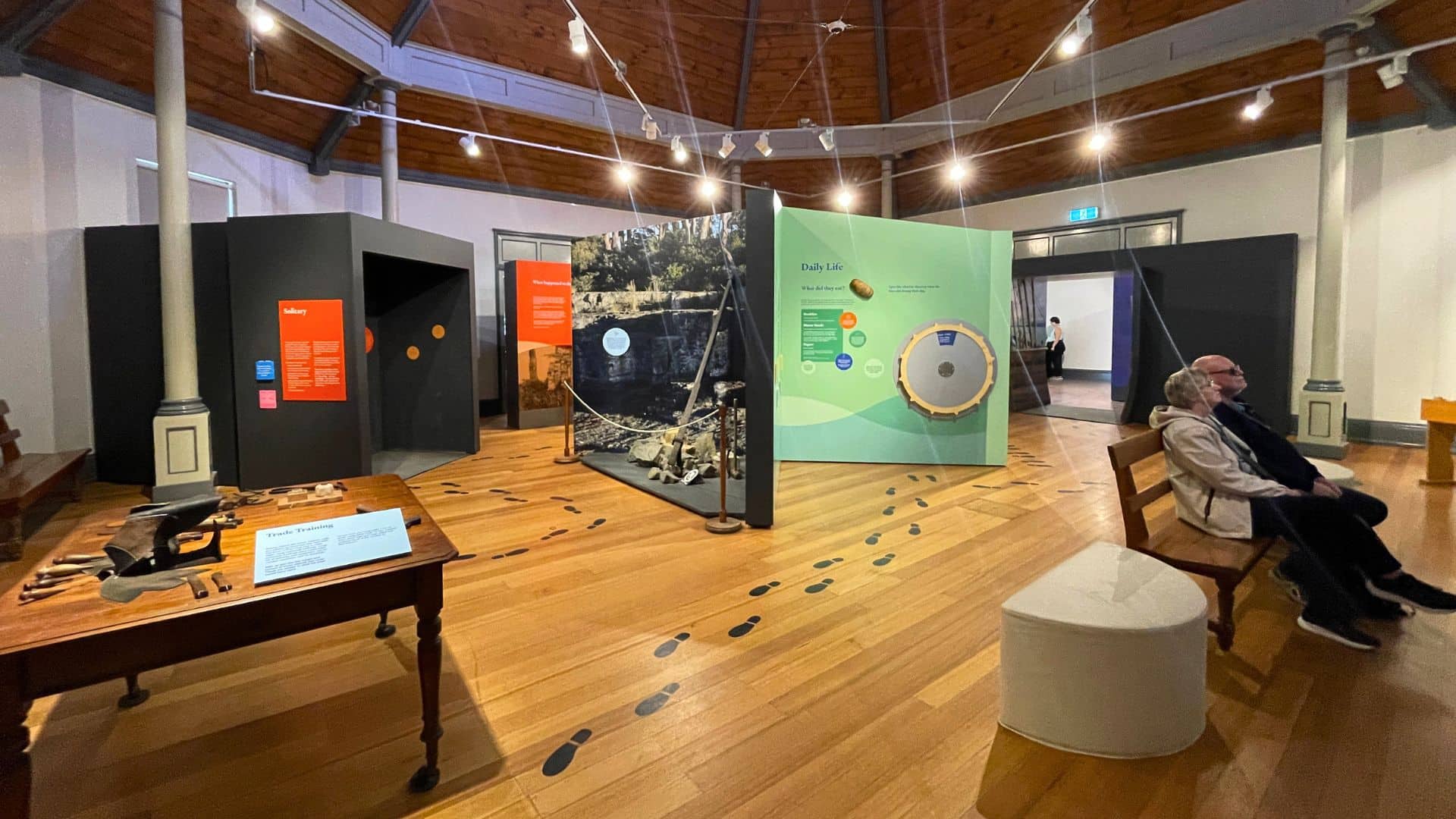
The Little Depraved Felons exhibition.
References & Bibliography
- Convict-Era Port Arthur: Misery of the Deepest Dye by David W. Cameron
- Port Arthur: Convicts & Commandants by Walter B. Pridmore
- The minimum age of criminal responsibility in Australia (Australian Institute of Family Studies)
- The age of criminal responsibility (Australian Institute of Criminology)
- Children’s rights (Australian Human Rights Commission)
- ‘Betrayal’: Indigenous and legal groups condemn Victoria’s backflip on raising the age (The Guardian)
- Northern Territory defies ‘do-gooders down south’ on age of criminal responsibility (The Guardian)
- Age of Criminal Liability in Tasmania (Go To Court)
- Explainer: Raising the age (Human Rights Law Centre)
Callum J. Jones studied English, History, and Journalism at the University of Tasmania. He lived in Western Sydney from 2022 to 2024 while working as a journalist for Professional Planner, a leading online publication for financial planners. He has written for Tasmanian Times since 2018 and has also been published in a range of other outlets, including Quadrant and the BAD Western Sydney anthologies.