Article
Renters Struggle Amid Deepening Housing Crisis

This collection of media releases, spanning November 29 to December 11, 2025, from The Greens, Labor, Super Consumers Australia, Short Term Accommodation Association Australia (STAAA), TASCOSS and Shelter Tasmania, reveals a multi-faceted and worsening housing crisis in Tasmania.
The releases cover escalating rents, delays in government housing projects, the financial catastrophe facing retired renters and the need for urgent reform and support services. The compiled content offers diverse perspectives on the crisis and its impacts on various segments of the community.


Media release – Vica Bayley MHA, Greens Acting Leader, 11 December 2025
Data Shows Renters Still Struggling
New TasCOSS and TUT State of Housing Dashboard data shows that things are only getting harder for Tasmanian renters.
In the last year, Hobart rents have gone up more than any other capital city, bar one – 6% for homes, and 11% for units.
The proportion of Tasmanians who rent from private landlords increased by 50% over the last 20 years, with the number of Tasmanians renting from the state housing authority almost halving.
It’s becoming impossible to find an affordable place to live in this state.
The price of everything from groceries to rent just keeps going up, and Tasmanians are really doing it tough.
This could have been avoided, but the Liberals simply haven’t done enough on housing over the last decade.
While rents have gone through the roof, the Liberal Government haven’t improved renters’ rights to fair and affordable leases, built enough public homes or reined in short stay.
Despite this, the Liberals are putting social housing on the stadium chopping block, with promises to reduce government business debt to fund the stadium.
This simply demonstrates that they are so out of touch with everyday Tasmanians.
Tasmania has some of the weakest rental laws in the country.
While the Liberal Government’s review of the Residential Tenancy Act is welcome, it must not be used to kick much-needed reform for renters down the road.
The experts and advocates have been clear on what needs to be done.
Tasmanian renters need real rights now.
We must stop unreasonable rent increases, end unfair evictions at the end of leases and ensure minimum energy efficiency standards.
Action from the Liberal Government is long overdue.


Media release – Tasmanian Council of Social Service (TasCOSS), 11 December 2025
Tasmanian renters are among the most exposed in the country due to a lack of rental rights and protections, new data shows.
TasCOSS, in collaboration with Tenants’ Union of Tasmania, has released new rental reform indicators on the Tasmania’s State of Housing Dashboard, which underscores the uphill plight facing Tasmanian renters who, despite growing in numbers, continue to be let down by inadequate government protections and regulations.
The Dashboard shows the proportion of Tasmania’s population who rent from private landlords has increased by 50% in the past 20 years. Adding to the challenge of finding and maintaining a home, rental costs in Hobart are swelling at a greater rate than all other Australian capital cities bar Perth over the past 12 months, with houses and units up 6% and 11% respectively.
TasCOSS CEO, Adrienne Picone, said there is approximately 58,000 rental households across Tasmania.
“With home ownership now out of reach of many, the number of long-term — and in growing cases lifelong — renters is increasing,” Picone said.
“The quality of the rental experience is arguably more important than ever, and it is imperative steps are taken to rebalance the power dynamic between tenants and landlords to make renting a more attractive proposition.
“As called for in TasCOSS’s 2026/27 Pre-Budget Submission: ‘Nowhere to Go:’ Fixing Tasmania’s Broken Housing System, a critical way to do this is to ensure adequate rental protections and rights are in place which increase security of tenure and ensure minimum housing standards.”
Tenants’ Union of Tasmania Acting Principal Solicitor, Alex Bomford, said Tasmania’s extremely low rental vacancy rates means tenants are uniquely vulnerable to unfair or even exploitative treatment by landlords.
“This makes stronger legal protections for tenants even more vital,” Bomford said.
“Despite recent legislative attention, Tasmania is lagging on rental reform, which is leaving Tasmanian renters vulnerable to arbitrary eviction, substandard housing conditions and unpredictable housing costs.
“The upcoming review of the Residential Tenancy Act 1997, which is due to commence in early 2026, presents a critical opportunity for the Tasmanian Government and the Parliament to commit to providing better protections and rights for Tasmanian renters, especially in relation to no-grounds evictions and rental increases.
“Access to legal services for renters also remains an ongoing concern. Funding for the Tenants’ Union office in Launceston is ad-hoc and uncertain, and we have no permanent presence on the North-West. This compromises our ability to assist the thousands of rental households in the northern half of the state.
“In order to be able to properly provide essential legal services to all Tasmanian tenants, and attract and retain quality staff, we require long-term and secure funding.”
Rental Reform Snapshot:
The average length of time for median income earners in Australia to save a 20% deposit to buy a home was 10.6 years in 2024, a near record-high.
In the past 12 months, Hobart’s rent prices for both houses and units have continued to increase (by 6% and 11% respectively), which is a faster growth rate than all other capital cities other than Perth.
Victoria and the Australian Capital Territory have the strongest tenant protections in Australia, as well as the most affordable rents. In comparison with other jurisdictions, Tasmania has made some recent improvements to key rental protections and rights, but evictions at the end of fixed terms (with no specific reason) are still allowed.

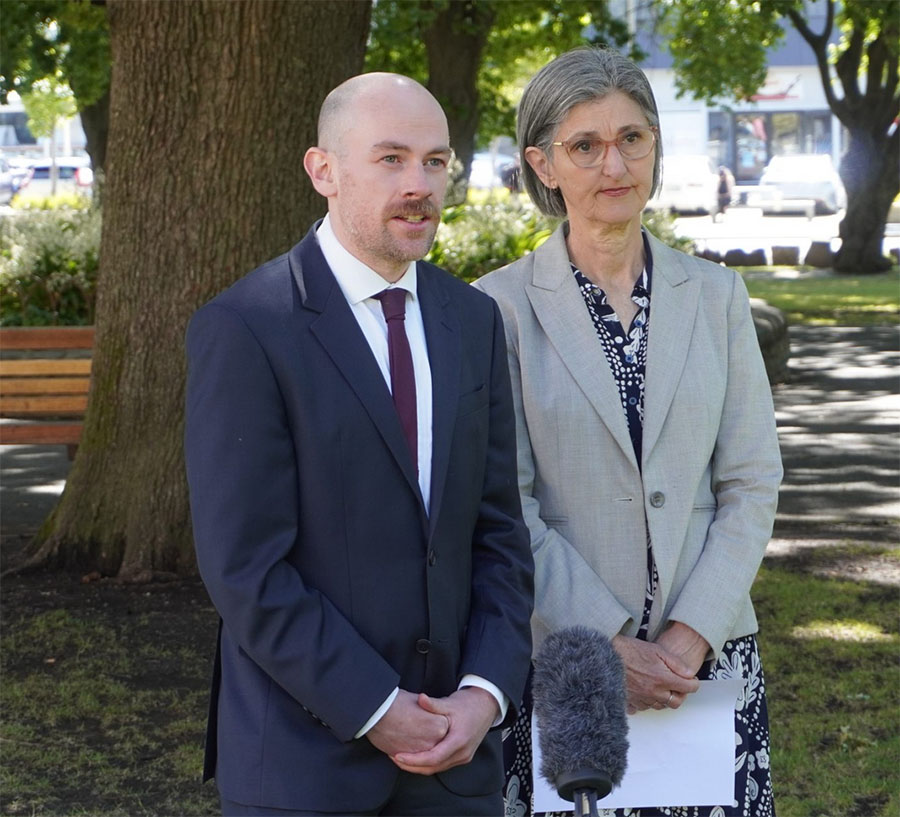
TasCOSS CEO, Adrienne Picone and Tenants’ Union of Tasmania Acting Principal Solicitor, Alex Bomford


Media release – Meg Brown MP, Shadow Minister for Housing, 10 December 2025
Another “fast-tracked” project that’s taken years to deliver
Meg Brown welcomes any new homes coming onto the market because Tasmanians desperately need them, but today’s announcement about the first lots at Huntingfield being released highlights once again how absurd the Government’s so-called “fast-track” scheme has become.
The Housing Supply Orders were introduced in 2018, but under the policy the Government has delivered just six homes statewide – less than one home a year.
The Huntingfield subdivision was one of the Government’s flagship fast-tracked housing projects.
Years later, we are only now seeing the very first lots hit the market, and not a single Tasmanian has moved into a home there.
The Liberals have neglected housing in Tasmania since they formed government 11 years ago.
Now Jeremy Rockliff’s Government is being propped up by the Greens, things aren’t getting any better.
The Liberal Government dishonestly tries to claim it is on track to meet its social housing targets but conveniently leaves out the fact they’re counting vacant lots of land and existing rentals in those targets.
While today’s release is welcome, it does not change the fact that the Government has been painfully slow to act.
After 11 years in power, this Government should be judged on its record: fewer homes being built, fast-tracked land sitting idle, and a social housing waitlist at record highs.
All Tasmanians deserve a roof over their head, but the Liberals have demonstrated they can’t be trusted to ensure that happens.


Media release – Super Consumers Australia, 9 December 2025
Renters face retirement disaster – Super Consumers Australia releases renter retirement targets
Independent figures show renters heading for dire retirement outcomes.
Based on the spending and lifestyles of real retirees, Super Consumers Australia has published the 2026 Retirement Savings Targets for Renters, sparking calls for urgent intervention to fix the inadequate levels of Commonwealth Rent Assistance.
Expert projections have found the typical renter will need around double the superannuation of homeowners in order to have a comfortable retirement.
A typical single retiree who rents would need $659,000 in super compared to $322,000 in super needed by a retiree who owns their home.
A couple who rents needs $786,000 combined in super compared to $432,000 combined in super for a couple who owns their home.
“Telling renters to simply “save more” isn’t the solution to this problem” says Xavier O’Halloran, CEO.
“The 2026 Retirement Savings Targets for Renters has found that renters are at a real risk of retirement disaster if the Government doesn’t act. Long term solutions need to focus on getting more people into affordable housing. But we’ve got a crisis facing retirees right now, Commonwealth Rent Assistance has not kept pace with actual rents. We’re calling on the Minister for Social Services Tanya Plibersek to address Rent Assistance as a matter of urgency. Every day this isn’t addressed, renters face an impossible financial challenge in retirement.” says O’Halloran.
Retired renters continue to face higher rates of financial stress and poverty than homeowners.
Government data from the Australian Institute of Health and Welfare shows there were over 325,000 Age Pensioners receiving Commonwealth Rent Assistance in June 2025, and 32% (105,000) were still in rental stress (spending more than 33% of their income on rent) after receiving Commonwealth Rent Assistance.

Media release – Short Term Accommodation Association Australia (STAAA), 29 November 2025
MEDIA RELEASE: Tasmania Short Stay Owners and Operators Face Challenging Consultation on Proposed Levy
The Short Term Accommodation Association Australia (STAAA) has expressed serious concern over the Tasmanian Government’s handling of the proposed short-term rental accommodation (STRA) levy.
Despite over 18 months of engagement with the Government since the introduction of similar legislation in Victoria, STAAA reports that discussions have been increasingly difficult. When Executive Director, Keiran Craig-Jones, met Premier Jeremy Rockcliff in June 2025 in Launceston, the Premier reportedly did not fully understand the implications of the proposed levy, which does not apply to international booking platforms that currently pay minimal tax in Australia.
After persistent follow ups, STAAA was notified in early November that the Tasmanian Government plans to publish a draft Bill and discussion paper from the 2 December 2025 to 27 January 2026, with the levy intended to commence 1 July 2026.
“The Government indicated that they were happy to discuss the matter at any time, but this has not occurred,” said Keiran Craig-Jones.
“We are extremely disappointed that consultation is being scheduled during Christmas, New Year, and the peak season for short-term rental operators.”
STAAA has engaged with MPs to raise concerns. During a recent Estimates hearing, Rosemary Armitage spoke to the Premier, who confirmed that the consultation period will be extended by two weeks.
STAAA calls on the Tasmanian Government to provide meaningful engagement with the STRA industry and to ensure that consultation periods do not disadvantage owners and operators during peak trading periods.
This release outlines the key issues, including the timing of the consultation during the industry’s peak season and the lack of meaningful engagement to date.


Media release – Lauren McGrow, Acting CEO, Shelter Tas, 28 November 2025
The latest housing and homelessness sector news from Shelter Tas Nov 2025
It’s been a busy week here at Shelter Tas, with the release of the 2025 Rental Affordability Index (RAI) by SGS Economics & Planning, National Shelter, and Housing All Australians.
This is our 11th year of the RAI, which makes for a sober read about rental affordability across the nation.
A follow-up webinar explaining the data proved to be a rich conversation, especially hearing from National Shelter’s John Engeler, who reminded us that there are ‘green shoots’, that is, we know what policy changes are needed and we can see them working in some jurisdictions in Australia.
It’s worth remembering this as we digest this year’s RAI results.
The key findings for Tasmania are:
• In the Hobart metropolitan area, rental affordability has declined by 1% in the past year, and all of Hobart is moderately unaffordable, as are Launceston and Devonport.
• In Hobart, the median rent is now consuming around 28% of the average renter’s household income.
• In regional parts of Tasmania, the decline is steeper the RAI shows that regional areas (outside major capitals) have seen affordability worsen by 3%.
• In 2025, affordable rental properties in Tasmania are in remote areas only, in towns like Queenstown, St Helens or Southport.
• Nationally, the Index also confirms what we are seeing locally: for many low- and moderate-income households, the rental market is forcing them out or putting people into high levels of housing stress.
An accepted benchmark is that rent should consume less than 30% of household income.
If rent climbs above 30%, households have less capacity to absorb shocks (job loss, illness, repairs) and might need to sacrifice other essentials (food, transport, health).
People are also more likely to move or become homeless, which places additional pressure on our homelessness services, mental health supports and community safety nets.
Lauren McGrow can’t help but put the RAI alongside the recent Housing Connect Front Door Service Quarterly Snapshot from Anglicare (Sept 2025), as the trends documented in both reports are seemingly aligned.
The Snapshot painted a stark picture: demand for housing support is surging, with a 34% increase in Tasmanians seeking support compared to the same quarter last year.
The Snapshot also shows a sharp rise in employed people seeking help, with a 64% increase in workers presenting at the Housing Connect Front Door over the past year a clear signal that employment is no longer a safeguard against housing insecurity.
Essential workers, like disability support workers, nurses and teachers, may be forced to live farther from work, face longer commutes, or leave their profession.
As rental stress worsens, more low-to-moderate-income Tasmanians are likewise pushed to the brink, forced to choose between unstable housing, rough sleeping, or unfit dwellings.
It is alarming to see there has been an 88% rise in people sleeping rough, alongside a 54% increase in those living in inadequate or substandard conditions this year.
Unfortunately, as more households face housing stress and instability, McGrow can expect rising demand for emergency services, homelessness services, financial counselling and crisis response.
And it’s on this note that McGrow has taken every opportunity to speak with media over the past week, using Shelter Tas’ platform to call for what we know will help:
• All levels of government working together to increase new supply with coordinated policy and investment;
• Greater funding to homelessness services;
• Better management of the short-stay rental system;
• Enacting all recommendations from A Better Deal for Renters;
• Hold the conversation: Housing is a Human Right.
This is a whole-of-society issue, and as the RAI notes, housing is essential economic infrastructure.
It’s not a want, it’s a need.
The good news is that return on investment is double, which means for every dollar spent on the construction of accessible, affordable, appropriate and adequate homes, $2 is gained in economic and social benefits that flow to all of us.
And that’s something we can all barrack for!
Tasmanian Times (TT) is a community-based news and current affairs service covering the island state of Tasmania. It exists to provide a diverse presentation of Tasmanian issues. TT creates and supports independent media content utilising the best of modern technologies and tried-and-true practices of public-interest journalism.
Support us in expanding our coverage and developing new content by and for Tasmanians.
New initiatives on the way include … what our contributors and readers suggest! Please get in touch with your suggestions.