Article
The Tragic View of Place

A way of understanding a location through a lens of loss.
Among the elected representatives in whose hands the fate of the Macquarie Point Stadium rests, few would remember the David and Goliath battle waged by a clutch of determined Battery Point residents during the 1960s.
The parliament of the time voted for the demolition of the sandstone colonial warehouses in Salamanca Place, described by the then Premier as ‘dilapidated rat-infested hovels.’ The Hobart City Council (HCC) was more concerned with the increase in rates that would flow from new development. Further, there was little interest at the time in preserving, enhancing or restoring old buildings, including the modest workmen’s cottages lining Montpelier Retreat and in Battery Point.
Up until the late 1950s, the City of Hobart boasted the finest examples of Georgian sandstone architecture in the Southern Hemisphere, not only in Salamanca Place, but also along Davey and Macquarie Streets. Unfortunately, too many of these buildings have since been razed or repurposed, mostly with the approval of local and state governments and, in certain circumstances, without that permission.
Complying with the political mindset of the 1960s, the Saturday Evening Mercury (its masthead until 1984) argued in favour of following the progressive mainland metropolises of Sydney and Melbourne. Hobart’s only widespread tabloid featured artists’ impressions portraying a gleaming high-rise future to deliver a death sentence to the island’s shameful convict past. Imported ‘urban renewal’ schemes promoted rows of concrete and steel-framed towers to purge the ‘embarrassment’ of the ‘rotting warehouses’ along Salamanca Place.
The Battery Point Progress Association (BPPA) (now the Battery Point Community Association) lobbied the HCC in the hope of saving buildings of interest, and when that proved useless, they petitioned the State Government who appeased some by instigating a ‘Battery Point Plan’.
Regrettably, by this time, many of the cottages and shops in Montpelier Retreat had either been demolished or stealthily burnt by developers who then blamed the locals for the crime.
The demolition of the old Prince of Wales Hotel (1843), owned by the Cascade Brewery, was the first tragic victim of this desecration. The area between Kelly Street and South Street was also earmarked for demolition. Endorsed by the State Government and Opposition of the time, developers proposed high-rise buildings like Empress Towers to emulate Sydney’s Potts Point. A similar development was conceived to replace the Salamanca warehouses, and although approved by the Parliamentary Committee on Public Works, the plans were postponed due to an economic downturn.
Once more, the BPPA petitioned the state government for ‘Battery Point Protection Legislation’ and a Bill to this effect was finally passed in the Lower House. However, when the Bill reached the Legislative Council, the HCC lobbied the Upper House against the idea and had the Protection Bill adjourned by a certain William Clark Hodgman (grandfather of recent Premier, Will Hodgman). As a result of this rejection, the second ‘green ban’ in the nation was proposed for Battery Point and Salamanca Place in an attempt to stop further demolition. The first Green Ban was imposed on the historic Rocks Area of Sydney, initiated by Jack Mundy of the Builders Labourers Federation (BLF). Fortuitously held in Hobart of that year, A J White and Major Mayhead of the BPPA attended the national conference of the BLF and a ban was easily achieved with the trade unions behind the proposal.
Following this decision, the HCC had architects Clarke Gazzard prepare a plan for the preservation of Salamanca and Battery Point. The HCC inherited the authority to ensure that a town plan for Salamanca Place and Battery Point was implemented. This was different from the ‘Protection Bill’, which had planning authority invested in a tribunal.
At the same time, the State Labor Government, led by Premier Bill Neilson, recognised that Salamanca was an important part of the heritage of Hobart, and in 1975 acquired Salamanca Place where the Arts Centre is now situated. Further lobbying of the Nielsen Government by the BPPA resulted in the State Government purchasing the Hunter Street buildings in 1976. The State Government created separate legislation for Sullivans Cove, which removed Salamanca Place and Hunter Street from the area covered by the Battery Point Planning Scheme. In effect, the Battery Point Planning Scheme was imposed on the HCC by the State Labor Government. This did not sit happily with the HC Council and some of its planning decisions failed to properly implement the intention of the scheme which was to preserve, enhance and protect the built heritage of the second oldest city in Australia. Pandering to the developers, the HCC failed to see the importance of protecting Hobart’s heritage, while some politicians gained unbridled satisfaction from being deliberately obstructive to those in the community who voiced their opposition (sound familiar?)
If those early planners and developers had had their way the unique mercantile streetscapes of Salamanca Place and Hunter Street would not exist, and – as we know it today – nor would Battery Point. [1]
Contextual Scale – The enemy of Corporate High-rise
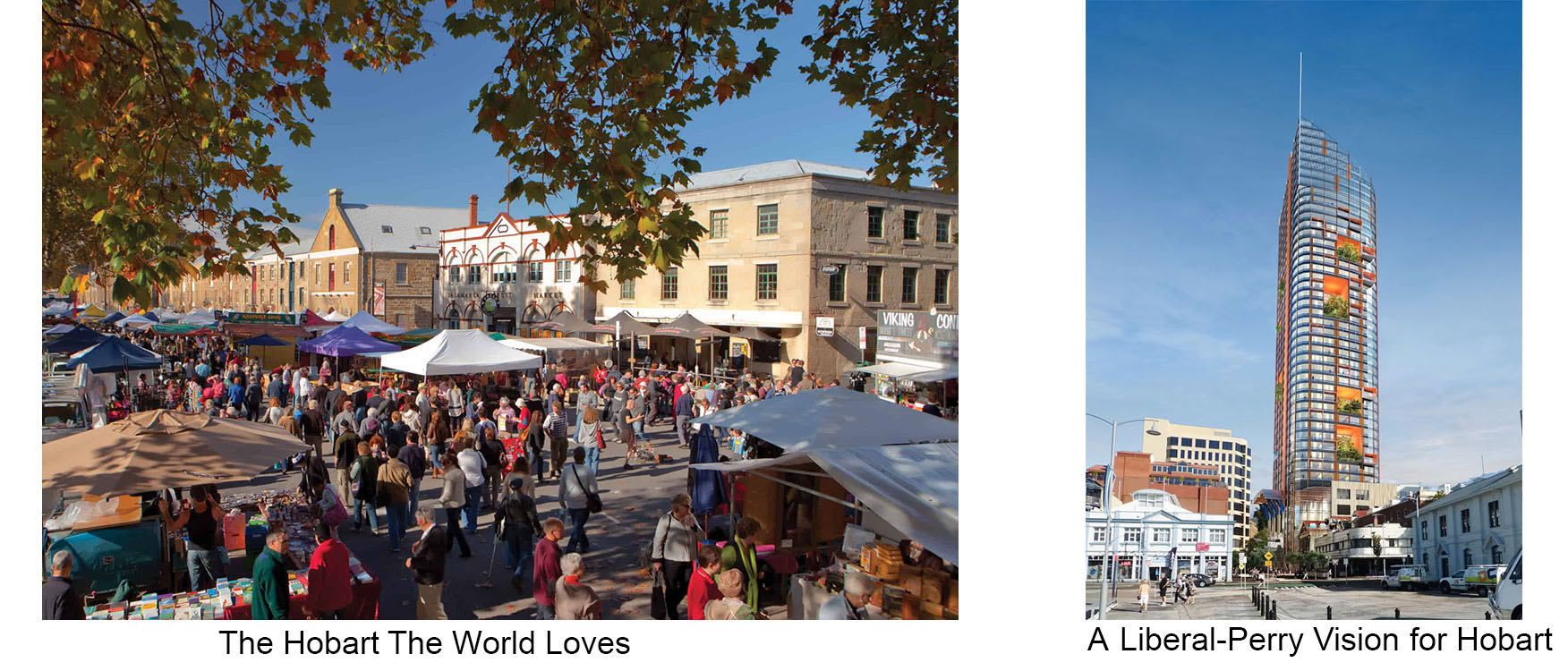

Since 2016, the Greens and the Tasmanian Labor Opposition have repeatedly attacked the State Government over the salary of a highly paid public servant working in a role created by the Liberals in 2014.
The Department of State Growth 2016 annual report revealed the Coordinator General, John Perry, took home a salary which the Opposition claimed was, “more than the Premier, and on par with the US President.”
Adding further, “over the life of his contract, the Coordinator General will be paid around $2 million.” [2]
The opposition leader then asked, “Minister, how can you possibly justify this obscene salary, and can you point to a single project your Coordinator General, John Perry, has actually delivered?”
In response to the question, the State Growth Minister defended the CG, John Perry, and pointed to two southern hotel developments worth $250 million ‘in the pipeline’. This proposal and the CG position was promoted by the same Jeremy Rockliff who, (earlier in opposition) successfully argued for the abolition of the Office of the State Government Architect (SGA) for its exorbitant $330k pa in salaries and expenses, the hypocrisy of which later proved as glaring as the Liberals’ 210-metre glass tower Perry’s Singapore developers had planned for Hobart’s waterfront.
“There is no better time to abolish this position.” Rockliff had said. “It’s a luxury the State Government can no longer afford. This is not an essential service. Essential services are particularly those social services at the frontline of our education and health systems.” [3]
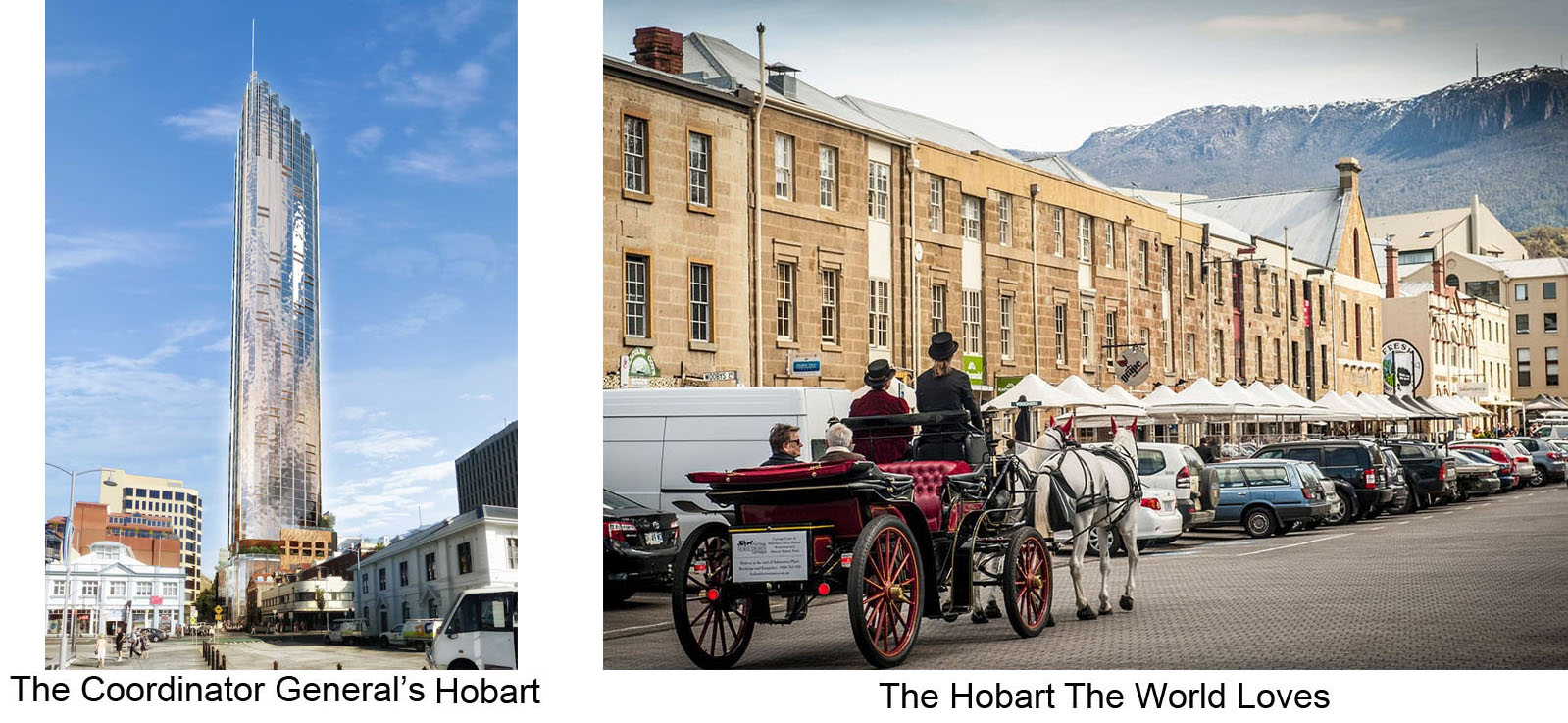
Elected to government a year later, Rockliff’s $330k SGA “luxury we can no longer afford” was replaced with a 2-million-dollar appointee whose mission included travelling the world – attending conferences in five-star hotels on every continent – in order to lure investors for the Liberals’ utopian vision of a shiny new Hobart metropolis.

There seems a neat chronological synergy between the sacking of the State Government Architect (Professor Peter Poulet) and the appointment of the highly paid Coordinator General (John Perry) by the newly elected Liberal Government, who – as seen now in its ‘Projects of State Significance’ mantra and its recent rejection of all expert Macquarie Point stadium assessments – has declared a covert war on development scrutiny.
Through the intervening years to date, Tasmania remains the only Australian state not to retain the invaluable advice and filtering guidance of a Government Architect.
As mentioned, Perry’s single globetrotting achievement was his successful invitation for the Singapore-based Fragrance Group to propose and design a 210-metre-high hotel/apartment tower near Hobart’s waterfront (see images).
Although this project has now been shelved (aided by the compelling need for an AFL stadium), it clearly documents Perry’s – and by extension the Liberal Government’s – vision for Hobart as a capital city of towering mainland sameness.
Inherent in this Futurist’s mindset is the blinkered disregard for contextual scale.
Respecting the city’s preservation plan, the retention of a Government Architect would not only have saved the state the cost of Perry’s profligate travels, but Hobartians would have been spared the rancid Fragrance of his mongrel proposal.
The wonderful Canadian singer-songwriter, Joni Mitchell laments,
‘You don’t know what you’ve got till it’s gone’.
When surveyed, it often falls to visitors to remind Tasmanians of what they have.
Including its natural beauty, the main attractions – for most tourists – are the colonial vestiges of its town and city streetscapes and the charm of their Georgian buildings. Hobart’s aesthetic qualities are unique among Australian capital cities, and any further abuse – by demolition or by subjugation in scale or form – will see our low-rise waterfront incrementally subsumed or totally devoured by corporate gluttony. Who among us would want our intimate quayside morphed into a pastiche of mainland anonymity?
Among my architecture heroes from late 1970s Sydney, Professor Philip Cox AO (founder of COX Architecture), responded to a letter I wrote which was included as part of an 4 April Tasmanian Times article titled ‘York Park or Nowhere’. [4]
Professor Cox wrote:
‘I have not been involved in the Hobart AFL Stadium although I am familiar with the proposal but not the political issues associated. I too appreciate the Salamanca and Sullivans Cove precincts and their 19th century Georgian urban space, by far the finest in Australia. I agree it is as important, or more so, than the remnants of waterfront space we have here in Sydney at the Rocks. The architecture in Hobart is superior, and the fact that much of the harbour has been preserved endows the waterfront with a unique scale of Georgian excellence to be found nowhere else.’
Professor Cox’s letter finished with his answer to my question:
‘Having now perused the York Park site, I agree it would seem a more comfortable and economic fit but, as an architect, you would appreciate we can only work with the cards we’re dealt.
To your question: Could the design that has been developed for Hobart be transferred to York Park, Launceston? The answer must be yes but ignores the politics of the situation. Mark, you can understand that I cannot give you much help being still a consultant to COX Architecture who in turn are responsible to their client, essentially the Government of Tasmania. I am, however, totally sympathetic to your courage and ideals’.
Kind Regards,
Philip Cox AO
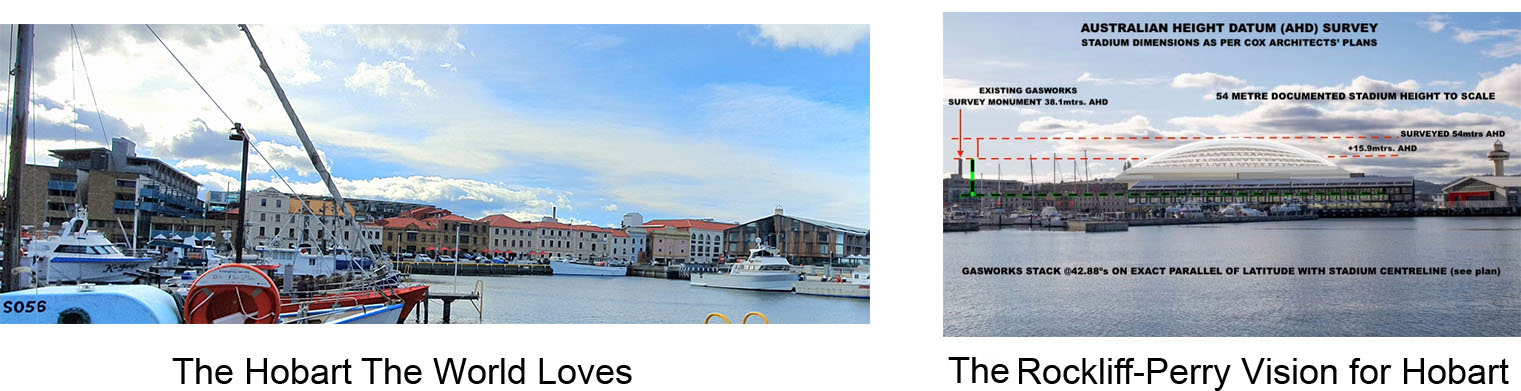
Irrespective of the fact that independent surveys confirm the Macquarie Point site will not safely accommodate the proposed stadium and its ancillaries, our government is banking on AFL-affiliated Melbourne architects who have been contracted $37 million to make it fit but will never be held accountable for the civic incongruity and the inevitable budget explosion as witnessed in the ongoing fiasco surrounding the ferries and their berthing.
Macquarie Point – the Liberal Government’s premeditated ‘wasteland’ – must be wrenched from the extortionary clutches of a football/gaming empire to be inclusively reimagined as a public space and finally to be renamed to celebrate its indigeneity.
As championed sixty years ago by a courageous few, we proud Tasmanians must not be silent witnesses to the degradation of our unique and hard-won urban fabric.
References:
[1] John White – Battery Point Community Assoc. https://www.batterypointhall.org.au/dead-mans-hand/
[2] Hansard 2016
[3] ABC, January 12, 2013
[4] https://tasmaniantimes.com/2025/04/york-park-or-nowhere/ –

Mark Pooley is a retired architect living in Hobart.
Tasmanian Times (TT) is a community-based news and current affairs service covering the island state of Tasmania. It exists to provide a diverse presentation of Tasmanian issues. TT creates and supports independent media content utilising the best of modern technologies and tried-and-true practices of public-interest journalism.
Support us in expanding our coverage and developing new content by and for Tasmanians.
New initiatives on the way include … what our contributors and readers suggest! Please get in touch with your suggestions.