Article
Pipeline Track Opens Gateway to Kunanyi/Mt Wellington

Hobart’s newest recreational trail has officially opened, creating unprecedented access to the foothills of Kunanyi/Mt Wellington for locals and visitors alike.
The two-kilometre Pipeline Track extension links Waterworks Reserve directly to Wellington Park’s trail network, making it accessible for everyone—from pram-pushing parents to serious mountain bikers. The project also unveiled a striking piece of Hobart’s hidden heritage – a beautifully preserved sandstone pipe-head well dating to 1883, now showcased with new interpretation panels telling the story of the city’s pioneering water supply system.


Media release – City of Hobart, 31 October 2025
$800,000 Pipeline Track project unlocks new access to the mountain
For the first time ever Hobart visitors and locals can hike, bike, run or pram along wide open tracks all the way from Waterworks Reserve up into the foothills of Kunanyi/Mt Wellington with the completion of the $800,000 Pipeline Track extension.
After years of planning, this two-kilometre new gravel track links the popular Waterworks Reserve with trails in Wellington Park, opening up exciting new opportunities for exploring Hobart’s bushland parks.
The project has also uncovered a long-lost piece of architectural history, revealing a century old sandstone pipe-head well hidden in bushland.
The project was funded by the City of Hobart with support from the Local Government Association of Tasmania, which contributed $181,800 through its Open Spaces Grants Program.
“This fabulous new trail is among our most significant recreational track projects in decades and creates a more accessible connection for walkers, trail runners and bike riders between Waterworks Reserve and Wellington Park. It is flat enough and wide enough for families to take their youngest up the new track in a pram,” said Hobart Lord Mayor Anna Reynolds.
“We’ve also installed new interpretation panels that tell the history of Hobart’s mountain water supply system, how it was built and how it helped save lives by providing clean, fresh water to a growing city in the late 1800s.
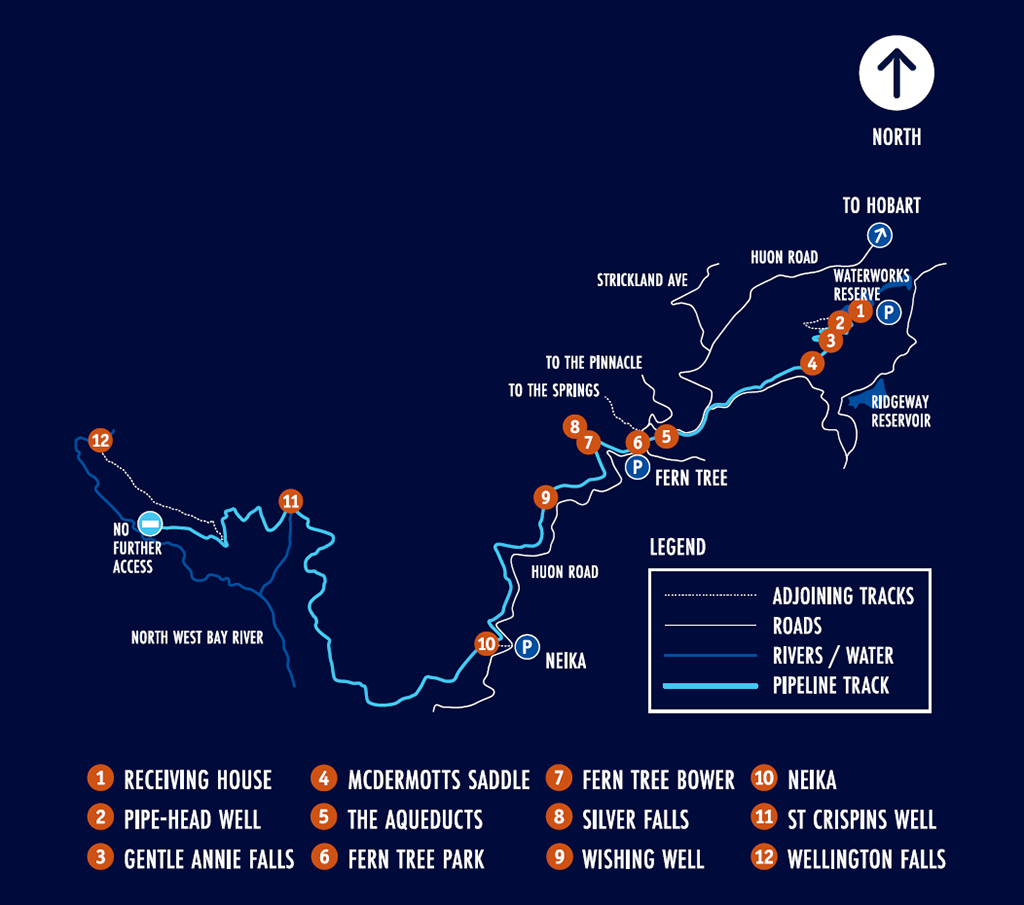
“The Pipeline Track passes beautiful old sandstone troughs once used to deliver water from the slopes of Kunanyi into the upper reservoir in Waterworks Reserve. It also goes to a new viewing platform that looks out over the rediscovered Pipe-head Well, on to Gentle Annie Falls, with a return loop to Waterworks Reserve or the option of walking or riding all the way to Fern Tree and beyond.
“Waterworks Reserve is one of our most popular picnic spots and this great new track is sure to draw even more people to this special part of Hobart’s public bushland.”
Minister for Local Government, Kerry Vincent said the Tasmanian Liberal Government was helping deliver for Tasmania, encouraging members of our local community to get active.
“This Pipeline Track extension is an exciting addition for the Hobart City Council,” Vincent said.
“Initiatives like the Open Spaces Grants Program help contribute to the health and wellbeing of communities, by providing critical infrastructure.”

Track facts
The 18km long Pipeline Track follows Hobart’s still-functioning water supply system, which was established in the 1860s. It starts at Fern Tree and winds gently around the southern slopes of Kunanyi/Mt Wellington, finishing at Waterworks Reserve.
The Pipeline Track is the backbone of Hobart’s recreational track network and earlier this year the City of Hobart also invested $200,000 to resurface and improve drainage on the section near Neika.
Waterworks Reserve was established in the 1860s and was central to Hobart’s first public water supply. Its twin reservoirs were built in 1861 and 1908 and fed by a pipeline from Kunanyi/Mt Wellington.
The pipe-head well was built in 1883 and screened and mixed water before sending it to Hobart by gravity. Its clever two-chamber design and classical architecture showcased engineering skill and elegant craftmanship.
Tasmanian Times (TT) is a community-based news and current affairs service covering the island state of Tasmania. It exists to provide a diverse presentation of Tasmanian issues. TT creates and supports independent media content utilising the best of modern technologies and tried-and-true practices of public-interest journalism.
Support us in expanding our coverage and developing new content by and for Tasmanians.
New initiatives on the way include … what our contributors and readers suggest! Please get in touch with your suggestions.