Article
Crayfish Closure Follows Salmon Antibiotic Deployment
The commercial rock lobster fishery south of the D’Entrecasteaux Channel is now closed effective 15 November 2025

The commercial rock lobster fishery south of the D’Entrecasteaux Channel has been closed effective 15 November 2025, one week after salmon industry deployment of florfenicol antibiotic in the region.
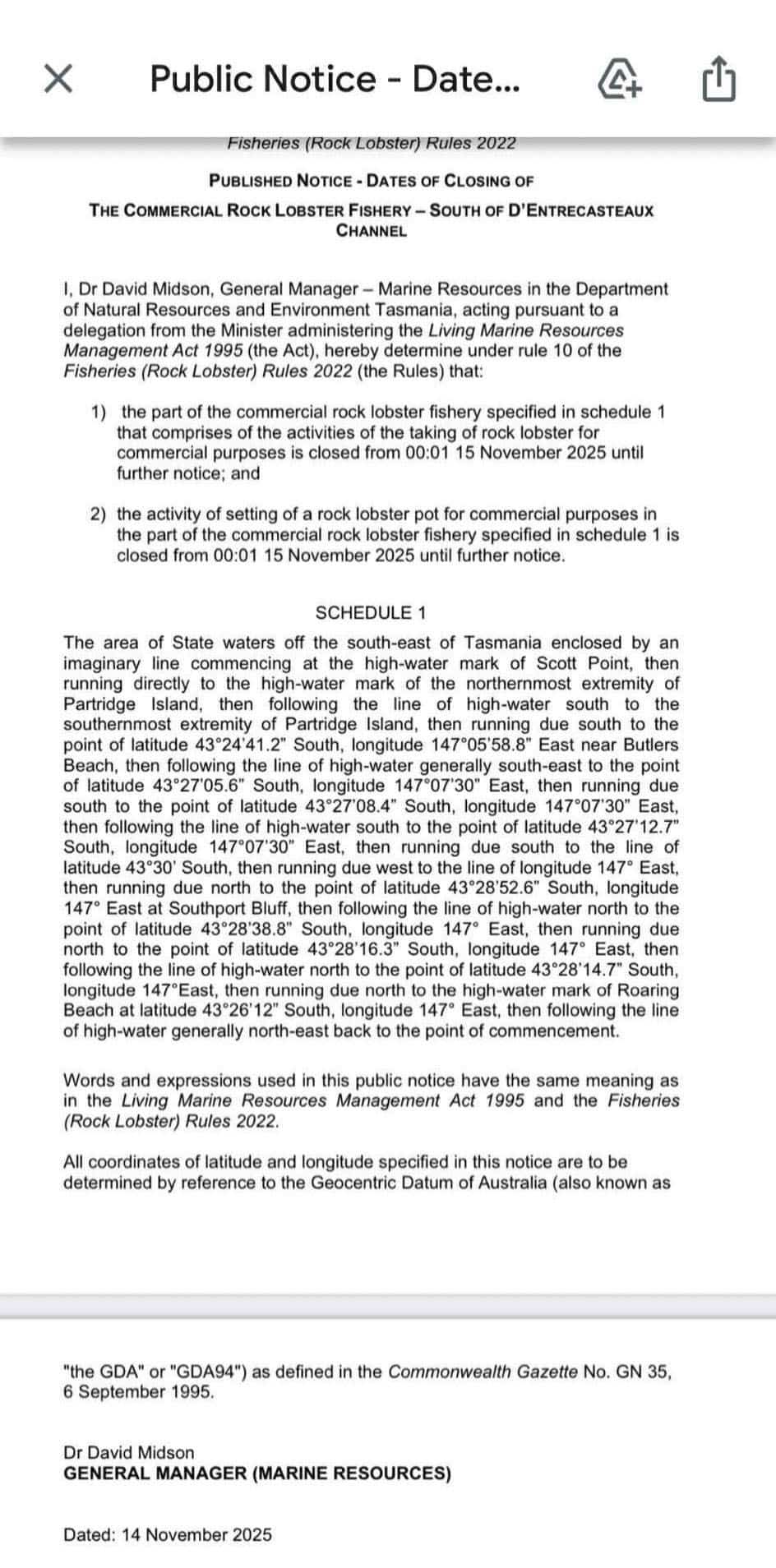
A public notice dated 14 November 2025, signed by Dr David Midson, General Manager – Marine Resources at NRE Tasmania, closes the commercial rock lobster fishery from 00:01 hours on 15 November 2025 “until further notice.”
The closure covers state waters off south-east Tasmania from Scott Point and Partridge Island, extending south past Butlers Beach, Southport Bluff and Roaring Beach. The closed area is located on the eastern side of Bruny Island, facing Storm Bay, rather than within the D’Entrecasteaux Channel itself.
The closure was issued seven days after Tassal began deploying florfenicol at Meads Creek (MFL 77) and Stringers Cove (MFL 209) lease sites on 7 November 2025. Florfenicol is a pig antibiotic being used in Australian waters for salmon farming for the first time.
The geographic separation between the treatment sites and the closure area indicates authorities anticipate antibiotic residues may disperse from the D’Entrecasteaux Channel treatment sites around the southern end of Bruny Island into Storm Bay waters where commercial crayfish operations occur.
The commercial rock lobster season opened across most of Tasmania on 15 November. The closure notice was dated one day before opening.
On 12 November, Huon Aquaculture also commenced florfenicol treatment at Zuidpool North lease (MF141).
The notice makes no reference to florfenicol, antibiotics, or salmon farming. It states the closure is made under the Living Marine Resources Management Act 1995 and the Fisheries (Rock Lobster) Rules 2022.
The notice prohibits taking of rock lobster for commercial purposes and setting of rock lobster pots for commercial purposes.
No timeframe for reopening is provided. No monitoring protocols or testing requirements are specified in the public notice.
The EPA’s regulatory notice issued 7 November 2025 stated it “has developed a new Florfenicol Antibiotic Residue Monitoring Schedule” and that “the Schedule also requires baseline surveys to be completed before any antibiotic treatment event.” The EPA notice states – “Results from this monitoring will inform future environmental and public health advice relating to the use of Florfenicol in Tasmania.”
The Department of Public Health issued separate advice on 7 November recommending recreational fishers avoid eating fish caught within 3km of treated pens for 21 days after treatment ends. This advice is not a mandatory closure.
Schedule 1 of the notice defines the closed area as state waters off south-east Tasmania enclosed by coordinates running from Scott Point, to Partridge Island, south to Butlers Beach (latitude 43°27’05.8″ South, longitude 147°07’30” East), continuing south to latitude 43°30′ South, then west to longitude 147° East, north to Southport Bluff, then north to Roaring Beach, and back to the commencement point.
The closed area encompasses waters on the eastern (Storm Bay) side of Bruny Island. Commercial rock lobster operations in this area are removed from access for an indefinite period during the peak season.
The closure removes access to this area for an indefinite period.
The notice applies to commercial operations only.
Recreational fishing is not prohibited by this notice, though the Department of Public Health’s separate advisory remains in effect.



Media release – Janie Finlay MHA, Deputy Labor Leader, Shadow Minister for Primary Industries & Aquaculture, 15 November 2025
Recreational fishers left in the dark by lousy response
The Tasmanian Government’s lousy public education response to the application of florfenicol has left recreational fishers in the dark.
By failing to actively educate Tasmanians about the antibiotic’s use, the Government has created a dangerous vacuum for misinformation to spread.
This vacuum has predictably been filled by players looking to push a political agenda, with little regard for those who love to drop a line and enjoy using our waterways.
Fishing is pretty much the most loved and classic Tassie way of life for so many.
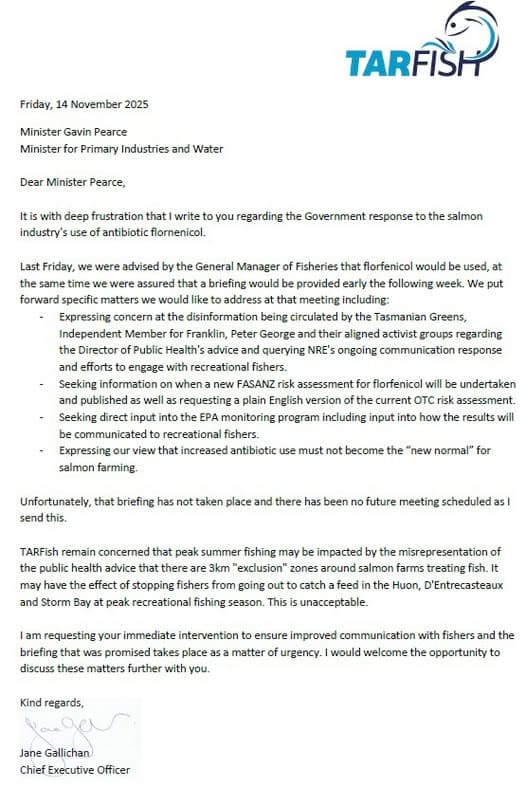
It’s simply not good enough that TARFish, the peak body for recreational fishers, hasn’t been given a briefing about the issue, despite being promised one.
The Government needs to pick up its game immediately and be more proactive and protective with information so Tasmanians can have clarity and confidence to make informed decisions for themselves.
If you’re going out fishing this weekend, stay safe and have fun!

Tasmanian Times (TT) is a community-based news and current affairs service covering the island state of Tasmania. It exists to provide a diverse presentation of Tasmanian issues. TT creates and supports independent media content utilising the best of modern technologies and tried-and-true practices of public-interest journalism.
Support us in expanding our coverage and developing new content by and for Tasmanians.
New initiatives on the way include … what our contributors and readers suggest! Please get in touch with your suggestions.