Article
Global Leaders Unite to Protect Ross Sea
Emperor Penguins Cape Washington Ross Sea – Image John Weller

Launch of new research network for world’s largest marine protected area
Hobart, Australia – 28 October 2025
Researchers, national representatives and ocean conservationists from around the world gathered at Hobart Town Hall on Monday evening to advance international efforts to protect and study the Ross Sea Marine Protected Area in Antarctica.
The event marked the public launch of the Ross Sea region MPA Research and Coordination Network, a new initiative aimed at improving collaboration and monitoring of the world’s largest marine protected area. The Ross Sea MPA covers an area roughly the size of Germany, France and Spain combined.
The gathering took place during the annual meeting of the Commission for the Conservation of Antarctic Marine Living Resources (CCAMLR), which is being held in Hobart this week.
It was in this same city eight years ago that CCAMLR achieved consensus among 24 nations and the EU to establish the Ross Sea MPA.

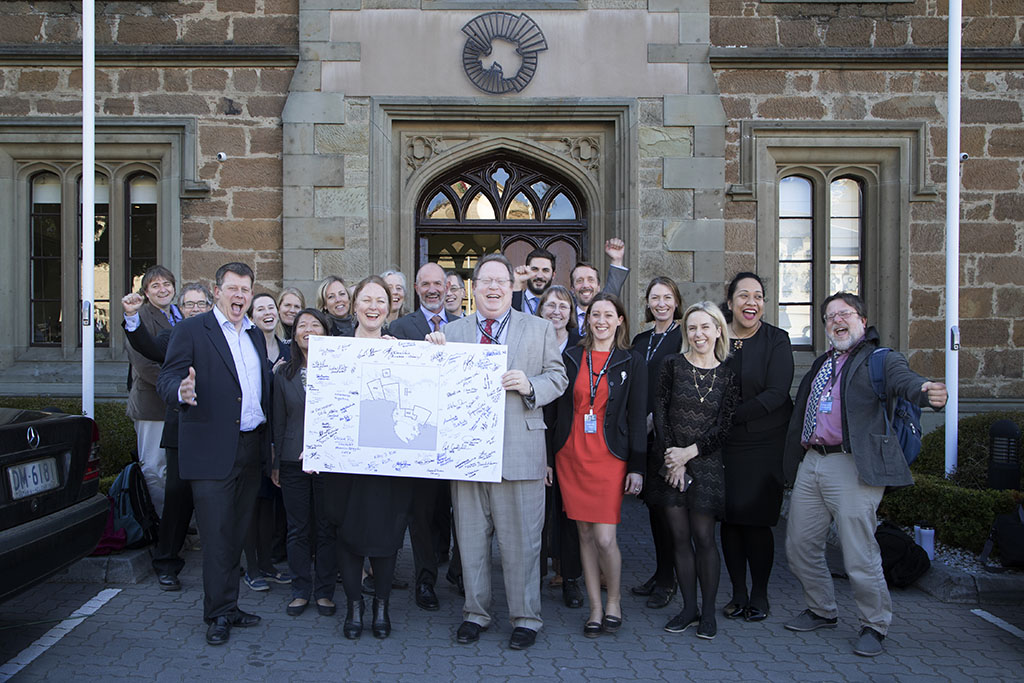
US and NZ CCAMLR Delegations with signed map of Ross Sea MPA
Lord Mayor Anna Reynolds opened the evening event, which brought together representatives from the scientific, policy and conservation communities. The newly launched network already includes participants from 22 nations and is open to anyone interested in contributing to Ross Sea research and protection.
Dr Cassandra Brooks, associate professor at the University of Colorado Boulder, explained the network’s purpose.
“We have developed an international research community around the Ross Sea MPA so that we can better understand this remarkable ecosystem which harbors an extraordinary array of marine life,” she said.
“This research coordination network for the Ross Sea will not only facilitate our understanding of the Ross Sea, it will also provide opportunities for science diplomacy and collaboration.”
The network, which receives partial funding from the U.S. National Science Foundation, will coordinate data science, modeling and fieldwork to better understand the Ross Sea ecosystem and monitor threats including climate change, potential overfishing and pollution.
The timing of the initiative is significant.
The Ross Sea MPA will undergo its first 10-year review by the CAMLR Commission in 2027, and organizers emphasized the need for continued research and international cooperation in preparation for that assessment.
Veteran Antarctic photographer John Weller presented imagery from the Ross Sea at the event, showing the region both above and below the ice. He also reflected on the moment the MPA was adopted in 2016.
“The profound beauty of the Ross Sea is incomparable. Except, perhaps, to the moment when the MPA was adopted,” Weller said.
“What happened within the stone walls of CCAMLR on 28 October 2016 was a critical step in the drive to protect our global ocean. It was also a peace treaty. Nations were hugging other nations on the floor of CCAMLR. And it made me believe that we have the power to build a better future through science and peace.”
The event also highlighted technological partnerships supporting Ross Sea research. Ocean Motion Technologies, based in San Diego, California, is providing support through its Big Blue Cloud platform, a cloud-based data science system that integrates ocean data to help researchers and policymakers access and share environmental information about the Ross Sea.
Dr Jack Pan, CEO and Lead Oceanographer at Ocean Motion Technologies, said the Ross Sea represents what’s possible through scientific collaboration.
“Through the Big Blue Cloud, we aim to make polar data more accessible and usable to everyone working to preserve these waters,” he said.
Looking ahead, the Ross Sea Research and Coordination Network and its partners plan to continue developing data-sharing tools to support global collaboration.
The goal is to ensure the Ross Sea remains both a focus of scientific research and a model for marine conservation efforts worldwide.
The event was open to CCAMLR delegates, media and members of the public.
Tasmanian Times (TT) is a community-based news and current affairs service covering the island state of Tasmania. It exists to provide a diverse presentation of Tasmanian issues. TT creates and supports independent media content utilising the best of modern technologies and tried-and-true practices of public-interest journalism.
Support us in expanding our coverage and developing new content by and for Tasmanians.
New initiatives on the way include … what our contributors and readers suggest! Please get in touch with your suggestions.