Agriculture
Black Swans Face Cull Despite Public Outrage

A controversial permit allowing the killing of protected black swans on private property near Ross has ignited debate about Tasmania’s wildlife management practices, with animal welfare advocates demanding immediate government intervention and questioning whether tens of thousands of native birds are being killed without justification.
The Animal Justice Party (AJP) Tasmania has led a growing chorus of opposition against the planned cull, which targets native black swans on a property some 10 kilometres west of Ross. The permit, issued by the Department for Natural Resources and Environment, has sparked hundreds of complaints from Tasmanians who say there’s no justification for killing iconic native birds simply for existing in their natural habitat.
“They are being persecuted for being swans,” said Chris Simcox, spokesperson for AJP Tasmania.
“These birds are only doing what is in their nature, and landowners need to show more tolerance for the native waterbirds that share their properties.”
The controversy erupted in late September when AJP Tasmania first publicised the permit on social media, generating immediate backlash. The post garnered hundreds of comments, numerous direct messages and over 400 shares from concerned Tasmanians.
Many subsequently contacted Primary Industries Minister Gavin Pearce directly, yet the Minister has not publicly addressed the mounting concerns.
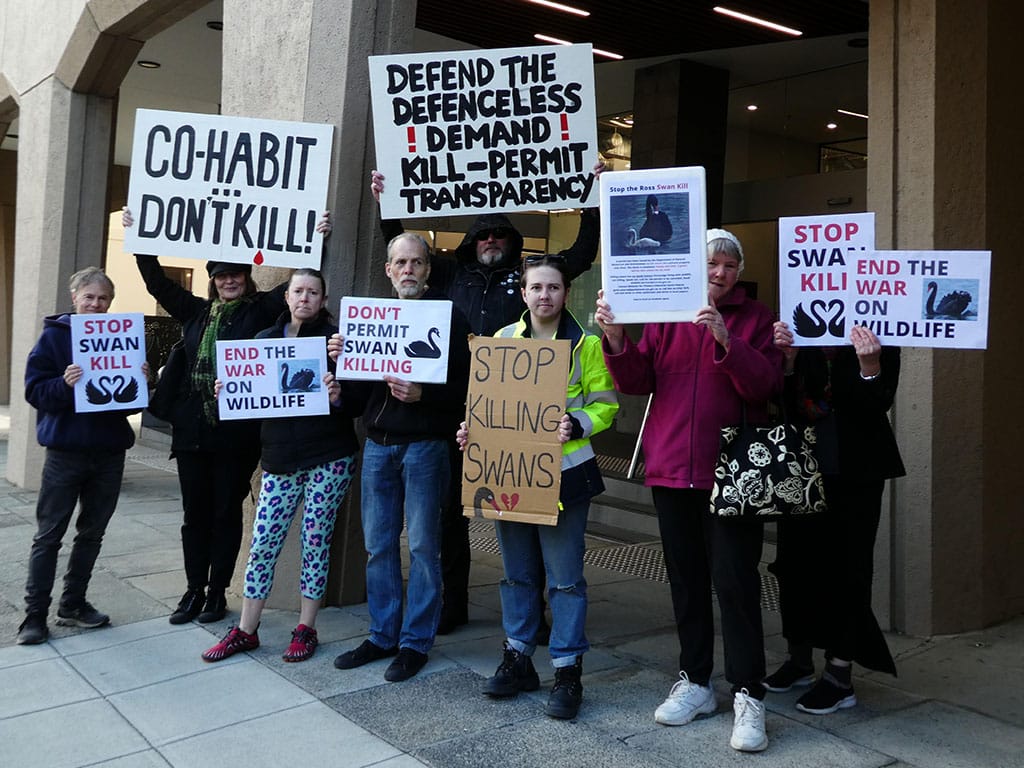
The initial cull dates of 11-12 October were postponed following public pressure, though authorities have not confirmed when – or if – the killing will proceed. On Friday morning, protesters gathered outside the Lands Building on Macquarie Street in Hobart, demanding the Minister cancel the permit and overhaul the entire property protection system.

The Ross cull is far from an isolated incident. Between 2014 and 2019, more than 22,000 native black swans were approved for culling in Tasmania, with almost half that quota coming from King Island alone. The scale of this killing has raised serious questions about whether such widespread slaughter of a protected species can be justified.
The black swan is the state bird and emblem of Western Australia, featured on that state’s flag and coat of arms. In Tasmania, these nomadic waterbirds with erratic migration patterns are an iconic part of the natural landscape, making the routine killing permits all the more controversial.
Property protection permits are regularly granted to private landowners across Tasmania, authorising the killing of various native species. Since 2014, quotas have included 5,000 wombats, 10,000 native hens, 50,000 forester kangaroos and 55,000 sulphur-crested cockatoos, all protected under Tasmanian law.
Critics argue this permitting system prioritises landowner convenience over wildlife conservation, allowing protected species to be killed without adequate scrutiny of non-lethal alternatives.
“Landowners need to be challenged to come up with wildlife-friendly, non-lethal methods,” Simcox emphasised.
“The Department needs to be more proactive in helping landowners find solutions that protect wildlife rather than defaulting to lethal control.”
Black swans can be drawn to protein-rich grasses sown by cattle farmers, and flocks of up to several thousand black swans have been found on King Island properties. Some experts suggest many swans may be coming from the mainland due to drought conditions, with enormous numbers of waterfowl being driven across by environmental pressures.
However, permits are only meant to be granted when alternative non-lethal strategies are neither effective nor practical. Wildlife advocates argue that culling is completely indiscriminate and that other methods to move the birds on, such as the use of drones and other deterrents, could be investigated but are not being adequately explored.
Troublingly, the Tasmanian government collects no information about the localised impacts of these culls on Tasmania’s swan population and undertakes no investigation about the animal welfare implications of these authorised slaughters.
Animal welfare advocates maintain there is no “social licence” for culling native black swans – birds that hold cultural significance and are celebrated as part of Tasmania’s natural heritage.
What constitutes sufficient justification for killing protected wildlife remains unclear, as does the extent to which landowners must demonstrate they’ve attempted non-lethal deterrents before permits are granted. The lack of transparency around the permitting process, combined with the absence of population impact monitoring, has fuelled public concern that Tasmania’s wildlife is being killed without proper oversight.
AJP Tasmania is urging Minister Pearce to conduct a comprehensive review of wildlife killing permits, implementing stricter criteria and mandatory exploration of non-lethal alternatives before any protected species can be killed.
“We need a fundamental shift in how we approach human-wildlife coexistence,” said Simcox.
“Respect for the diversity of species that share our landscapes should be the starting point, not an afterthought. When over 22,000 swans can be approved for killing in just five years, something is fundamentally wrong with the system.”
As the controversy continues, the fate of the Ross-area black swans remains uncertain – a situation that critics say exemplifies the need for urgent reform of Tasmania’s wildlife management policies.
Tasmanian Times (TT) is a community-based news and current affairs service covering the island state of Tasmania. It exists to provide a diverse presentation of Tasmanian issues. TT creates and supports independent media content utilising the best of modern technologies and tried-and-true practices of public-interest journalism.
Support us in expanding our coverage and developing new content by and for Tasmanians.
New initiatives on the way include … what our contributors and readers suggest! Please get in touch with your suggestions.