The Minister for Local Government, Kerry Vincent, has released a discussion paper on proposed reforms to deliver fairer pay and more effective representation in local government and is pushing ahead with its Local Government Priority Reform Program, a plan sparked by the Future of Local Government Review.
The discussion paper outlines a plan to reform the local government sector, with proposed changes aimed at reducing the number of councillors while simultaneously increasing their allowances. However, critics argue this is a “bandaid” solution after the government failed to push through more significant structural reform, such as council amalgamations.
The proposal would see a significant reduction of 60 councillors across the state, a move the government says is necessary to attract and retain “diverse, skilled representatives.”
The discussion paper put together by the Office of Local Government posits Tasmania has a system that is outdated, inefficient, and in some ways, unfair. The state has one of the highest numbers of councillors per person in Australia, leading to democratic outcomes where some candidates were elected with very few votes.
Furthermore, years of ad-hoc reviews had created inconsistencies, with councils of similar size having different numbers of representatives. The pay for councillors is also low, failing to reflect the growing complexity of their roles and discouraging a diverse range of talented people from running for office.
The new plan would reduce the total number of councillors from 263 to 203, with each council having either 9, 7 or 5 councillors based on a new scoring system. This system uses a three-tiered approach, with population as the main factor, followed by the complexity of the council’s role (measured by development activity and infrastructure value), and finally, geographic factors like urbanisation and road networks.
This comes after the government’s own Future of Local Government Review, completed in October 2023, recommended a plan for voluntary council amalgamations. However, the government has since stated it will only support voluntary mergers, effectively shelving a core recommendation from its own review. This has led to the current proposal being labelled as a lesser, more politically palatable option.
Critics say shrinking the number of councillors on each council may harm democratic accountability and reduce diversity.
With fewer positions available, it becomes harder for a broad range of community members with different backgrounds and interests to be elected. By reducing councils to the size of a corporate board, it is argued that the system becomes more homogenous and less representative of the diverse communities they serve.
Despite these concerns, the government is pushing ahead, asserting that the proposed model will deliver a minimum 14.25% increase in all councillor allowances without any additional cost to the Tasmanian community.
Vincent, stated that the reforms are part of the government’s commitment to “improving local democracy and representation.”
The reforms follow a period of discussion and advocacy from the Local Government Association of Tasmania (LGAT). The minutes from an LGAT general meeting on 25 July 2025, show a strong negative response to a previously proposed 3% increase to councillor allowances. The LGAT’s submission argued that such a minimal increase did not “recognise the contemporary expectations or workload required of a councillor” and would fail to position the sector to attract suitable candidates. The association had been directly lobbying the Office of Local Government and the Minister’s office, requesting that the review into councillor numbers and allowances—a recommendation from the Future of Local Government Review—be brought forward as a priority.
In June 2025, councillor allowances were already updated as per the Local Government (General) Regulations 2025, with a recalculation to align with national superannuation practices. The allowances now include a 12% component for the Australian Government’s 2025 Superannuation Guarantee.
These updated figures will remain in place until the next annual adjustment on November 1, 2025.
Looking to the future, the reforms also include a plan for ongoing sustainability. The new methodology for setting councillor numbers and allowances could be embedded in legislation, providing certainty and transparency.This would also establish a mandatory schedule for reviews every four years, ensuring the system remains fair and equitable over time.
The government is currently inviting public feedback on the discussion paper until 7 November 2025.
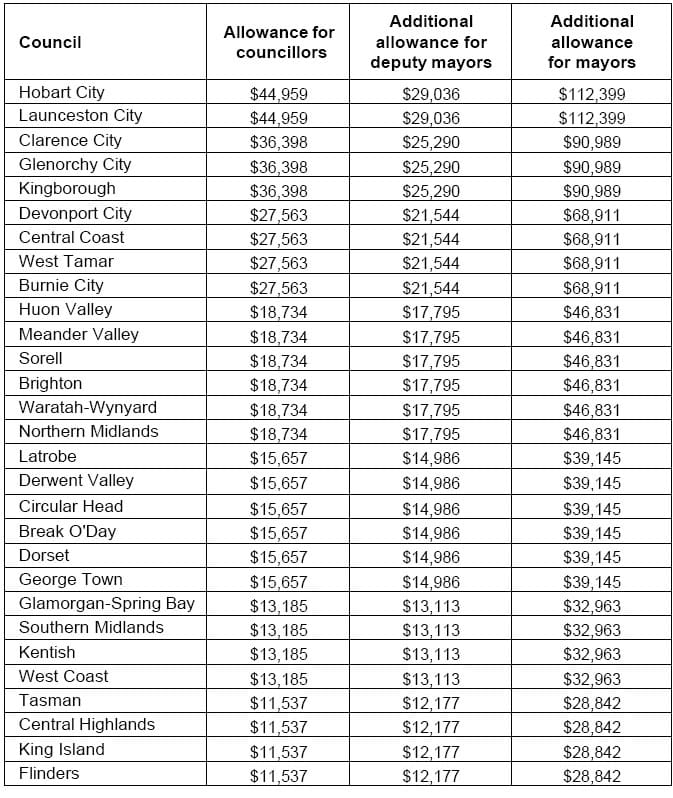
Councillor Allowances – updated June 2025

Media release – Kerry Vincent MP, Minister for Local Government, 15 September 2025
Delivering reforms to councillor numbers and allowances
The Liberal Government is delivering for Tasmania by strengthening the local government sector.
Minister for Local Government, Kerry Vincent, has today released a discussion paper on proposed reforms to deliver more effective representation and fairer councillor pay.
“The discussion paper is part of the Government’s review into local councillor numbers and allowances,” Vincent said.
“The Government is committed to improving local democracy and representation to better serve our communities, and has listened to the Local Government sector about these reforms.
“Councillors’ roles are increasingly complex, and we must fairly recognise their valuable service while attracting and retaining diverse, skilled representatives.
“Having the right number of councillors in a local government area is critical to ensuring effective governance, representation and service delivery.
“The proposed model would reduce the number of councillors across the State by 60, while supporting a minimum 14.25 per cent increase to all councillor allowances at no net cost to the Tasmanian community.
“We believe this would deliver a fair, appropriate, and cost-neutral pay increase for councillors.
“The review was a key recommendation of the Future of Local Government Review and will support and complement the Government’s broader efforts to strengthen the local government sector.”
The proposed reforms will lay the groundwork to attract and retain diverse, talented candidates for the October 2026 elections and beyond.
The discussion paper is available on the Department of Premier and Cabinet website.
Feedback is invited until 7 November 2025.
Tasmanian Times (TT) is a community-based news and current affairs service covering the island state of Tasmania. It exists to provide a diverse presentation of Tasmanian issues. TT creates and supports independent media content utilising the best of modern technologies and tried-and-true practices of public-interest journalism.
Support us in expanding our coverage and developing new content by and for Tasmanians.
New initiatives on the way include … what our contributors and readers suggest! Please get in touch with your suggestions.