Tas That Was
Tas That Was – Railton
The Railton limeworks is the longest continuously operating site of its kind in Australia.

Before the arrival of Europeans in Tasmania in 1803, the Tommeginne First Nations people occupied the area around what is now Railton.
It was surveyed by J.M. Dooley in 1853, and the town – originally called Redwater Creek – was settled shortly after.
The town was renamed ‘Railton’ around 1880, and a railway line from Deloraine through Railton to Latrobe was completed five years later. Before the railway, there was a Mersey-to-Deloraine tramway line that also passed through the town.
In 1860, an abundance of limestone was discovered in the Railton area. To make use of it for cement production, a limeworks and cement factory were established. Sixty-eight years later, in 1928, the Advocate reported:
“Since the cement industry was established here many have hoped for a big advance for the town and district. […] The quality of the cement turned out has come to be recognised as the best produced in Australia, which is saying much.”
The Railton limeworks is now the longest continuously operating site of its kind in Australia.
During the 1990s, businessman Neil Hurley started a topiary sculpture project in Railton. The first sculpture was of a horse and farmer working a plough. Today, there are over a hundred sculptures around Railton, which is now known as the ‘Town of Topiary’.
Railton also has a rich sporting history, particularly in football. The town was the home of several premiership teams in the Leven Football Association, with notable victories in 1990, 1991, 1994, 1995, 1997, 1998, 1999, 2001, 2002, 2003, and 2005.
Today, the town is primarily a service centre for the surrounding agricultural community.
Its well-known topiary sculptures also attract visitors, contributing to local tourism.

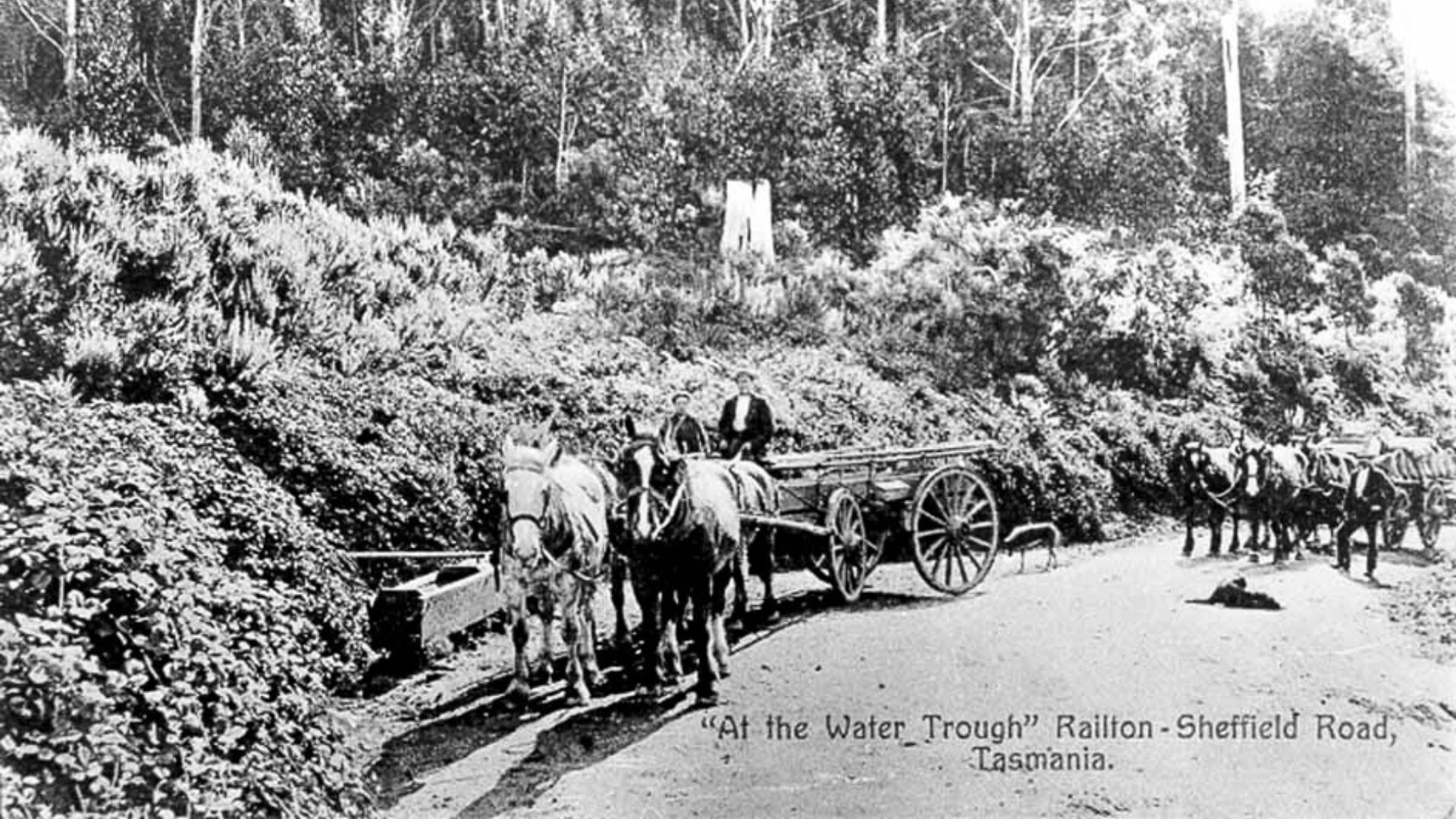
The road into Railton (1900).
Callum J. Jones studied English, History, and Journalism at the University of Tasmania and lived in Western Sydney from 2022 to 2024 while working as a journalist for Professional Planner, a leading online publication for financial planners. He has written for Tasmanian Times since 2018 and has also been published in a range of other outlets, including Quadrant and the BAD Western Sydney anthologies.
Tas That Was is a column that includes:
- anecdotes of life in Tasmania in the past;
- historical photographs of locations in Tasmania; and/or
- documentaries about locations in Tasmania.
If you have an anecdote or photograph you’d like to share with us, please send it to submit@tasmaniantimes.com.