Article
Review – ‘The Language of Mathematics’

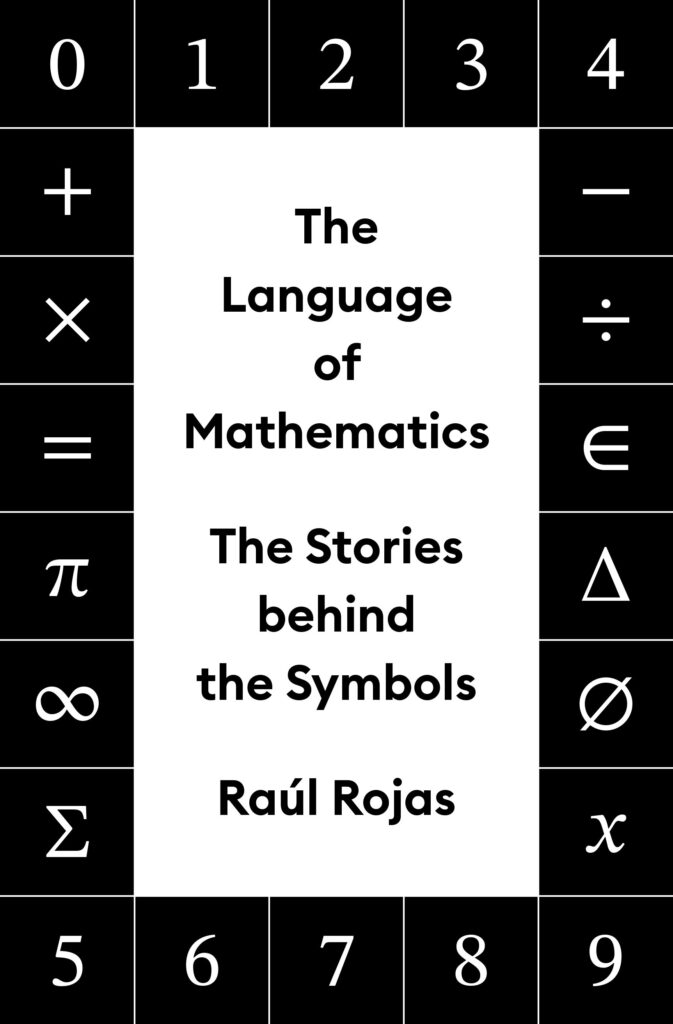
The Language of Mathematics – The Stories behind the Symbols, by Raul Rojas

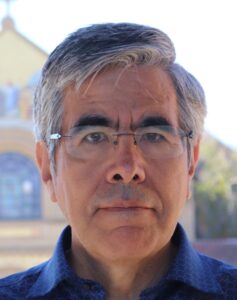
Author, Raul Rojas.
Mathematics either fascinates or leaves us indifferent – there’s no middle ground. But for those who thrill at the insights math provides into the world around us, Raul Rojas, Professor of mathematics, statistics and computer science, and an expert in neural networks and artificial intelligence, has provided this wonderful small book on the stories behind how the symbols we use to make math work were created.
Some symbols indicate, in a single pen- or brush-stroke, a concept like addition or subtraction, but, somewhat surprisingly, took many centuries to evolve. Another universal symbol for ‘equal’ (two parallel horizontal lines) was anything but straightforward to conceptualise, let alone symbolise. Likewise the stunning insight that basic numbering required a ‘null’ number – zero, required breathtaking genius.
So math is simple and complex, often counter-intuitive, and its history is full of characters.
Alfred North-Whitehead and Bertrand Russell’s grand 1910 opus – Principia Mathematica – was an epic quest to find a complete and consistent set of axioms that encompass the entirety of mathematical logic that underpin our ability to question, quantify and understand the natural world. It would’ve been one of mathematics’ greatest achievements, but was its most outstanding and grandest failure.
It started out well, though ‘the reader has to move at a snail’s pace through a jungle of mathematical notation to find…
…after hundreds of pages, the proof that 1+1=2’.
So far, so good. Whitehead and Russell had faith that all that could be known could be reduced to provable logical statements. But it can’t.
Young mathematician, Kurt Godel took a long look at the issues and came away with two Incompleteness Theorems that showed mathematical logic had limits to the provability of problems using natural numbers. In other words, 1+1 [very probably] = 2.
Either way, this book is a set of small joys for math-happy explorers of mathematical-cultural history.
B.P. Marshall is a scriptwriter and author.