Article
Letters to the Editor

Duigan Criticised for Marinus Agreement Amid Election Count
In response to Energy Minister Nick Duigan’s decision to sign the Marinus agreement with the Federal government during the caretaker period, while the House of Assembly election votes were still being counted, twelve Tasmanian organisations have united in calls for Minister Duigan to either withdraw from the Marinus Agreement and restore democracy to energy policy, or else resign.
These organisations, which come from a range of backgrounds including environment, climate, energy policy and democracy advocacy, have signed an open letter to the Minister highlighting his mismanagement of his ministerial portfolio in relation to Project Marinus and associated energy proposals.
The letter emphasised that Project Marinus is the largest proposed investment in Tasmania’s history; yet, Duigan signed the Marinus deal despite long-standing conventions that a caretaker government make no major policy decisions or commitments that could inappropriately bind an incoming government and limit its freedom of action. He also did so in breach of the government’s promise to publish the Whole of State Business Case 30 days before making a Final Investment Decision. This business case, when finally released, was in places heavily redacted, with entire pages almost completely blackened out, and whole graphs covered with black, or else their numbers concealed.
The open letter to Duigan also drew attention to his conduct in relation to the Robbins Island wind farm case, when he allegedly sent a text message to David Pollington, CEO of ACEN (the Robbins Island wind farm proponent) that appeared to favour the proponent in a case that was yet to be resolved by TASCAT. The Robbins Island wind farm does not have social licence. In March, twenty-six environmental and community groups signed an Open Letter to Environment Minister Tanya Plibersek, urging her to deny approval of the Robbins Island wind farm.
The open letter to Duigan additionally brings to light the failed public consultation on Tasmania’s first Renewable Energy Zone (REZ), when the Minister refused repeated requests to meet with affected residents or even to provide a ReCFIT public consultation meeting in an adequately large room. In the end, only three residents in the proposed REZ received a one-on-one appointment with ReCFIT staff, and others were refused. Duigan allegedly took no action to provide a new, genuine public consultation, which was requested by Tasmanians in a Parliamentary petition.
The Tasmanian organisations that signed the open letter to Duigan called on him to withdraw from the Marinus agreement, reevaluate Tasmania’s current energy plan, undertake a thorough investigation and analysis of different energy generation alternatives, and provide a genuine process for the Tasmanian people to voice their decision on all major energy developments.
The letter concluded with the following statement: “We sincerely hope that Duigan will fulfil the actions specified above. However, if he is not prepared to do so, then with all due respect to the Minister, the most appropriate course of action would be for him to resign.”
– Kim Phillips-Haines, Leven River Cruises
UTAS Real Estate Deals Questioned in City Development Debate
Dear Councillor Posselt
I just read your article in today’s Mercury, you said –“ it was unfathomable that the K&D site could remain undeveloped for another decade” I’m sure it was an oversight for you not to have mentioned who owns the site or the other large eye-sore the old Webster building on the corner of Argyle and Melville Streets. It was purchased by UTAS in 2015 and lay idle ever since. We are both aware of the numerous other taxpayer funded eye-sores scattered around the city. Of course, you are right the HCC badly needs people to move into the city, they will be forced to pay their rates, in a fair and honest way, unlike the mob that run the show now.
August 2015. Webster building. $9,800,000. March 2006. Sold for $1,550,000.
I read that you moved here in 2014 so I think it only fair to give you – just one example – of real estate valuation UTAS style, before you arrived here. On 9 May 2003 Mr Sultan bought No 12-16 Bathurst St, a 461 square metre garage used by – TAFE to train mechanics for $410,000 at market value, from the then government. On 22 July 2009 he sold this property to UTAS for 3.5 million dollars. Personally, I find the real estate situation unfathomable. I can’t wait to see who using their own money will pay $30 million for the UTAS, K&D building.
So I decided to share with you the sale history of the MidCity Hotel and the Fountainside Hotel. And hope somebody like you with such an interest in our exercise targets, our drinking habits, fuel consumption, oh and let’s not forget to ride, our bikes – in our little city -would find the time to help me understand the CBD real estate market. And why rates are not collected in a fair, honest and legal way.
I did contact Spark Living – for a comment, about not paying student accommodation rates on the 10 buildings they have leased for 30 years. But I was foolish to think they would bother to reply when numerous requests from the HCC have never been answered.
Fountainside Hotel – Purchased by those using their money on 18/07/2013 for $5,814,168. Purchased by UTAS with taxpayer’s money meant for education on 21/12/2018 for $18,758,387. Purchased by the government/taxpayers in 2024 for $16.25 million.
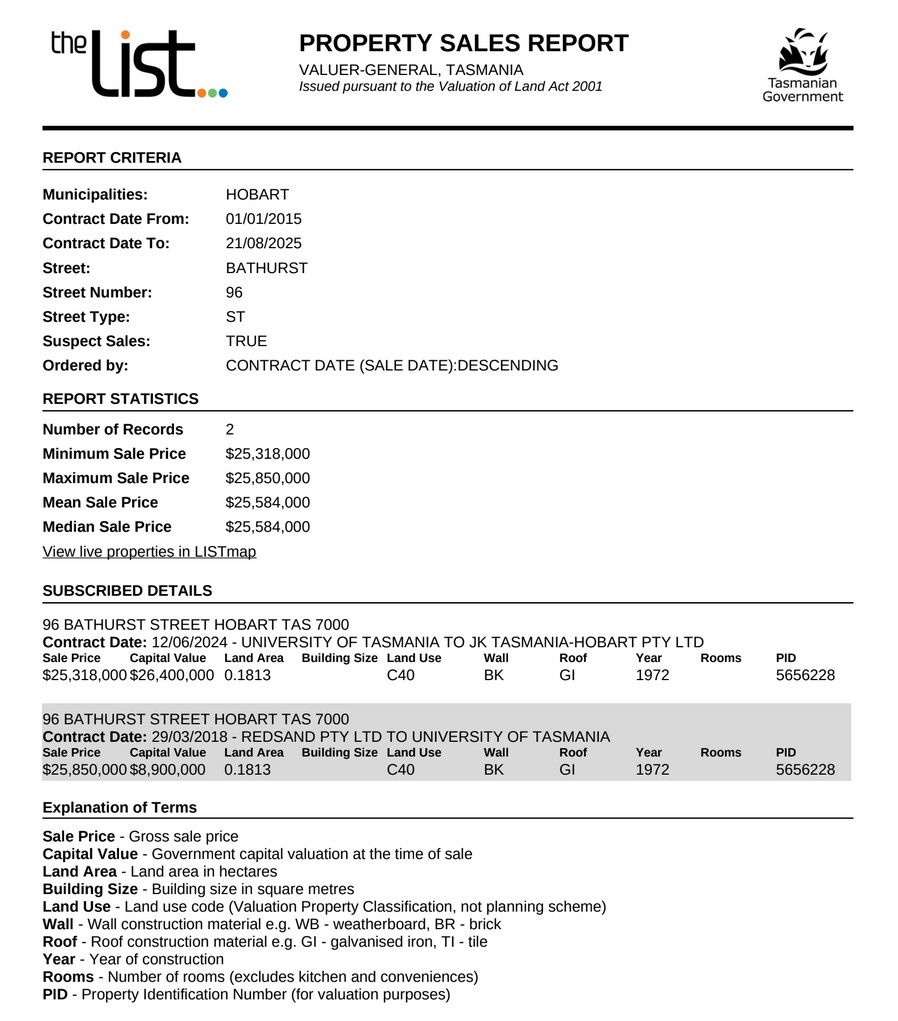
MidCity Hotel was purchased by UTAS for $25,850,000. Capital Value $8,900,000 it was refurbished by UTAS for $7 million, then leased to Vision Hotels.
Do you think I would have a chance of getting the following in the Mercury.
– Elaine Anderson, Hobart

Labor’s Deputy Choice and Salmon Stance Under Scrutiny


It would be fair to say that quite a few Tasmanians were hoping for better when Josh Willie became leader of the Parliamentary Labor Party. Although something of an unknown quality, his predecessor Dean Winter had developed a public persona that caused the Labor vote to sink to historically low levels, and in his own electorate he was the fifth candidate to be elected. In the aftermath to the election Winter proved to be inflexible and divisive, easily outsmarted by Jeremy Rockliff.
Things could only get better. Or so we thought. But then Labor selected Janie Finlay as Willie’s deputy to replace the capable and measured Anita Dow. It seems likely that having a member of the left faction as leader required the right faction to get the deputy role. Nothing to do with previous performance in the role.
And in a further blow, Janie Finlay scored the Shadow Environment role. This is a choice that causes one to remember how former Prime Minister Tony Abbott once made himself the Minister for Women.
The Shadow Minister for the is also the Shadow Minister for Aquaculture. She will clearly relish that role. In the first few days after being made Deputy she posted four times about salmon after she visited two salmon industry sites, both outside of her own electorate. Her social media history is laden with gushing posts about the salmon industry. She has previously been anointed by Salmon Tasmania as a Salmon Champion, a role which comes with the special hi-vis.
Finlay will also be remembered for the free advertising she gave to Hill Street Stores when she posed with packs from each of the three salmon companies. While there is no suggestion that she is corrupt, she seems besotted, and behaves as if she is working for the salmon industry. Tirelessly.
As a result she is perceived by many as belonging to the salmon industry. Therefore why would any constituent concerned about an environmental issue believe it worthwhile to make contact with her, or see Labor as having any environmental credentials whatsoever?
– Ian Sale, spokesperson for Friends of the Bays, a community group formed on the South Arm Peninsula during 2023 with a goal of curtailing salmon farming in Storm, Frederick Henry and Norfolk Bays
Dean Winter Criticised for Labor’s Election Performance
Dear Mr Winter,
Thank you for your e-mail. Here is a late night response to your letter.
As a past member of Tasmania’s Labor Party (et al) I will try to tell you why Labor’s vote-count was the lowest for a hundred years. I’ve been a labourer, a shearer, and a nurse (among other things), but my disappointment with your ‘leadership’ of Tasmania’s ALP is more than profound, it merges into rage!
I do not know you personally, but I have gleaned a few issues where I think you and the rump of Tasmania’s ALP (which you ‘lead’) have completely ignored the will of the majority of Tasmanians:
1. You have not even once mentioned Global Heating, yet that is the accelerating hyper-threat that will very likely kill your own children – most probably through starvation from the destruction of our food production systems.
2. You have failed to negotiate in good faith with the Greens Party who (you should know by now) only want to preserve the health of the living biosphere which supports us all. Your children will never forgive you for this, when they are old enough to understand your obdurate, belligerent, deliberate ignorance.
3. You have failed to admit that an AFL stadium proposed for Macquarie Point is an utterly foolish and extravagant Liberal Party ego-festival (somewhat like Scumo’s AUKUS, only a bit less expensive). The proposed stadium is unaffordable, unnecessary and in the worst possible position – even if it was necessary – which it is not, especially in the face of all the important things that the state must invest in, and despite the insanely growing debt being built by the continuing Tasmanian Liberal government (which thrice now the ALP has failed to unseat). The One Thousand Millions of dollars (or more) that the stadium would cost should be going to Health and Housing in Tasmania, but you have never once articulated this obvious truth. You have also failed to notice that the majority of Tasmanians do not want Rockcliff’s stupid stadium.
4. You parrot a nonsense about Tasmania’s ‘traditional industries’ and throw your Party’s support behind Forestry and the (recently developed, foreign-owned) Salmon feed-lot industry whose practices are polluting our marine environment and producing disease and antibiotic-laden salmon for human consumption. And then there’s Tasmania’s foolish and loss-making forest practices that clear-fell healthy, rain-making, carbon-storing forests and then burn the evidence of this destruction every Autumn; thereby adding mega-tonnes of global heating gasses that your children will also not thank you for.
Mr Winter, if you or anyone in your Labor Party were Science-literate you would understand that the methods used by your so-called ‘traditional industries’ are completely unsustainable and are only hastening the early death of your own children as the human species drives itself into extinction with its growth-mad, business-as-usual obsession.
Mr Winter, don’t try to make excuses to me, or to anyone who has had their brain in gear for as long as I have. You, your hidden backers, and more widely the deluded and deceived members of your party must each bear the responsibility for your own descent into insignificance and oblivion.
Yours in bitter disappointment,
– Bob Elliston, Bruny Island
Labor Leadership Change Urged After Election Results
Dear Mr Willie
It is time to ask Mr Winter to leave as leader. He fails the tests of leadership by choosing to totally irresponsibly ignore all those of us who voted for the greens and even those who voted independent. It is clear he has no idea what it means to negotiate and compromise esp in circumstances where his vote was abysmal compared to Peter George and even David O’Byrne. Unbelievable and basically unacceptable.
I ask that there be a change in leadership immediately to give Labor a chance to govern. We simply can’t have the basket case liberals in for another 11 disastrous years.
I ask that you nominate for leadership. No use flogging a dead horse Mr Willie.
Mr Winter is a burden to the Tasmanian Labor party and must be removed along with the muttering of Luke Martin and Mr Lennon who don’t give a hoot about our environment or us Tasmanians but their crony mates. This is just so obvious! Look at their history and historical bad decisions.
It is time for a change for someone who is better than Mr Rockliff and Mr Abetz and gets on with cooperating and sharing governance rather than dictating to all of us.
I am utterly shocked at his and the other two faceless men’s sneaky behaviour. There is no transparency, decisions are dictated by some faceless people.
Enough we all say.
By the way the stadium is unaffordable and totally unacceptable at precious MacPoint. We need a park and Aboriginal reconciliation area and attractive interactive ideas like before 2020 as was suggested!
By the by the Tasmanian Planning Commission hasn’t handed down their findings and they can’t be ignored. I went to as many days of the hearings as I could and it is clear the proponent (the Liberal government) is relishing spending huge amounts of money that we don’t have (not their money mind you!) on lawyers and other dubiously instructed supposed ‘experts’!
Please I ask in all sincerity that you take over the leadership with the view we must have a complete change of attitude in the dismally irrelevant Labor party!
Enough is enough please. We are just so sick of the ‘jobs jobs jobs’ mantra and ‘I won’t negotiate with the greens’ mantra and walking in lockstep with the liberals. The lib/lab partnership must stop and you must be a relevant opposition.
Regards and awaiting a change we can accept and thank you.
– Maria Riedl, Battery Point
Productivity Forum Urged to Value Nature’s Services
My name is Helmut Schwabe and I have been living in north-west Tasmania for over 40 years. I am a keen observer of my local and broader natural environment.
I feel this upcoming productivity forum is a fantastic and vital opportunity to address long overdue recognition of nature’s vital services to our economy.
As it stands our outdated tax system continues to misguide and favour a diverse range of destructive and counterproductive economic activities like land clearing, fossil fuel extraction and – consumption, while on the other hand we are fighting an uphill battle with the costly effects of rising CO2 levels in the atmosphere and our oceans, triggering dangerous warming and acidification.
At this point in time the increasing costs of climate impacts are mainly carried by our local-, state- and federal governments, forcing them to utilise general tax revenue to cover the costly environmental consequences. In other words, we are all paying via unrelated taxes and rates for the environmental degradation incurred by industries that are obviously putting our long term quality of life in jeopardy with unsustainable activities.
Innovative tax reform aimed at productivity will need to reflect the vital roles that healthy natural ecosystems play in our wellbeing and the wellbeing of our economy at large. The upcoming reforms will have to recognise and remunerate all of “natures services.”
For example the quality water supply from our ecologically still intact water catchments is completely undervalued in financial terms and therefore cannot stand up against and compete with the counterproductive demands from forest industries. As I observed over decades in my local area, after forestry operations in catchments, communities downstream often have to bear the cost of extra water treatment and infrastructure damage caused by increased flash flooding and erosion. This makes it a hidden counterproductive subsidy on top of other financial concessions and incentives to the unsustainable, woodchip driven timber industry.
The self-sustaining carbon sequestration services provided by our continuously threatened native forests and woodlands urgently need to be remunerated and built into our economy via taxes or levies. Currently these financially unrecognised carbon sequestration services are inadvertently jeopardised by forest industries and other land management entities that don‘t have to and are not financially guided to consider this particularly crucial aspect of a sustainable economy. If not appropriately considered with the productivity reforms, it will continue to distort the economy and stay an unjustifiable financial burden on general tax revenue, while simultaneously undermining desperate efforts to slow the progress of climate change.
As we are all aware, escalating costs of climate change are already manifesting in numerous ways, like crop failures, sea level rise, extreme weather events, ecosystem collapse, rapidly rising property insurance premiums, just to name a few. All these costly environmental impacts which are currently not addressed in any meaningful way that sends a financial message to the main contributors – the fossil fuel companies. Instead we are still incentivising the expansion of destructive business in multiple ways. Something that must be addressed urgently and decisively with this productivity reform.
It is only logical that fossil fuels, destined for export, also have to attract appropriate environmental levies as the CO2 released from these fuels in other parts of the world still has detrimental impacts on the environment, including our own. A fact we desperately tried to – but now no longer can ignore.
The escalating environmental damage and damage to human health caused by plastics and other pollution also needs to be addressed if this is a meaningful and sincere reform.
We are well and truly past “5 minutes to midnight“ where climate and environmental issues are concerned. Decisive and targeted taxes, levies and subsidies, accompanied by strong public education efforts, are now the only effective option left to guide the economy to ecologically sustainable grounds at the rapid pace required. (Sadly we wasted the last three or four decades to deal with these arising problems.)
Increasing GST contributions is far too clumsy, at best it will only buy us slightly bigger “bandaids” to attend insufficiently to future climate – and other inevitable disasters affecting all of us.
An economy that relies on perpetual growth is self destructive unless the costs to the environment are formally, effectively and responsibly accounted for and consequently eliminated.
I wish us all good luck! We need it when we have to guide and regulate multinational companies that know no boundaries unless they can play nations against each other.
But let’s not forget, about 70 percent of Australia wants and backs strong action on climate change.
– Helmut Schwabe, Gunns Plains
When the Mob Rules – Why Majority Opinion Shouldn’t Dictate Our Legal Freedoms
One of the most overused lines in politics and public debate is: “The community expects…”
It’s rolled out to justify new laws, bans, or restrictions. It’s supposed to sound reasonable, even democratic. But too often it really means this: a group of people, sometimes a majority, sometimes just a loud minority, deciding that because they don’t like something, no one else should be allowed to do it.
That way of thinking is dangerous. History shows us where it leads. Once upon a time, “community expectations” kept women out of the polling booth. They banned books, outlawed religions, and criminalised lifestyles. The fact that a majority agreed didn’t make it right.
The problem is that these opinions are usually shaped by emotion, hearsay, or a quick headline; not by first-hand knowledge. It’s easy to sit on the sidelines and demand something be stopped when you’ve never done it, never had to deal with the decisions involved, and have nothing at stake yourself. Whether it’s fishing, logging, hunting, farming, owning certain dog breeds, or running small rural businesses, it’s usually people with no connection to the activity calling the loudest for its end.
There’s an old saying about glass houses and stones. These days, stone throwing has become a sport. Social media gives everyone a megaphone, and suddenly a handful of shocking photos or a viral clip is all it takes to whip up outrage. Complex realities get boiled down to “for” or “against,” with no room for context or compromise.
In a free society, the law is not supposed to work that way. Freedom means protecting the right to do something even if most people don’t like it; as long as it’s peaceful, lawful, and doesn’t cause harm to unwilling others. The moment we start banning things simply because the majority find them distasteful, we move from democracy into mob rule.
Yes, there are lines. But so often, the calls for bans target activities that are already regulated, already monitored, and already legal. These bans aren’t about preventing actual harm, they’re about imposing one group’s moral code on everyone else.
It’s also worth pointing out that “the community” isn’t one big, united voice. People in rural, regional towns value traditions and livelihoods that city dwellers might not understand. City communities enjoy things that seem strange or pointless to people in the bush. And that’s fine. That’s how a diverse society should work, you leave space for others to live by their own values, even when they’re different from yours.
The danger comes when one group’s tastes get turned into law over another’s. Once that happens, no one’s freedoms are safe. Today it’s a hobby, job, or pastime you don’t care about being banned. Tomorrow it might be something you do care about. And when that day comes, the principle you allowed to be broken will be the very one you need to defend yourself.
The loudest voices are often the least informed. People with real, hands-on knowledge of an issue, the people who work with animals, run the farms, fish the waters, train the dogs, are often drowned out. Outrage is easy. Understanding takes effort.
The more we give in to the idea that the majority’s momentary mood should decide what’s legal, the more we shrink the space for personal freedom. If you believe in freedom at all, you have to accept that others will do things you don’t like.
That’s the point of living in a free western society. Those who throw stones today may find themselves the target tomorrow. Protecting other people’s lawful rights, even when you disagree with them, is ultimately the only way to protect your own.
– Adrian Pickin, Chair, Shooters, Fishers & Farmers Party Tas
Letters are welcome on any Tasmanian subject, up to 300 words (we allow a few longer ones occasionally but you’d be surprised how much people appreciate you getting to the point). Letters should be concise, respectful of others and rely on evidence where necessary. No links please! Letter writers should provide a real name and town / suburb. Letters can be sent on behalf of organisations or groups. Submit letters in the body of an email to letters@tasmaniantimes.com
Comments are turned off on this post…send us a letter!
Tasmanian Times (TT) is a community-based news and current affairs service covering the island state of Tasmania. It exists to provide a diverse view of Tasmanian issues. TT creates and supports independent media content utilising the best of modern technologies and tried-and-true practices of public-interest journalism.
Support us in expanding our coverage and developing new content by and for Tasmanians.
New initiatives on the way include:
- a weekly podcast covering current affairs
- a revamped website
- a monthly cartoon competition
- a user-friendly app for both Android and Apple devices
- a weekly roundup of key stories