The Stella Day Out festival came to Hobart last week after a successful inaugural event in Melbourne last year.
The event – which was held in the Hedberg at the Theatre Royal – was a celebration of the work of Tasmanian female and non-binary authors.
It was organised by the Victoria-based not-for-profit organisation Stella, which runs the annual Stella Prize.
Tasmanian writer Heather Rose won the Stella Prize in 2017 for her novel, The Museum of Modern Love, which tells the story of a movie soundtrack composer who is struggling with his wife’s degenerative illness. He ends up finding solace in Serbian artist Marina Abramović’s performances at the Museum of Modern Art in New York.
Speaking at Stella Day Out, Rose reflected on her experience winning the Stella Prize.
“I had one of those classic moments that you see in movies,” she explained.
“The person tells you on the phone that something’s happened and you can’t speak. Your mouth is moving, but no sound is coming out. I couldn’t believe it. I was sure another book was going to win. It never occurred to me that I would win with The Museum of Modern Love. I was amazed it was even longlisted.”
Rose revealed that it took her 11 years to write novel.
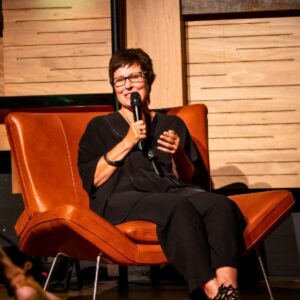
Heather Rose discussing her work at Stella Day Out.
“I don’t think it’s easy to understand the complexity of the craft of writing a novel unless you’ve actually tried to write one and completed it,” she said.
“It’s a difficult process in so many ways. It’s time consuming.”
She went on to explain that the task of writing The Museum of Modern Love was particularly challenging and “extreme”.
“It was an endurance, that novel,” she said.
“I nearly gave it up so many times.”
Rose explained she started The Museum of Modern Love after becoming inspired by a photograph of Marina Abramović during her six-hour performance art piece, ‘Rhythm 0’, where the audience was encouraged to use 72 objects to do whatever they wished to her.
“All this was written as a little blurb under the photograph at the National Gallery in Victoria,” Rose said.
“I remember looking at this picture and reading the blurb and I thought, ‘Oh, here’s a character for a novel’. So, I made a fictional version of her.”
Rose worked with this for a long time before meeting Abramović during her ‘The Artist is Present’ piece at the Museum of Modern Art in New York. In this performance, strangers were invited to sit across from her and stare into her eyes for as long as they wished. It was in this moment that Rose realised Abramović was ‘too powerful’ to be fictionalised.
“[She] was so extraordinary in that gallery space,” Rose said.
“The way [the performance] was affecting people was the most extraordinary thing for me. People would sit and start crying, and she’s witnessing them and she’s not responding – but she’s present. It was exquisite to watch that. That was when the overarching narrator [of The Museum of Modern Love] came in, and all the other bits and pieces. So, [writing the novel] was an endurance, and I had no idea that it would become the book it has become.”
Winning the Stella Prize brought Rose widespread recognition and expanded her readership. It also helped her secure a three-week writer’s residency, which enabled her to write “the significant draft” of her 2019 novel, Bruny.
“There was a gardener on the property [of the residency], and he dropped in on me every now and again to make sure everything was all right,” she said, reminiscing.
“One time when he came round, I was sitting outside working on something. He asked, ‘It’s very lonely being a writer, isn’t it?’ And I said, ‘You have no idea – there are hundreds of people in that room in there!’”
Hobart’s UNESCO literature distinction
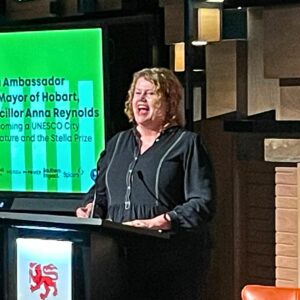
Anna Reynolds speaking at Stella Day Out.
Hobart’s designation as a UNESCO City of Literature last year made Lord Mayor Anna Reynolds wonder what makes the city a great place for writers and writing.
“Perhaps it’s the presence of kunanyi / Mount Wellington looming large above us,” she said, speaking at Stella Day Out.
“Or perhaps it’s our proximity to Antarctica. Or perhaps it’s our isolation. Or perhaps it’s our rich and interesting literary history. So, we’ve learned to develop our own styles, our own ways of expression – our unique voice.”
She added that she is nonetheless “very proud” of Hobart’s UNESCO designation.
“Hobart joins 53 very interesting cities globally who are part of this UNESCO cities of literature network. It’s an extraordinary achievement for Hobart to attract this global recognition and reflective of the importance I think the writing, reading, and storytelling has to the people and culture of Hobart.”
Reynolds added that not all Tasmanians are “able to share in our literary culture”. Some 50 per cent of Tasmanians are functionally illiterate, she explained, and of these Tasmanians, “the opportunities to engage with our stories and to indeed tell their own stories is limited”.
“So, we miss out on these voices and these experiences and this untapped potential.”
But Reynolds added that Hobart’s designation as a City of Literature “provides us an opportunity to fix this”, noting that the city is currently focused on hosting events and launching initiatives to enhance literacy.
UNESCO distinction was an inspiration
Hobart’s designation as a City of Literature inspired Stella to hold Stella Day Out in the city, according to Stella CEO and director Fiona Sweet.
She told Tasmanian Times last week that she hopes the event will be held annually in every capital city of Australia, once enough funding is secured.
“Then my next goal is to start looking at regional Australia, for [people] who can’t get into the city,” she said.
“We know from surveys that we’ve done that lots of people in regional Australia would love access to these kinds of talks.”
Empowering women and non-binary writers

Fiona Sweet.
While talking to Tasmanian Times last week, Sweet emphasised the significance of the Stella Prize.
She explained the prize was established in 2012 by “four or five significant women in the literary world” to amplify the voices of female and non-binary writers’ voices.
“They felt those voices weren’t being heard,” she explained.
“Most of the prizes at that stage were [mostly] being won by men, even the Miles Franklin, which of course is the nom de plume for [female Australian writer] Stella Miles Franklin.”
Sweet added that the prize founders wanted it to be a significant cash prize so that it could change writers’ lives.
“A $60,000 cash prize – as many of our winners will attest – actually gives them the time to write,” she said.
“Royalties from book sales are never enough to live on these days, so the prize is a really significant amount of money to inform and change a writer’s life.”
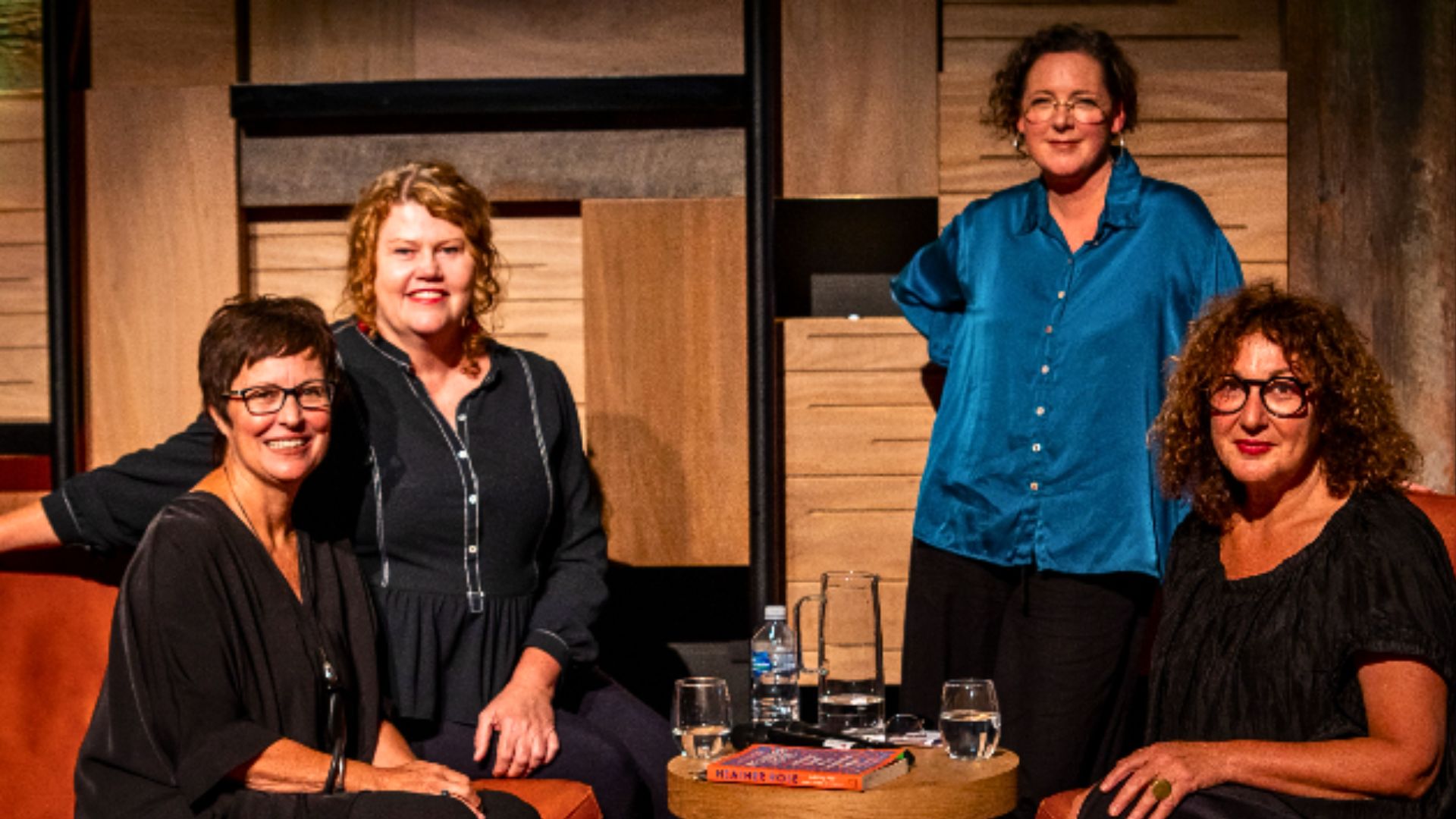
Featured image above: (L-R) Heather Rose, Anna Reynolds, Danielle Wood, and Fiona Sweet at Stella Day Out.
Callum J. Jones studied English, History, and Journalism at the University of Tasmania. He has written fiction and non-fiction for Tasmanian Times since 2018, and can be traced by the smell of fresh coffee.
Follow him on Twitter (@Callum_Jones_10) and Facebook (@callum.j.jones.creative).