Media release – Australian Bureau of Statistics (ABS), 17 August 2023
Unemployment rate rises to 3.7 per cent in July
Labour Force, Australia, July 2023
The unemployment rate increased by 0.2 percentage points to 3.7 per cent in July (seasonally adjusted), according to data released today by the Australian Bureau of Statistics (ABS).
Bjorn Jarvis, ABS head of labour statistics, said: “with employment dropping by around 15,000 people and the number of unemployed increasing by 36,000 people, the unemployment rate rose to 3.7 per cent.
“The fall in employment follows an average monthly increase of around 42,000 people during the first half of this year. Employment is still around 387,000 people higher than last July.
“July includes the school holidays, and we continue to see some changes around when people take their leave and start or leave a job. It’s important to consider this when looking at month-to-month changes, compared with the usual seasonal pattern. The only other fall in employment in 2023 was in April, which also included school holidays.
“While unemployment increased by 36,000 people in July, to 541,000, it was still around 172,000 lower than before the pandemic.”
The employment-to-population ratio fell 0.2 percentage points to 64.3 per cent. The participation rate also decreased 0.1 percentage point to 66.7 per cent.
“Despite these falls, both indicators were still well above pre-pandemic levels and close to their historical highs in May,” Mr Jarvis said.
Employment and hours worked
Monthly hours worked increased 0.2 per cent in July 2023, while employment decreased 0.1 per cent. Some of the increase in hours worked reflected fewer people than usual taking leave during the school holidays.
“The strength in hours worked shows that it continues to be a tight labour market. Hours worked were 5.2 per cent higher than in July 2022, well above the 2.8 per cent annual increase in employment.
“The strength in hours worked over the past year, relative to employment growth, shows the demand for labour is continuing to be met, to some extent, by people working more hours,” Mr Jarvis said.
“Consistent with the growth in hours worked, there were 386,000 more full-time workers than in July 2022. In contrast, part-time employment only increased by 1,000 people,” Mr Jarvis said.
Underemployment and underutilisation
The underemployment rate remained at 6.4 per cent in July, around 2.4 percentage points lower than before the pandemic.
The underutilisation rate, which combines the unemployment and underemployment rates, rose 0.2 percentage points to 10.1 per cent. This was 3.9 percentage points lower than March 2020.
The trend unemployment rate remains at 3.6 per cent, in line with the updated figure for June.
Employment grew by 27,000 (0.2 per cent) and hours worked increased 0.3 per cent in July.
The employment-to-population ratio remains high at 64.4 per cent, in line with the updated figure for June.
“Hours worked has consistently grown faster than employment over the past 12 months,” Mr Jarvis said.
The participation rate remains high at 66.8 per cent. The underemployment rate remains at 6.4 per cent.
“In trend terms, all key indicators still point to a tight labour market,” Mr Jarvis said.
Further information, including regional labour market information, will be available in the upcoming July 2023 issue of Labour Force, Australia, Detailed, due for release on Thursday 24 August 2023.
The ABS would like to thank Australians for their continued support in responding to our surveys.

Media release – Shane Broad MP, Shadow Treasurer, 17 August 2023
Economic storm clouds continue to gather
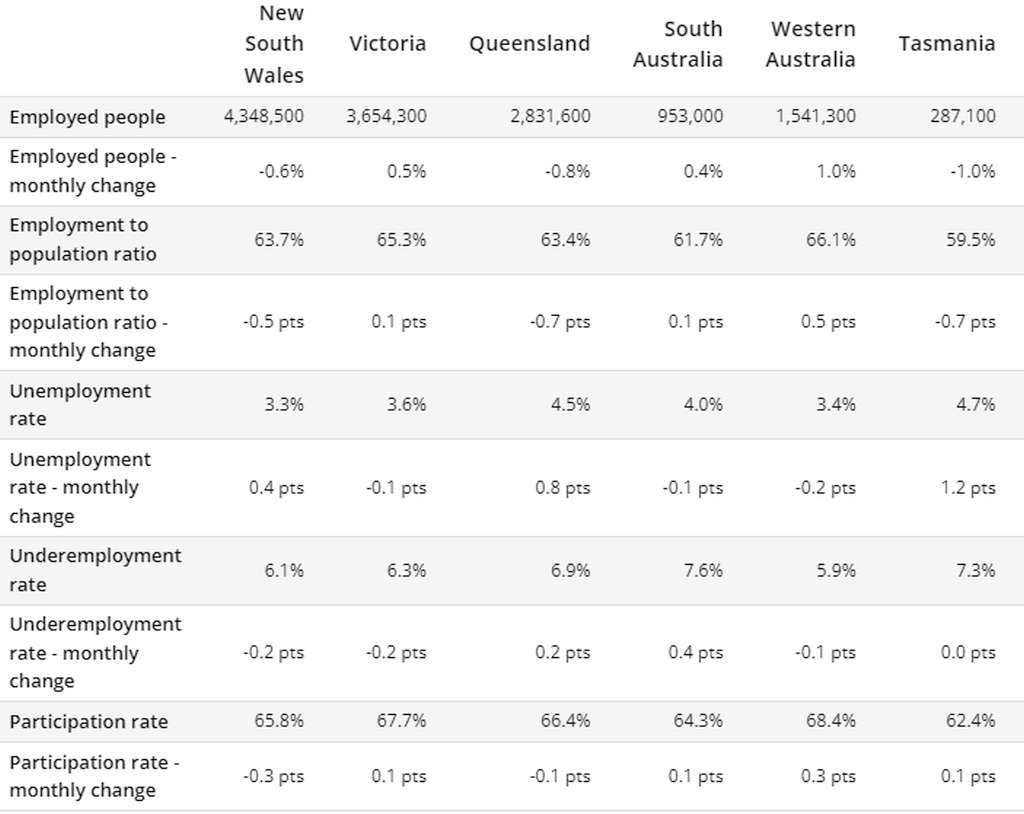
The Liberal Government should be concerned that Tasmania’s unemployment rate continues to bounce around and is at its highest level in nearly two years.
Figures released by the ABS today shows that the unemployment has risen to 4.2 per cent and is the highest of any state or territory.
With the instability of the government, business confidence has wavered and the total number of people in work has fallen for the third month in a row, down 1000 jobs in total.
This is having a massive impact on our youth with the data showing that youth unemployment has also risen to 12.6 per cent, towering above the national average of 9.6 per cent.
With underemployment the highest in the country and workforce participation falling, this spells bad news for Tasmania and bad news for Tasmanians who are already struggling with housing and the cost of living.
Deloitte Access Economics has estimated that Tasmania’s economy shrunk during 2022-2023 and predicts further declines in the year ahead.
Just this week in Parliament, we have uncovered the fact that the energy policy failures of this government have constrained Tasmanian businesses looking to expand and driven potential investors and new jobs away from Tasmania.
It is clear that after 10 years in government, the economic storm clouds are gathering as a result of Premier Jeremy Rockliff and the Liberals’ energy and economic policy failures.