Report – Tourism Research Australia, retrieved 15 June 2023
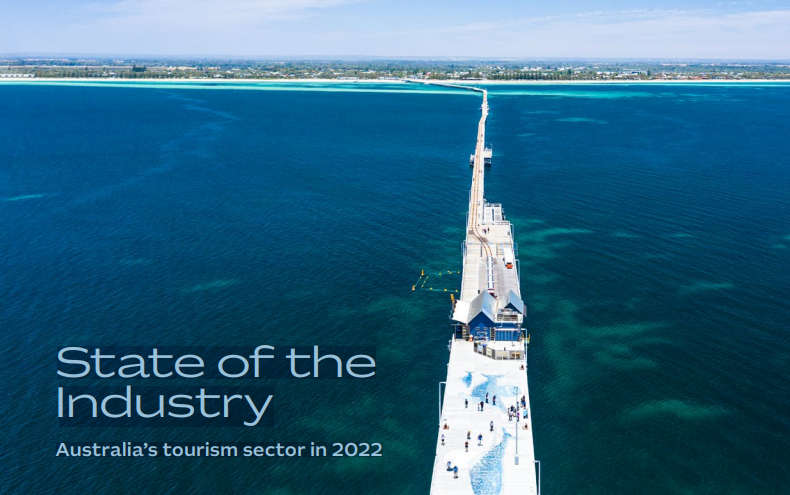
State of the Industry – Australia’s tourism sector in 2022
Summary
The COVID-19 pandemic had a devastating impact on Australia’s visitor economy from March 2020. However, Australians responded by travelling more in Australia in 2021 and 2022. The international border also reopened in early 2022, bringing a steady increase in international visitor arrivals.
The re-emerging visitor economy saw total tourism spend in Australia in 2022 surpass the 2019 level, largely due to strong domestic travel spend.
The rapid rise in demand for visitor services was affected by supply-side constraints in 2022, such as workforce shortages. Other countries around the globe experienced similar constraints.
Visitor economy outlook
The outlook for the visitor economy is brighter than at any time over the past 3 years. However, TRA forecasts a full recovery may take until 2025. Skills shortages are likely to ease over coming years.
The industry-led and government-enabled THRIVE 2030 Strategy, the national long-term tourism strategy, supports the recovery of the visitor economy through and after the pandemic. The Strategy aspires to boost expenditure in the visitor economy to $230 billion by the year 2030.
About this report
The State of the Industry report presents evidence and insights of Australia’s visitor economy performance in 2022. It reports on developments in the visitor economy and helps industry and government understand and adapt to the changing demand and supply environment by:
- using data from many sources
- reviewing trends in both demand and supply of visitor economy services
- presenting contributions from TRA’s research partners.
Below are key metrics used to measure demand and supply in the visitor economy:
Demand and supply metrics
Demand metrics
| Demand metric | Description | 2019 value | 2022 value | Change 2022 on 2019 (pre-pandemic) | Change 2022 on 2021 |
|---|---|---|---|---|---|
| Total visitor spend | Combined value of total international visitor and total domestic visitor spend (in Australia only, excluding international students staying more than 12 months) | $138.5 billion | $143 billion | 3% up | 78% up |
| International visitor spend | Spend from international visitors in Australia only (excluding international students staying more than 12 months) | $31.4 billion | $12.7 billion | -59% down | 780% up |
| Domestic overnight visitor spend | Spend by Australian residents who travel away from home for at least one night (for non-routine purposes) | $80.7 billion | $101.3 billion | 25% up | 67% up |
| Domestic day trip visitor spend | Spend by Australian residents travelling on a day trip (more than 4 hours and 50 km round-trip from their home, for non-routine purposes) | $26.3 billion | $29 billion | 10% up | 59% up |
| THRIVE 2030 target: Total visitor economy spend* | Combined value of total international visitor and total domestic visitor spend (in Australia only) including international students staying more than 12 months | $166.2 billion | $164.2 billion | -1% down | 60% up |
| International visitors | All international visitors to Australia aged 15 or over who stay less than 12 months | 8.7 million | 3.4 million | -61% down | 1424% up |
| International student visa holders in Australia** | Number of international students in Australia that hold a student visa (primary or secondary, excluding the foreign affairs and defence sectors). | 564.2 thousand | 571.8 thousand | 1.3% up | 73% up |
| Domestic overnight trips | Australian residents aged 15 or over who travel away from home for at least one night (for non-routine purposes) | 117.4 million | 108.2 million | -8% down | 32% up |
| Domestic day trips | Australian residents aged 15 or over travelling on a day trip (more than 4 hours and 50 km round-trip from their home, for non-routine purposes) | 248.3 million | 201.4 million | -19% down | 26% up |
| Australian resident outbound trips | All Australian residents returning from travel out of Australia for less than 12 months | 11.3 million | 5.2 million | -54% down | 1637% up |
* This metric aligns with the THRIVE 2030 Strategy spend targets
** Data for 2019 (pre-pandemic year) refers to student visa holders as at 29/03/2020. Data for 2022 refers to student visa holders as at 27/03/2023.
Supply metrics
| Supply metric | Description | 2019 value | 2022 value | Change 2022 on 2019 (pre-pandemic) | Change 2022 on 2020 |
|---|---|---|---|---|---|
| Accommodation rooms | Total number of rooms available in accommodation establishments with 10 rooms or more | 304.9 thousand | 316.1 thousand | 3.7% up | 2.4% up |
| Accommodation occupancy | Percentage of rooms sold, or occupied in establishments of 10 rooms or more | 70.9% | 66.5% | -4.4 percentage points (ppts) down | 13ppts up |
| International aviation seats | Total number of seats available on flights to Australia | 26.8 million | 12.1 million | -55% down | 233% up |
| International aviation load factor | Percentage of seats on flights into Australia occupied by revenue passengers | 81.7% | 80.6% | -1.1ppts down | 61.3ppts up |
| Domestic aviation seats | Number of seats available to people flying within Australia | 77.5 million | 65.2 million | -16% down | 67% up |
| Domestic aviation load factor | Percentage of seats on domestic flights occupied by revenue passengers | 80.8% | 78.9% | -1.9ppts down | 18ppts up |
| Tourism jobs | Number of filled jobs in the tourism industry | 757.5 thousand | 676.4 thousand | -11% down | 42% up |
| Tourism businesses* | Number of Australian businesses in tourism-related industries | 324.2 thousand | 358.3 thousand | 11%up | 6% up |
| Tourism investment* | Total value of investment in tourism infrastructure projects valued over $20 million | $45.3 billion | $44.3 billion | -2.2% down | 3.5% up |
* Data for year ending June (financial year basis).
Data sources for tables
Tourism spend and trips data
- Tourism Research Australia, National Visitor Survey results December 2022, accessed April 2023
- Tourism Research Australia, International Visitor Survey results December 2022, accessed April 2023
- Australian Bureau of Statistics, Overseas Arrivals and Departures, Australia, February 2023, accessed April 2023
International student visa holder data
- Department of Home Affairs, Student visa numbers inside and outside of Australia (data supplied by Department Education) accessed May 2023
Tourism jobs data
- Australian Bureau of Statistics, Tourism Satellite Accounts: quarterly tourism labour statistics, Australia, experimental estimates, December 2022, accessed April 2023
Domestic and international aviation data
- Department of Infrastructure, Transport, Regional Development, Communication and the Arts (BITRE), International Airline Activity—time series, accessed April 2023
- Department of Infrastructure, Transport, Regional Development, Communication and the Arts (BITRE), Australian Domestic Airline Activity—time series, accessed April 2023
Accommodation rooms and occupancy rates data
- STR, subscription data, accessed April 2023
Tourism investment and tourism businesses data
- Tourism Research Australia, Tourism Investment Monitor 2020–2021, accessed April 2023
- Tourism Research Australia, Tourism businesses in Australia: June 2017 to 2022, accessed April 2023