Article
Future of Local Government Options Paper Released

Options Paper – Department of Premier and Cabinet, 14 December 2022
Future of Local Government Review
Executive Summary
Over the past 11 months, the Board has heard from Tasmanians how important strong, sustainable, local communities are for the future wellbeing and prosperity of our state. Local government – alongside our other levels of government, volunteers, community organisations, and local businesses – will play an increasingly important role in shaping and supporting our communities. To do this well, local government needs to have both the capacity and capability to provide the high-quality representation, services, and infrastructure that Tasmanians need and deserve.
This Review is a once-in-a-generation opportunity to design a local government system that can respond to the growing demands and changing needs of our communities, now and in the decades ahead. Tasmania is a small state, and while we must celebrate and support our diverse local communities, we should also harness the collective strength that comes from working together to address the big challenges on the horizon. These challenges include tackling entrenched intergenerational disadvantage, managing the impacts of climate change, and supporting communities through any number of other technological, economic, and demographic transitions the 21st century will bring.
The future role of local government
Understanding the role of local government in the 21st century is at the core of this Review. We know that a lack of clarity regarding the current role of local government has created uncertainty about what councils can or should be doing. This can result in some councils feeling pressure to provide services they might not be well placed to deliver. Sometimes this expansion can be detrimental to some of local government’s traditional core services, infrastructure, and functions.
During the Review, we have heard there is generally broad support for councils continuing to deliver the core functions and services they currently provide, while also expanding their offerings to further enhance the wellbeing of Tasmanians. We have also heard there is a need to ensure that councils retain the flexibility to tailor services (where appropriate) to meet the particular needs of their communities.
There appears to be broad agreement that the Tasmanian local government sector needs to have the capacity, capability, and frameworks if it is to evolve and adequately meet the future needs of Tasmanian communities. While councils need to maintain strong connections with their communities, they also need to have the ability to adapt as their role continues to expand from ‘services to properties,’ through ‘services to people’ and, eventually, to ‘services to support the wellbeing of communities.’
Developing reform outcomes
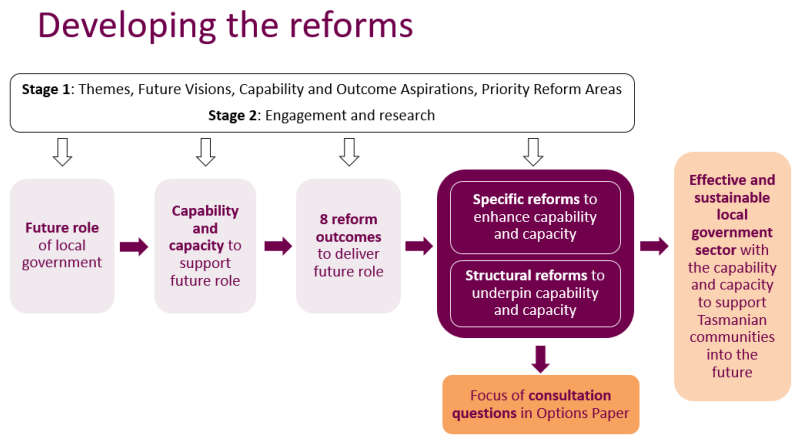
Through its broad inquiry in Stage 2 of the Review, the Board has identified eight reform outcomes which the Review aims to deliver for the local government sector. These are the things we believe are essential if Tasmania’s system of local government is to deliver the services and support the community needs.
There is significant scope for improvement in local government across each of these outcomes. Capability and capacity are highly uneven from council to council. The sector itself agrees with us on these points. In many ways, the sector’s capability challenges are unsurprising given councils’ workforce constraints. In 2018, 69 per cent of Tasmanian councils were experiencing a skill shortage and 50 per cent were experiencing skills gaps. In 2022 this had deteriorated, with 86 per cent of the responding Tasmanian councils experiencing a skill shortage.
The purpose of this Options Paper is to set out a range of specific ideas the Board believes have the potential to get the sector where it needs to be in terms of addressing these challenges and delivering reform outcomes.
The Future of Local Government Review reform outcomes
1. Councils are clear on their role, focused on the wellbeing of their communities, and prioritise their statutory functions
2. Councillors are capable, conduct themselves in a professional manner, and reflect the diversity of their communities
3. The community is engaged in local decisions that affect them
4. Councils have a sustainable and skilled workforce
5. Regulatory frameworks, systems, and processes are streamlined, simple, and standardised
6. Councils collaborate with other councils and the State Government to deliver more effective and efficient services to their communities
7. The revenue and rating system funds council services efficiently and effectively
8. Councils plan for and provide sustainable public assets and services
Enhancing capability and capacity for the future
In exploring how we deliver these Outcomes, we have concluded that specific reform initiatives can only achieve so much in delivering a local government sector that is in the best possible position to meet Tasmania’s future needs and challenges. We must address the fundamental problems with the current structure and design of Tasmania’s existing local government system.
There is broad agreement from the sector that:
• The status quo is not an optimal or sustainable model for the sector as a whole, given growing demands, complexity, and sustainability challenges;
• Some form of consolidation is necessary to deliver greater economies of scale and scope, at least for some services; and
• The scale and extent of the consolidation needed to deliver significantly better services will, unfortunately, not occur on a purely voluntary basis within the current framework.
The Board accepts, through its engagement with the sector and the information it has considered, that a critical part of the solution for local government reform is finding scale in key areas. We know enough to conclude that having 29 organisational boundaries can be detrimental on, for example, the ability of councils to attract and retain key skills, to uniformly manage assets well, and to deliver important regulatory functions.
We also know that the competition, fragmentation, and duplication of effort across 29 councils can hinder collaborative effort and outcomes when it comes to managing regional and state-wide challenges which inevitably transcend our current LGA (local government area) boundaries.
We do not know everything about how scale is impacting on the operations of councils, or what the exact solutions should be in terms of future structural models. Further work will need to be done as we move towards framing final reform recommendations in Stage 3 of the Review. It is clear, however, that we cannot deliver a meaningful set of reform recommendations without an open, objective, and purposeful discussion on how to access the capability benefits that greater economies of scale and scope can provide.
It is also the Board’s view, and the majority view among experts and sector stakeholders, that the solution to addressing the issues of scale is unlikely to be found through minor modifications to the current model of local government. It is almost certain that system-wide reform will be required. This means redesigning Tasmania’s system of local government to ensure councils in the future have the requisite scale, resources, capability, and capacity to deliver on their critical functions.
If this ‘joining up’ is well planned and properly supported by the State Government, we think the sector can improve the overall quality and range of services it provides to all Tasmanians and better support a range of important social, economic, and environmental outcomes.
We also think this could make local government a better place to work and help attract and retain talented workers. If the status quo continues, and there is no meaningful reform of the sector, it is our view that significant challenges will continue to emerge. Without substantive and well-planned reform, we think there will, inevitably, come a ‘tipping point’ at which services suffer, and some of our 29 existing councils will not be able to afford to function effectively. When we put it in these terms, the Board believes the opportunity cost of inaction is too great to ignore.
We cannot deliver a meaningful set of reform recommendations without an open, objective, and purposeful discussion.

Pathways for structural reform
Some form of ‘scaling up’ is critical to delivering the capability that is needed for 21st century local government service delivery. The broad approaches to achieving consolidation being considered are:
1. Significant (mandated) sharing and consolidation of services
Under this pathway, certain local government functions and services would be consolidated and centralised at the sub-regional, regional, or state-wide scale, where there are clear efficiency and effectiveness benefits in doing so. Current local government areas would be largely – if not entirely – preserved, but councils would be required to participate in formalised and consistent shared services arrangements for identified functions.
2. Boundary consolidation to achieve fewer, larger councils
Under this pathway, the administrative boundaries of Tasmania’s current 29 LGAs would be ‘redrawn’, and a series of new, larger LGAs established. New councils would be established to represent and deliver services to these LGAs.
3. A ‘hybrid model’ combining both targeted sharing of services and targeted boundary consolidation
This would involve some boundary changes (though less than under option two), and some service consolidation where clear benefits can be identified.
There are already many good examples of councils working together to provide services in different ways, including by sharing staff and other resources. In some cases, councils have created joint authorities to manage specific functions or facilities, like Dulverton Waste and Southern Waste Solutions. There is further potential for this way of working, but it is likely the State Government will need to provide leadership and support to the sector to make it happen at the required scale. There are simply too many barriers right now to expect councils to ‘go it alone.’
The Board understands that Tasmania’s system of local government is complex, and that reform is challenging. We also appreciate that larger urban councils – who are in a relatively strong position in terms of their current scale and organisational capability – may not see why they need to be part of a wholesale restructuring of local government.
The Board’s view is all stakeholders will need to elevate their thinking beyond the interests of individual councils if Tasmania is to have a system of local government which best meets the future needs of the overall Tasmanian community
Bearing in mind the current council boundaries were drawn 30 years ago, and these were adapted from boundaries which were set in the early 20th century, it is hard to argue they will be relevant today, let alone in 30 years’ time. No doubt, ideas of place and connection to community remain central to the Tasmanian way of life. With the technological innovations of the past 20 years, people are living more flexible and mobile lives. Many Tasmanians can now work remotely online for at least part of their week, while others are happy to commute from outlying areas into urban centres because they value the lifestyle benefits of smaller communities.
In other words, our perception of ‘local’ has changed and is more complex and nuanced than it was 30 years ago. Our local government boundaries need to better reflect these realities, so there is a strength, fairness, and logic in how communities collectively help shape, pay for, and access crucial services and infrastructure. We must all remember that ultimately, councils exist to play a vital role in serving communities, but they do not necessarily define them.
The Board wants to know how people feel about the way councils work and to understand their views about which ideas and options we are putting forward that could make the most practical and positive difference for local communities.
The Future of Local Government Review is at a critical juncture, and Tasmania has an opportunity to be bold. We should not rule out big ideas because we think they will be hard to implement.
As the Review nears its final stage, the Board wants to hear your feedback – both on the specific reform options we have identified and on the ‘big picture’ structural reform pathways. The Board does not think the status quo is an option, and would like to better understand where the community sees the future of local government.
Finally, the options and models discussed in this paper do not reflect the Board’s final views on any preferred reform pathway – they reflect the information and evidence received and considered to date.
Read the full paper here: https://www.futurelocal.tas.gov.au/wp-content/uploads/2022/12/FoLGR-Stage-2-Options-Paper.pdf.

Media release – Local Government Association of Tasmania, 14 December 2022
Local government welcomes review options paper
The state’s peak body for local government welcomes today’s release of the Local Government Board’s Future of Local Government Review Options Paper.
LGAT President and West Tamar Mayor Christina Holmdahl said she is pleased the Board has consulted broadly with the sector prior to putting the options together for the future of local government in Tasmania.
“As the closest level of government to the people, councils play a vital role in ensuring all Tasmanians have the opportunity to live healthy, active lives in communities that support connections to people, place and culture,” Mayor Holmdahl said.
“The Board has offered a number of significant reform options for councils and the community to consider, and we encourage members of the community to provide their feedback on this important work,” she said.
Councils will now work through this paper methodically and provide their feedback to the Board early next year.
“On behalf of the sector, we will continue to work with the State Government to ensure local government has both the capacity and capability to provide the high-quality representation, services and infrastructure that Tasmanians need and deserve,” Mayor Holmdahl said.
The Local Government Board is seeking feedback on the Options Paper until 19 February 2023, you can find the paper here.