Article
Linda Cockburn – Eat My Shadow

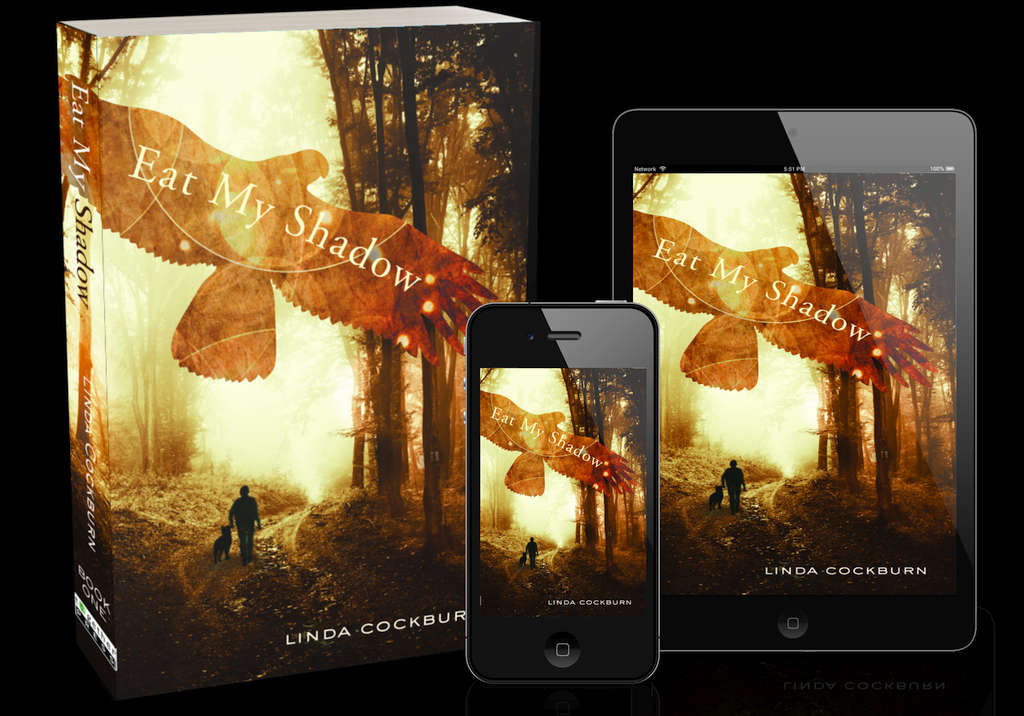
Eat My Shadow, Australian dystopian literary fiction from the author of Living the Good Life, has just been released.
Blurb
20 years ago the world went quiet. Father is stranded between the living world and the lost, he saw the end and he can’t let it go. Finn was a child when it collapsed. Now he’s a young green vine growing up through the ribcage of a lost civilisation. It’s 2053, Father and Finn live alone in a remote valley in Tasmania. Everything is about to change. A story of survival, of being lost and finding ourselves again, and the love between a father and son.
WHAT PEOPLE KNOW
Linda Cockburn is best known for challenging her family to go six months without spending a dollar by growing their own food, using bicycles for transport, harvesting rainwater and sunlight from their roof in Living the Good Life, How One Family Changed
Their World From Their Own Backyard. Hardie Grant, 2006.
As a result the family had three television appearances and radio, newspaper and magazine coverage, including Time magazine.
Linda Cockburn has written for ABC Organic Gardener Magazine since 2004. More recently (2022) she has appeared on ABC Gardening Australia with partner Trev Wittmer about their rare heirloom seed business, Seed Freaks (recently sold).
WHAT PEOPLE DON’T Know


“I didn’t realise what I was doing until I stumbled upon a description of lucid dreaming. I’m not awake and I’m not asleep. The ego falls away and insights and connections I might not have seen are revealed. I see everything like a movie, hear the words and can semi‐wake to record long passages by memory, often in reverse.”
Her passion is to connect people with the lives of their descendants, and emphasise the part they’re playing in them.
Eat My Shadow is available via Tasmanian Publisher www.togetherpress.com.au and at 40,000 global booksellers/libraries.
ISBN: 978‐0‐6455142‐0‐9 $26.95 (pbk)
ISBN: 978‐0‐6455142‐4‐7 $9.95 (epub)
ISBN: 978‐0‐6455142‐5‐4 $9.95 (mobi)
With the author’s permission Tasmanian Times is able to publish a sample chapter below.
Chapter Four
Father
17 years earlier
Hegira (n) A mass journey to escape danger or persecution.
Regret Grief
I met Nicholas on the driveway. We’d seen him walking down the road wearing a backpack with a sleeping bag tied to it. Piper and Finn were hiding in the goat house. Just a precaution. But Nicholas hadn’t eaten or drunk anything in days and was no threat. I invited him in. He sat at our kitchen table and promised to share news in exchange for food and drink. I would have given it regardless.
He had dark hair and sallow skin; his hands trembled. His smile was tentative, sincere. I sat a large glass of water with half a squeezed lemon, a little salt and a teaspoon of melted honey in front of him.
‘It’ll help you absorb it better,’ I said, and he’d swallowed it, eyes closed, water overflowing the corners of his mouth, which he wiped with the back of his hand and licked.
I gave him another and watched him surreptitiously while I prepared him a plate of beans with preserved tomatoes and a sprinkle of salt. He started with gusto, then stopped, grimaced and pointed at his mouth.
‘Gotta cramp. Roof of my mouth.’
He was forced to rest and take it spoon by slow spoon.
He’d walked from Hobart five days before. Part of the last great exodus. The population had diminished over the years. Piper and I been part of the first breaking away. We travelled by car, our last tank of fuel. But the people who remained left it till they had no means of leaving but their feet. They’d not left earlier because of their age or the age of their children; some were just those stubborn few who clung to the idea things would get better, would return to normal.
They’d survived on backyard gardens, on growing food at the botanical gardens, converting lawns to gardens, and occupying the glasshouses. It was a knife-edge they lived on. The electricity had either gone or was a sporadic mystery one learnt to live without, though the sound of battery-powered chainsaws could be heard the day after they’d had a shot of the good stuff. But mostly houses were dark, the tiny lights of appliances blinked off forever.
Water persisted. In the driest city in Australia, some may have worried it might one day stop. But most assumed it would endure.
Four days before Nicholas started his journey, the city had woken to taps that no longer ran. Instead, they grunted in spurts of compressed air, rattling the pipes like old men coughing up phlegm. They waited. Those with rainwater tanks were inundated with requests. If they refused, the crowds simply took it. But most stood at their kitchen sinks and turned their taps on and off hoping for a burst of water, still smelling faintly of chlorine. Enough to drink, wash and tend their gardens.
Groups huddled on the streets to discuss it. Plans were made. The following day roughly twenty-five thousand people woke thirsty and began the grim journey. People bundled up as many belongings as they could. Wheelbarrows and wheelie bins were the chosen mode for carrying items deemed essential.
Some walked across the Tasman Bridge, the humpbacked whale of infrastructure, and stared back over the sides at the abandoned city. Some left for to Richmond, or for the strong, the Peninsula. No one knew what was there. Others walked north to the Derwent Valley. Some took to the water and let their boats drift south down the channel.
‘Lucky for us,’ Nicholas said, the fewest took the route south to the Huon Valley; the first obstacle is a steep mountain, followed by further mountains. But there’d been stories of small enclaves of thriving people who would welcome them, and for many, it was enough to make them strap their babies to their bellies, their belongings to their backs, and start walking. He’d joined them.
At first, if something was dropped, someone would scoop it up and return it, but as the sun blazed and tongues clagged, belongings were cast aside. What was once deemed of great worth found itself superfluous. Photo albums, jackets, an assortment of umbrellas to shield one from the sun. Axes, fluffy toys, pots, blankets and odd things, china teapots, wooden stools, no longer chargeable cameras, and a large aloe vera in a plastic pot.
People clustered beneath the sparse shade at roadsides contemplating their loads and making agonising decisions about what to leave behind. Some waded into the roadside grass and attempted to hide things to retrieve later. But most quietly stacked them in neat piles or tossed them aside and moved on.
It took only an hour of slogging up the first long hill before the thin legs of the elderly were seen draped over the sides of barrows as they stared glassily behind them, clutching what they could to their bony chests. Children lay like sleeping puppies, or mewled like kittens as their parents heaved and blustered.
On the first day, Nicholas had seen a pink and white bundle of rags on the side of the road and had almost passed it before he recognised it as an elderly woman, her mouth agape, the skin of her eyes dull and dry. Like roadkill, he’d thought. He’d walked on.
It took three hours to get to Kingston, a large town only ten minutes drive south of the city. It too was largely abandoned. Faces appeared at windows and doors and watched the line of refugees with horror. Their taps were full of air, and their river was dry too. Many joined their ranks, while an equal number of elderly begged to be left behind, frightened by the thought of dying on the road. Vacant houses were found for them, goodbyes said, and the young and the strong continued, knowing those left behind would not be seen again.
He’d slept the night with a party of a hundred or more at the top of Vinces Saddle, the curving grey road with its rock walls radiated heat so great many turned back to Kingston, liking their chances better there. But the tenacious stayed, softly groaning in the dark, their mouths cracked and bleeding.
There was a shout in the middle of the night, a scuffle, the low growl of dogs. A man had a dog attached to his lower leg. Six or seven others surrounded him. A Rottweiler, as you’d expect, some kind of crossbred poodle, and others Nicholas called medium-sized brown dogs with lots of teeth. A couple of women ran at them waving their makeshift walking sticks. The Rottweiler let go and scarpered to the pack, who hung back, wary. As more of the group struggled to their feet and came forward, the dogs realised their mistake and disappeared into the darkness.
Afterwards, the group clustered together and shared the unwanted heat of their bodies, but the dogs did not return.
In the morning Dan, who Nicholas guessed was fifteen, discovered his grandmother had died during the night. He’d half carried her up the last hill the previous day–they’d all tried to help, but it was token stuff. Dan did the work.
He was distraught, punching trees and screaming. His parents had stayed too long in the US, leaving it too late to return. His Grandmother had brought him up. He was incoherent with grief. No one could work out what he was doing when he climbed the only tree with limbs low enough to reach. Had he gone mad?
Once in the tree, he beckoned for them to hand him his grandmother. They heard the word dogs amidst the sobs and snot and realised he could not leave her to be scavenged. They passed her rag doll body up to him. It was a struggle. It took longer than they had to do it and her thin body lolled obscenely. Finally, Dan had her propped on a branch with her back to the trunk. She kept slipping. A group were passing, and seeing what was happening, one of the men peeled away. He reached into his pack and pulled out a battery-operated nail gun.
He looked at them looking at him and shrugged.
‘Only weapon I have.’ He explained that Dan could nail her clothes to the tree, and hold her there.
The nail gun was passed up. Dan carefully buttoned her cardigan and nailed the sides of it to the tree, rolled it up at the back of her neck and nailed it there too. Gently he settled her head against the bark and kissed her forehead and told her he loved her.
It was the strangest, most disconcerting thing Nicholas had ever seen.
He’d since lost track of Dan.
Gravity sped up their descent, and no one had escaped a tumble, with muscles spasming and weak; most were seen picking gravel from their palms. Many were too far gone from dehydration to complain. Others offered encouragement, reeling off techniques like sucking pebbles to create moisture in their mouths, or keep them closed to reduce evaporation, to walking at first light, finding shelter during the heat of the day, before moving on in the late afternoon. Someone would point out an edible plant on the roadside, and within moments it would be stripped bare and people stood wince-faced, chewing on bitter leaves or astringent berries.
A couple of young boys sped past on skateboards wavering, teetering and whooping. Going, Nicholas thought, at least sixty kilometres an hour. He watched till they were out of sight, trying to recall the tightness of some of the curves and doubting their ability to survive. It was a point of interest that kept him moving. Each curve he’d look for their bodies, some blood-streaked stretch of road and splintered board to indicate the outcome. But he didn’t see them and could only assume they’d made the journey or had sailed off the side and were resting invisible.
Seeing the first dead child was difficult. A boy, indeterminate age–Nicholas was not used to guessing the ages of children–maybe school age, he thought. He was under a tree at the side of the road, his head resting on a worn Buzz Lightyear pillow, his thumb in his mouth, the petals of dandelion flowers scattered over his still body. He would not be the last. At the kitchen table Nicholas closed his eyes and made a whining noise in his throat.
They found a rock with a slick of water seeping down its side. People jostled to lick it. Someone finally yelling that the children should be allowed to go first. People reluctantly stood back, except for one man who refused. He was knocked to the ground by another. No one protested, instead ushering the children forward, hoping to reduce the time spent waiting. No one spoke.
At turn-offs those in front would splinter off and try their luck down overgrown tracks. An unspoken agreement was made–if you saw a group on the road already, pass it by. Everyone was after the mecca of isolated, uninhabited houses with rainwater and firewood, with food still in cupboards or growing in gardens. Too many people down the same road meant competition for resources. It was a fray no one wanted to enter.
They came across empty cars, some locked, others with the key still in the ignition. Nicholas liked to contemplate the mindset in those who left them locked. To lock something signified you felt continued ownership–you thought you’d be coming back. Those who left them open had come to terms with the new world, where cars were stranded assets, whether parked in your garage or haphazardly at the side of the road. At one point he realised it wasn’t just cars, trucks, planes, houses, roads and buildings that were stranded assets, it was all of them, the refugees as well. Stranded, no longer seen as taxpayers, or voters, but liabilities, nothing but mouths to endlessly feed.
If there still was a government, they’d cut their ties to the small island of Tasmania.
On the second night his group clustered around a car, placing the smallest children inside to sleep the night, and protect them from billows of determined mosquitos. A guy called Matt took his guitar off his back and played for them. The sound of it drew people. They stood or crouched and listened in silence. When he stopped no one said a word but shuffled into the darkness to find a spot to sleep.
On the third day, the refugees walked into the Huon Valley, scurrying into overgrown orchards and scrounging for apples. There were a few wrinkled fruits, which were reported to be of incomparable flavour.
Huonville was a watery ghost town, with quiet waters lapping at the foundations of houses, inky waters swallowing the floors of long-gone businesses. The slow stream of people split off down streets on higher ground, calls coming out when water was found; rainwater tanks were not uncommon. Taps flowed and mouths became gulping fish, overflowing, shirts decorated with what could not be caught. They tended to their blisters, poked in gardens for potatoes gone weedy, for self-seeded lettuces, and slept in the dusty beds of strangers.
They’d rested several days, but the town would yield little food, and the mosquitos drove them mad. Then they stepped into the main street with its bent poles and broken windows, office chairs sprawled like strange mechanical weapons in a war long spent. Plastic, leaves and the corpses of birds swelled along the high ground gutters and the hot winds swirled them, reminding people of American westerns.
Half of them turned towards Cygnet, groping their way around the flooded areas, clambering up rocky cliffs and setting off over what was once private land. The other half waded and swam through the greasy waters. The Huon River bridge was a metre below water with at least twenty metres of groaning woody debris piled high on its western side. They half-swam, half-walked. They felt the rifts beneath their feet and stepped across them. It would ease into the waters and be gone one day. They hoped not this one. Should they return, they wondered, would the bridge still be standing?
They knew too much to risk drinking from the river. Instead, they carried bottles filled with rainwater and kept walking. They saw few faces. Some would come to greet them and ask if they knew of a particular person or people; it was a long shot, and at no time did he hear of anyone who had. Next, they asked what was happening in Hobart, which could be relayed. What was happening with the government, were they coming to help? No one liked to answer that one. What of the rest of the world? No one knew. It had been years since there’d been news of the outside world, years since a plane had been sighted, an official seen. They were on their own.
They continued, a shuffling line of human caterpillar. They talked little, the groups splintering off till Nicholas guessed there were only several hundred left, mostly the young. One couple had a child with them, the rest found themselves together due to their greater resilience, tied together by the belief the further they were from Hobart the safer they would be.
‘I’m the head of the caterpillar, the rest of it is inching its way south,’ he said.
Piper painted Betadine on his blisters, and made him up a bed to sleep in. She laughed when he fell asleep before she’d finished making it.
While he slept I talked to Hog. We pooled the last of our fuel and Hog fired up his chainsaw and dropped several stringybarks over the road entrance, then started up his ancient John Deere and pushed up a pile of dirt behind it. It looked fresh and raw, so we tore off branches, spread leaf litter and tried our best to disguise our efforts. Then we stood behind the barrier and watched the poor bastards stagger past with hollow faces and dragging heels.
Nicholas left the following day. We plied him with water and ensured he left with a full stomach and a promise to welcome him should he return.
The following evening, I killed a man.