Article
Anti-Vax Teachers Set to be Dismissed

Editor’s Note: This story was sent to us by a member of the public who has demonstrated their need to remain unidentified. We publish this in the public interest; however, the views contained herein are not necessarily the views of Tasmanian Times.
The Tasmanian Department of Education (DoE) is set to dismiss staff that are not yet compliant with the February 9 deadline to upload their vaccination status, despite the fact it has decided not to make a COVID-19 vaccine booster dose mandatory for all staff.
Secretary of Education Tim Bullard will decide the fate of almost 40 staff that have been in a stand-off with the Department since the February deadline. This follows on from the sacking of a number of teacher assistants and health professionals working in various departments at the end of 2021, due to the government’s response to public health advice & direction.
It is possible that later in the year nearly 100 more staff will resign or face termination as they return from leave or their partial exemptions from having a COVID-19 vaccination expire. Sources close to the author confirm that there were a number of permanent staff who resigned, and others whose contracts were not renewed in 2022 due the vaccination mandates.
In the revision of the DoE risk assessment, which occurred in April of this year, it stated that
“The original risk management plan required workers to be fully vaccinated. Whilst boosters optimise protection from the Omicron SARS-CoV-2 variant, the costs and associated consequences for staff of requiring evidence of having their vaccines up to date as opposed to being fully vaccinated potentially outweigh the impact of the mitigation on the level of risk of transmission.”
The policy was that being ‘fully vaccinated’ with two injections was a requirement to keep schools safe but does not further mention the need for staff to be ‘up-to-date’ with their third dose.
Instead, the revised DoE risk assessment now believes that the cost (and associated consequences) of further mandating vaccinations across the Department is greater than the mitigation impact of being vaccinated at all.
Documents seen by the author show the staff members being stood down are arguing the DoE policy has not been able to demonstrate that the requirement to vaccinate is a lawful and reasonable direction. The state government contends that publicly available statements made by the TGA and ATAGI are sufficient evidence.
Is the public education system undergoing a shortage of employees?
With Tasmania continuing to have amongst the lowest numeracy and literacy rates in Australia, it’s hard to gauge the effect of removing experienced staff and increasing load on younger and not yet qualified employees when they are already harder to retain within the education sector.
The potential leakage of public teachers to the private sector may also have further consequences for the public education system, with some private schools not mandating COVID-19 vaccinations for their employees.
The state government touted its large relief employee pool at the end of the 2021 school year.
Right to Information Showed Questionable Support for Mandatory Vaccination amongst Educators
In December 2021, the DoE drafted a policy requiring that all staff upload confirmation of being double vaccinated. Prior to this announcement, the DoE consulted with staff and unions to discuss the impact of measures and gauge their support.
Staff received a consultation survey accompanied by eight paragraphs of information claiming that Covid-19 would have a devastating effect across Tasmania.
“As you are aware Tasmania’s plan to reopen borders on 15 December 2021 increases the importance of being fully vaccinated against COVID-19 in order to protect the State’s most vulnerable including our families, colleagues and students.”
The question that was asked in the survey was: “Do you consider mandatory vaccination is an effective control measure against the risk of harm to employees from COVID-19 in the workplace?”
This was the question the DoE used to gain implicit support for a mandatory COVID-19 vaccine for the organisation. It wasn’t a direct question like – “Do you support a mandatory COVID-19 vaccination policy for staff in your school / across the DoE?” – A question which would have possibly received less support for.
Following consultation, a draft risk assessment and policy was released to staff in December 2021, stating that:
“Almost 1,300 individual responses to the consultation survey were received during the consultation period, and this feedback has been carefully considered. In addition, consultation has occurred with unions and their feedback has also been considered.
We need to ensure that we have done all that is reasonably practicable to protect the health and safety of all our workers and we clearly heard that our employees want to feel as safe as possible when they come to work. We also hear that the vast majority of respondents supported the need for workers to be vaccinated to attend the workplace.
While I acknowledge that some people have expressed opposing and strongly held views on this matter, the proposed vaccination control measure for workers has gained strong support from our employees.”
A Right to Information request and some simple data analysis reveals that while there was some support for mandatory vaccination it was not from the ‘vast majority’ of the DoE’s 10,869 total workforce.
The Department only received 1,295 responses in total. Of these responses, the Department concludes that,
- 1003 (77.45%) supported mandatory vaccination measures in the workplace
- 92 (7.1%) respondents were against mandatory vaccination measures in the workplace
- 200 (15.45%) respondents being undecided
Whilst this could have been the green light sample population the DoE was looking for to justify their decision, the survey only received an 11.9% response rate. The actual responses detailing their position were redacted from the document released through the RTI request.
From the survey, the mandatory vaccination policy was supported by just 9.2% of the DoE workforce. There was limited consultation of 88.1% of the workforce that did not respond to the survey at all.
According to the RTI released, there were ‘additional’ free text responses, 708 with:
- 516 (72.9%) from supportive respondents
- 142 (20%) from non-supportive respondents
- 50 (7.1%) undecided
Were they in addition to the survey respondents or as part of respondent’s feedback? For all intended purposes, it can be assumed that they are extra responses. The percentages start to become somewhat less clear.
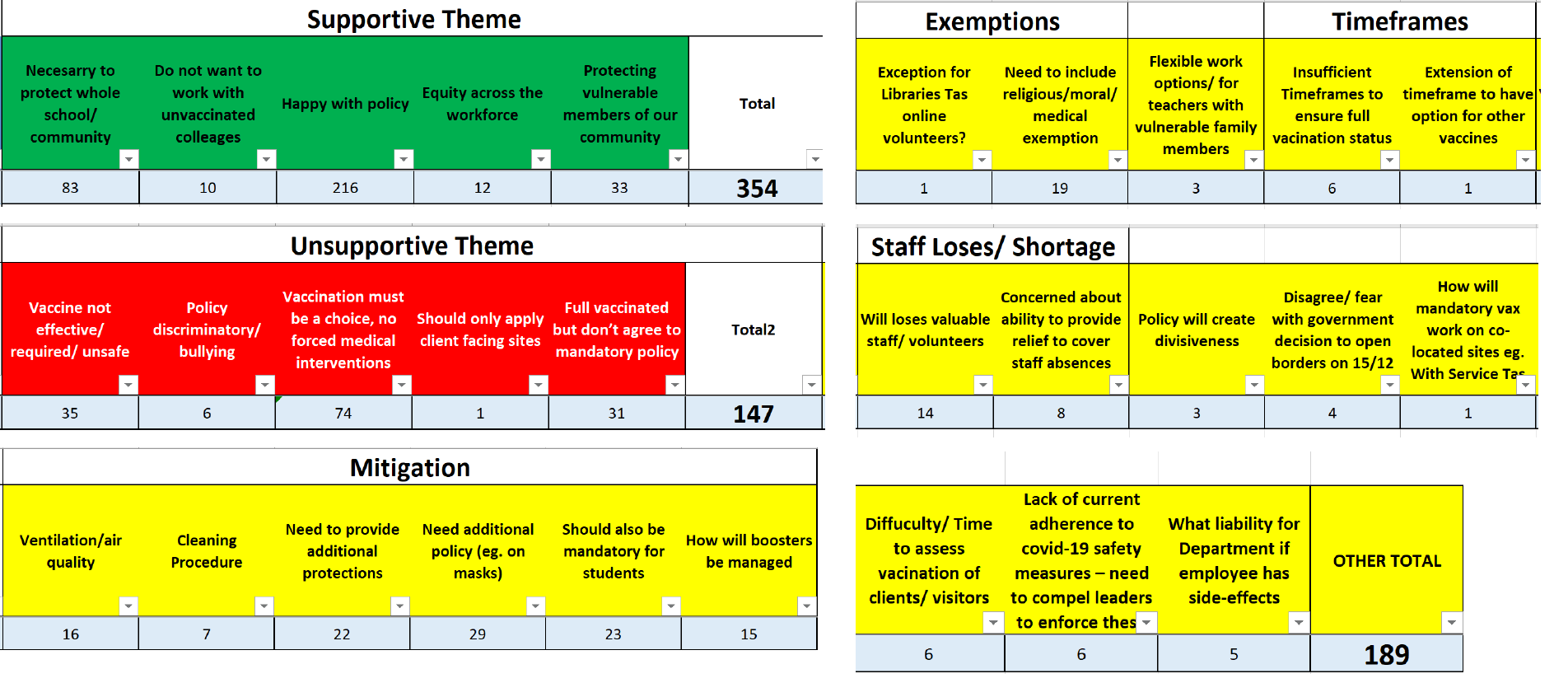

The DoE analysis provided a breakdown of 690 responses into the various themes of the data. It is uncertain as to why only 690 responses could be categorised into themes out of a around 2000 submissions. One possible reason is that more information was not provided by respondents because they had neither the time or interest to go into detail.
- 354 (51.3%) were supportive
- 147 (21.3%) non-supportive
- 189 ‘(27.4%) Other’ responses
The numbers for ‘vast majority’ start to become quite unreliable. Until someone within the Department releases more information about how they structure their questionnaires and how they analysed feedback received, it can be assumed that the secrecy is to cover up the Secretary & Deputy Secretary’s agendas to gain support for an idea they’d (or the Department of Premier & Cabinet) already decided was good for the Department. This follows well established patterns of community consultation that takes place in all tiers of Government.
Contact with unions has also revealed that out of the three unions involved, one did not support the measures and one would not comment.
Another, the Australian Education Union, has conceded that while making no attempt to personally canvass members prior to consultation, it maintains support for the government measures. This has left members impacted by the mandates very little support in the fight to retain their employment.
The Minister for Education Roger Jaensch has declined to respond to inquiries and calls to review the DoE policy despite a difficulties in staff shortages, both permanent and casual, across the state.
A more comprehensive consultation with employees could help the Secretary of Education Tim Bullard, obtain a broader view of how the staffing impact has affected public schools’ ability to provide quality education services to Tasmanian communities.
Insider story
Tessa* is an employee of the Department of Education but wishes to remain anonymous as she is currently suspended for not providing her vaccination status. She contacted us to share her experience:
“It’s incredibly difficult to feel so helpless. I know some staff that are also in the same position as I am but didn’t respond to the survey for fear of being targeted as ‘anti-vax’. Lots of my colleagues and friends still at work have voiced their objection to the mandates but also didn’t respond because the survey was sent at an incredibly busy time of year and unlike the annual Staff Wellbeing Survey, no time was allocated in staff meetings.
“It’s crazy to be sat on the sidelines fighting to keep your job, while your colleagues struggle to provide quality education in very difficult conditions. As more and more people contract the virus it has become obvious that vaccination does not stop transmission and some of the DoE measures simply do not work, it’s time to dissolve the mandates.”
*pseudonym
Are you a current or former public servant? We’d love to hear your perspective on the issue. Send a letter to the editorletters@tasmaniantimes.com.