Article
Jessie Rooke’s Message: Perseverance and Persuasion Make Change

Jessie Spinks Rooke may have died over a hundred years ago, but she has a message for us that is more important than ever.
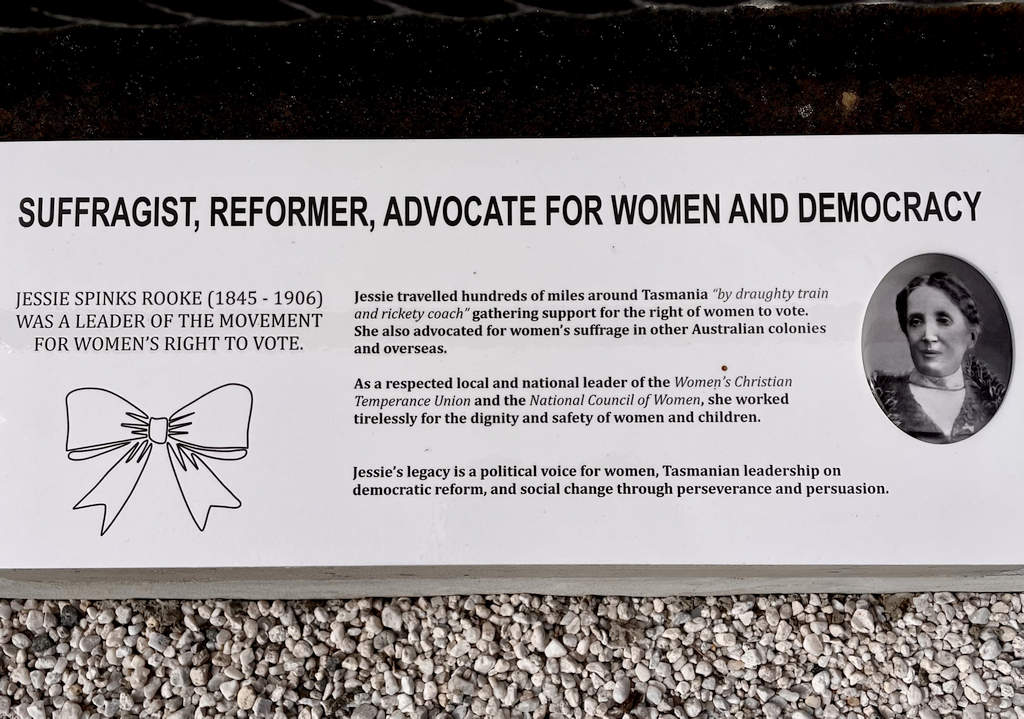
Jessie was Tasmania’s leading advocate for women’s right to vote. Born in England in 1845, Jessie moved first to Melbourne, and then to Burnie in the 1890s with her second husband Charles Rooke. Soon after, Jessie became the president of the Burnie Women’s Christian Temperance Union.
The WCTU was the main group pushing for women’s suffrage because it believed women voting was essential if the law was to protect the safety and dignity of women and children.
Jessie went on to become the president of the Tasmanian and Australian WCTUs, as well as an active member of the National Council of Women which was also heavily involved in the women’s suffrage movement.
Alongside another prominent Australian women’s suffrage advocate, Vita Goldstein, Jessie was a delegate to the first international women’s suffrage conference in the United States in 1902. It is said that she was one of the first Tasmanian women whose achievements were recognised around the world.
Finally, on September 16th 1903, thanks in no small part to Jessie’s efforts, Tasmanian women finally got the right to vote.
That achievement alone is inspiring. But what urgently matters today, even more than what Jessie did, is how she did it.
At the time Jessie became involved in the Tasmanian women’s suffrage movement in the mid 1890s there was a need for a new strategy. More than a decade earlier Tasmania had been the first Australasian colony to have legislation introduced allowing women to vote. But that attempt to change the law, and the many subsequent attempts, were all blocked by the backwards-looking and unrepresentative Upper House.
Clearly, not enough men in Parliament were listening, so Jessie and her fellow suffragists decided it was time to go to the people. Jessie and a fellow advocate spent months travelling around Tasmania in horse drawn carts along muddy roads in freezing temperatures to gather signatures on a petition for women’s right to vote.
They visited towns large and small, addressing large public meetings with the refrain that women’s right to vote was “an act of common justice”.
It worked. Thousands of everyday Tasmanians signed the petition. Then, when the Tasmanian Upper House again said No to reform, Jessie went around the island all over again with a second petition.
Even when Parliament finally said Yes, Jessie didn’t stop.
She founded the Tasmanian Women’s Suffrage Association to educate women about voting in a way that would improve their lot. She continued this task right up to her death of heart failure in Burnie in 1906, aged 60.

In short, Jessie Spinks Rooke believed that change arises from perseverance and persuasion. She did not give up despite the powerful forces standing in the way.
She believed that everyday Tasmanians would embrace her cause if only they could hear her message. She lived up to the women’s suffrage motto, ‘Agitate, Educate, Legislate’.
She believed in what we today call ‘change from the grassroots’. So she could rise to the challenge, Jessie cultivated the qualities necessary to run an effective grassroots campaign.
She was known as ‘an excellent and forceful speaker’, a ‘good mediator’ and a ‘self-denying worker’. She knew how to build bridges to other people so her message could stride into their hearts.
Jessie’s belief in people power matters to us today because of a growing disillusionment in our capacity as citizens to make positive change.
We look around at the climate emergency, growing inequality, creeping authoritarianism and dysfunctional government, and wonder what difference we can possibly make, indeed whether change is possible at all.
Too many of us give in to anger, apathy, cynicism and disdain for those with different views. Too few of us still have hope that we can make a difference.
Jessie Rooke’s neither abandoned hope, nor give in to negativity. She didn’t just sit in her drawing room sounding off to her friends about ‘those men in government’. She didn’t shrug and say ‘someone else will fix it’, or ‘nothing ever changes’.
Jessie’s unshakable faith in her cause and in her fellow citizens saw her get on with the job of persuading and advocating, no matter how hard it was. And her faith was vindicated. As she slogged through the mud from town to town, Tasmanians rallied around her so ardently the world paid attention to what she had been doing.
Not even the old men in power could stand in the way. Jessie’s story might be from another age. The reforms she campaigned for might be taken for granted now.
But the inspiring and optimistic example she set for those of us who want to make the world a better place is one that never grows old.
Rodney Croome contributed to the recent restoration of Jessie Rooke’s grave in Burnie.

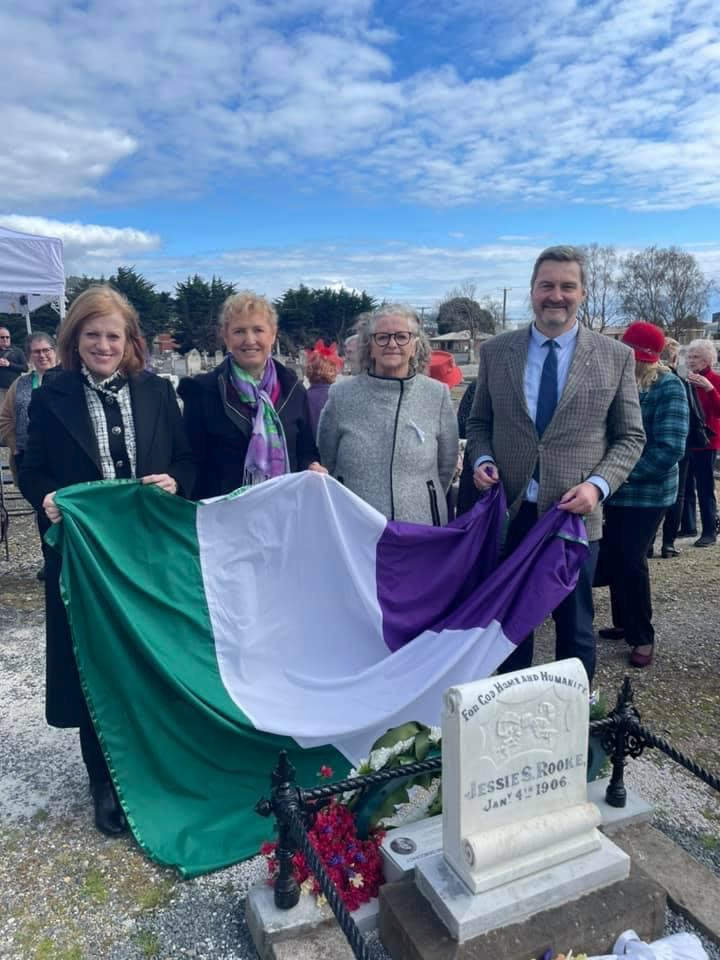
Governor of Tasmania Barbara Baker, Ruth Forrest MLC, Vicki Russell who coordinated the restoration project and Rodney Croome.