Article
700K-signature Assange Petition to be Presented to Parliament

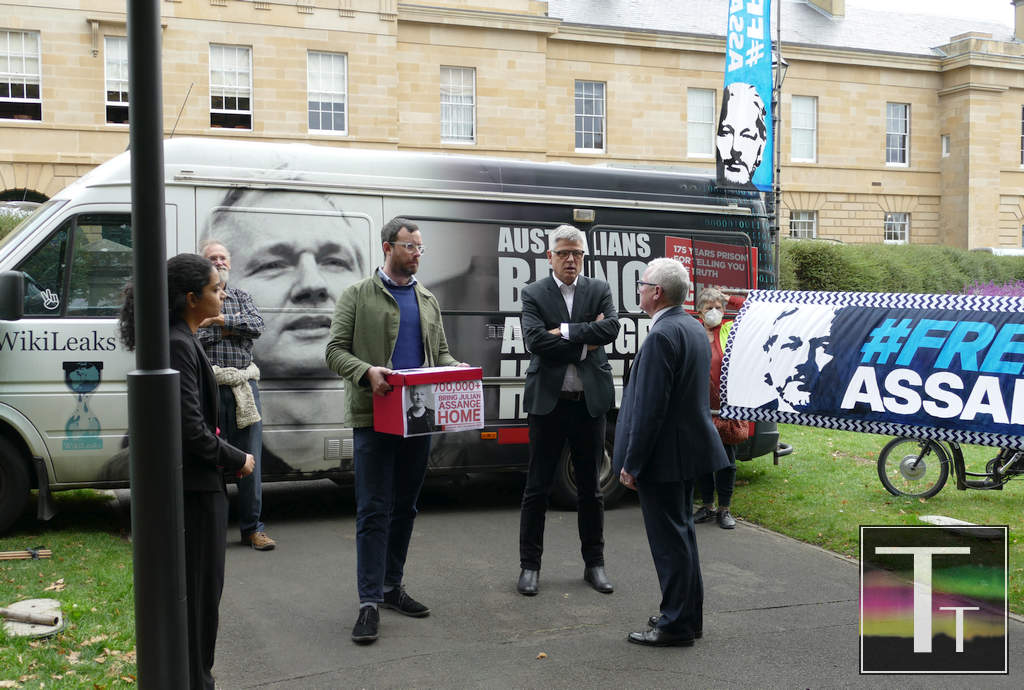
Media conference with Salonie Dua Change.org, Gabriel Shipton brother of Julian Assange, Andrew Wilkie MHR for Clark and Greg Barns legal adviser to Assange family, Parliament House Lawns, Hobart, 3 May 2022.
Salonie Dua
Hi everyone, thanks for coming down here today. My name is Salonie Dua, I’m the Senior Campaigner change.org. Today on World Press Freedom Day we’re here for Julian Assange, with his brother Gabriel Shipton, to deliver a 700,000-strong change.org petition to Mr Andrew Wilkie, who’s the independent Member for Clark. We’ll be hearing from Mr Wilkie followed by Gabriel and Greg Barns, who’s the legal adviser for the family. If you have any further details you need or specific footage, just please let me know. Thanks all.
Andrew Wilkie

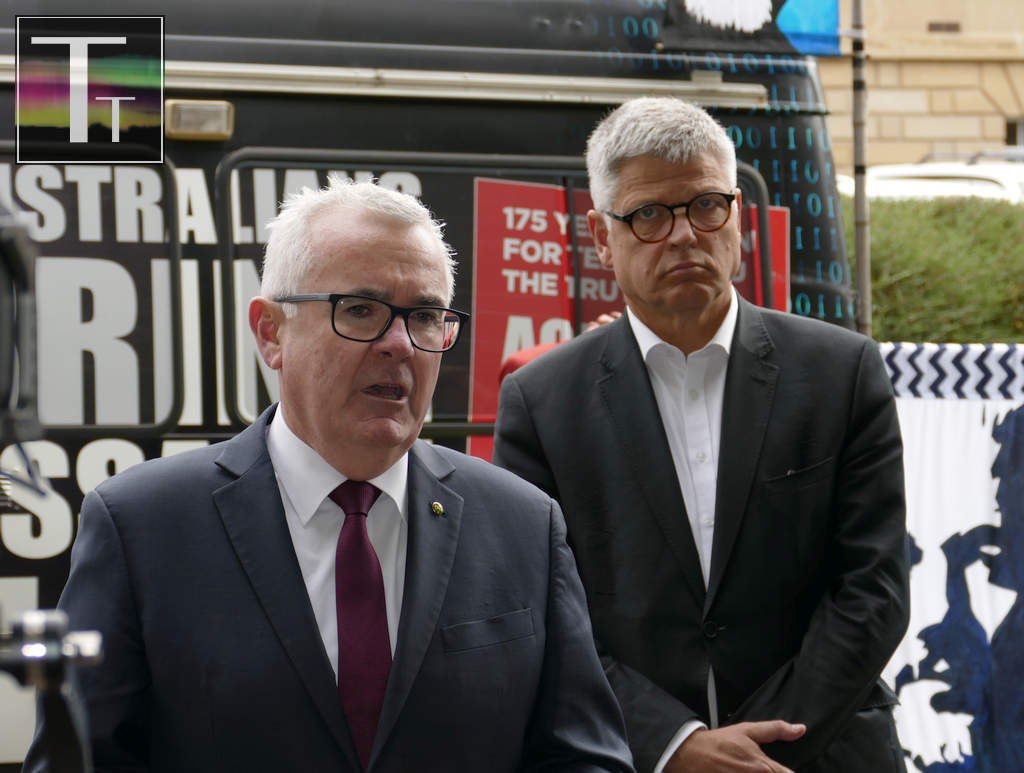
Andrew Wilkie.
Well, it’s very important that I accept this petition of over 700,000 signatures in support of Julian Assange, and calling for his release from Belmarsh prison. It’s very telling that so many people are of one view, that the continued imprisonment of Julian is a terrible injustice, and a terrible attack on media freedom.
Here we are on World Press Freedom Day, and it’s a very appropriate day to reflect on the media aspect of the incarceration of Julian. You know, at the end of the day, Julian Assange is an Australian Walkley Award-winning journalist who has been imprisoned for years and facing the very real prospect of life imprisonment, for nothing more than acting as a journalist, and bringing to the public’s attention, hard evidence of US war crimes.
That he is in prison in Belmarsh high security prison for I think about three years now, the fact that the US is so determined to get even and to take him to the US, and to shove him in a federal high security prison for acting as a journalist – consistent I would add with the US constitution and the rights enshrined in the US constitution – this is beyond the pale. In my opinion Julian should be immediately released from Belmarsh prison, and allowed to return to Australia if that’s his wish, and the US pledge to drop and to drop forever their vendetta against him, including this unconscionable intention to extradite him to face imprisonment in the US for acting as a journalist. It really is that simple.
Now, I’m going to take this opportunity again, to call on the Australian Prime Minister to pick up the phone to the US President and say ‘enough is enough’. This persecution of an Australian citizen and an acclaimed journalist must end. If Scott Morrison has the good relationship with the US that he tells us, then he has every ability to pick up the phone and put an end to this. And he could also pick up the phone to Boris Johnson. And to remind Boris Johnson that an extradition in these circumstances is entirely at odds with the extradition agreement that the UK has with us, because political crimes are explicitly excluded from that extradition agreement.
Until our Prime Minister does that he is treating an Australian citizen and the rule of law and the principle of media freedom with contempt. And I call again, on the opposition leader, the man who could be the Prime Minister in as little as a few weeks, to get out in front of a camera and to unambiguously tell the Australian people what he will do for Julian Assange if he becomes the Prime Minister. You know, this is a real test of leadership for the Prime Minister and the alternative Prime Minister, and so far they are letting an Australian citizen down. They’re letting an Australian journalist rot in prison.
Gabriel Shipton

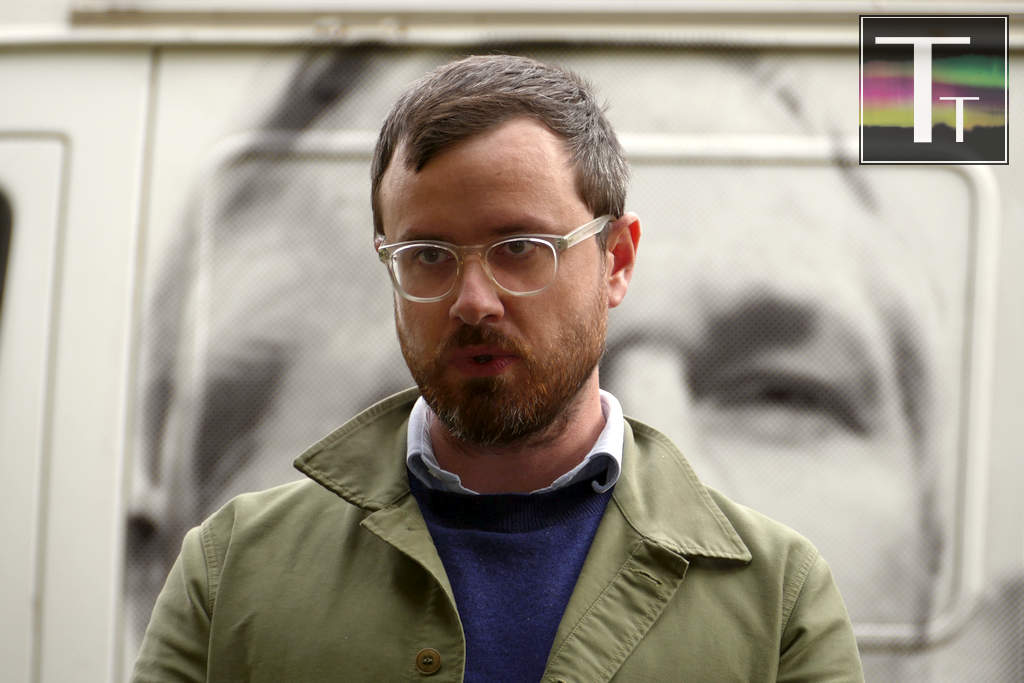
Gabriel Shipton.
Thank you everyone for coming. I think this is very significant. This petition – 700,000 people – just goes to show the broad support there is for bringing Julian home. There’s also the last poll done in the 9 newspapers, at the end of last year, showed 70% of Australians support bringing Julian back to Australia. So yes, now is a critical time in the UK; there is no legal proceeding to hide behind any more in the UK. The extradition order is with the UK Home Secretary, Priti Patel. And so now is the time the government can intervene and come up with a political solution to bring Julian home. It’s up to the Prime Minister now to pick up the phone and bring Julian home. Thank you.
Greg Barns
Just to add to Andrew and Gabriel’s comments, this matter has been in the courts, it’s now in front of the UK Home Secretary. It is a political matter. There is plenty of precedent for Australian governments getting involved in cases where Australian citizens’ lives are at risk. And particularly in cases where Australian citizens are facing, as in this case, what is an effective death penalty of over 170 years in jail. That’s been done before. We do it in cases where people find themselves in China. We do it in cases where, for example, David Hicks, a number of years ago, we have done it, and we can do it.
And so it’s incumbent upon not only Prime Ministers, but also our Foreign Minister, the current Foreign Minister Marise Payne, Penny Wong, who would be Foreign Minister, to get heavily involved in this matter, along with the Attorneys-General of each of the jurisdictions to bring an end to what is, as Andrew says, a disgraceful case based on a person who revealed war crimes, something that of course in Australia, we’re currently looking at with allegations in relation to Afghanistan. Thank you.
Journalist – unidentified
What will you be doing with this petition now that it’s been presented to you?
Andrew Wilkie
Yes, well, look, I’m looking forward to taking this petition to Canberra should of course I be re-elected. But if I’m re-elected, I’ll take it to Canberra and I will seek to table it as a document in the Parliament. And that will be a very powerful thing to do. Because, you know, there in the parliamentary record the names of 700 people, with the common goal of seeing justice for Julian Assange. It’ll be one more thing that a decent government cannot ignore. They’ve ignored all these voices up until now, but they can’t ignore that sort of thing, when that’s an enormous gesture of support for Julian.
Journalist – unidentified
And how much power does the Australian Government actually have in this situation to intervene?
Andrew Wilkie
Up until recently, the Australian Government and the Australian opposition to some degree were hiding behind the excuse that Julian’s extradition was before the UK courts, and that that process had to run its course before they could seek to intervene or even really speak up much. Well, it’s now finished in the UK courts. In recent weeks, the UK – the Westminster Magistrates Court, I believe – has ruled that the extradition can go ahead. Now, that’s grim news. But it’s got a silver lining, because it means now that it’s out of the courts, and it is only a political matter, which means that there is no reason why the Australian Government can’t speak up. There’s no reason why the British government can’t put an immediate end to this. And to say, ‘Julian, you can go free’, and they won’t entertain the notion of an expedition.
So the ball is very much in our Prime Minister’s court. He has a good relationship with Boris Johnson. He has a good relationship with Joe Biden. I actually have no doubt that if Scott Morrison took a stand and stood up for this Australian citizen and journalist, I have no doubt that Boris or Joe would say, ‘Okay, it’s gone on long enough’. And you know what, that’d be consistent with the views of many Australians. There’s a lot of Australians now who either like Julian or don’t like Julian, but they all share one view: this has gone on long enough. Let’s just put an end to it.
Tasmanian Times
What’s the latest on Julian himself? I don’t mind who answers this question.
Gabriel Shipton
Julian, Julian’s in Belmarsh prison. He’s been there three years on the 11th of April. You know, he’s not doing well at all. There’s…with this extradition moving forward there’s intense pressure on him. He’s facing a 175 year sentence in the US if extradited and convicted there. So yeah, at the moment he’s really feeling that weight on him after this, you know, three years in prison, seven years in the Ecuadorian Embassy in London, have just worn away at Julian, over the past 11 years. So, you know, he’s, he’s, you know, we live in fear that he might not survive this ordeal.
Journalist – unidentified
Do you have much contact with him? Were you able to contact him?
Gabriel Shipton
No, I don’t…last time I saw him was at his wedding in March. That’s the last time I saw him. So.
Journalist – unidentified
And this petition, is it from people across Australia or the world?
Gabriel Shipton
It’s from people across the world. But interestingly, the biggest cohort of people who have signed this petition, a quarter of a million Australians, and that is the biggest amount of any country who have signed this petition. So I think that’s very significant that the largest cohort of people who signed this are actually Australians.
Journalist – unidentified
And the significance of this petition considering today is World Press Freedom Day?
Gabriel Shipton
Well, you know, Julian is a journalist, publisher. So he is in prison now for publishing the truth, essentially, the truth about war crimes, corruption. And that’s why people are signing this petition as well, because what it means to them their right to know, what has been done in their names by their governments.
Journalist – unidentified
And what does his case say about the way that journalists have been treated more broadly? And I suppose the future of press freedom?
Gabriel Shipton
Julian, he’s been made an example of and, and his persecution gives license to the Australian Government to go after whistle-blowers like David McBride. Bernard Collaery. So, you know, I think that’s what this prosecution means to journalism around the world. And also, you know, our governments in the West, they like to hold themselves up to say, China or Russia, and say ‘your press freedoms’, you know, lecture on press freedoms in those countries. And so when you have a journalist in prison in London, they lose the moral high ground when making those arguments. Thanks.
Journalist – unidentified
Anything else you wanted to add? Greg? Just on press freedom.
Greg Barns

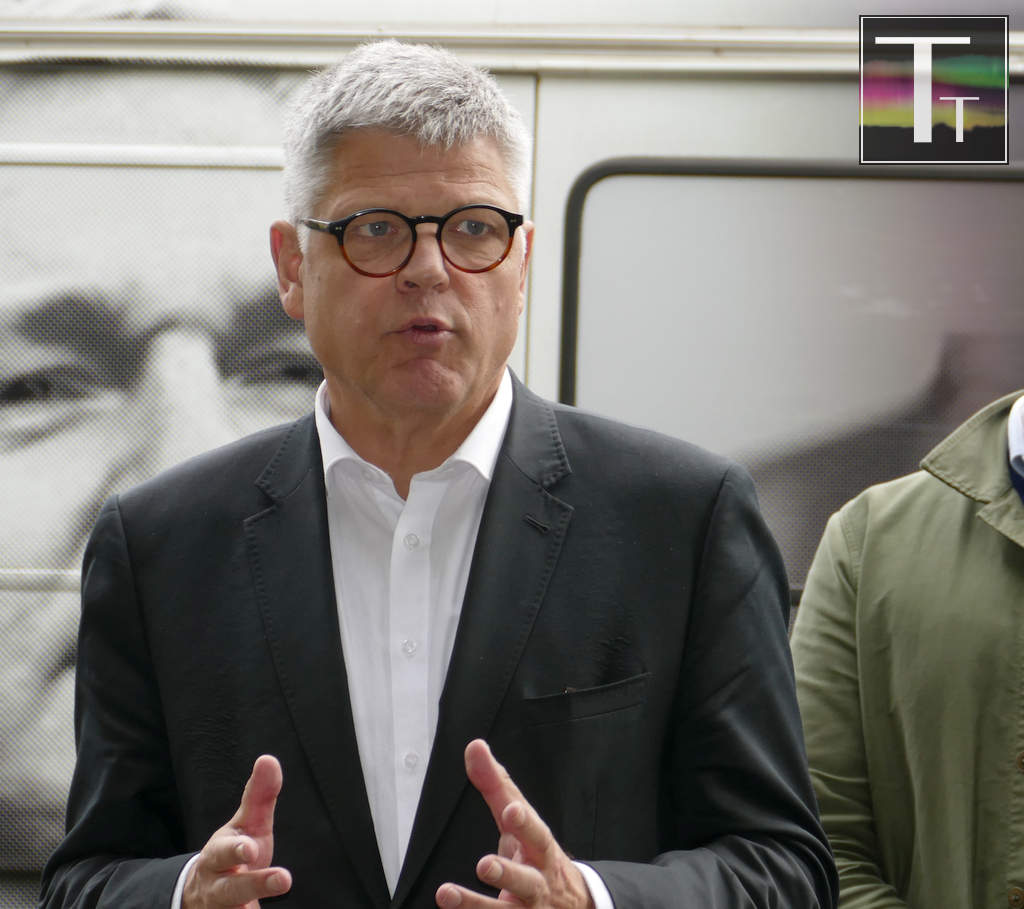
Greg Barns.
Yeah, I mean, we’ve already seen in Australia over the past 10 years a decline of the rule of law, and, most evidently, in laws relating to journalists. Most journalists now are aware of a huge increase in powers on the part of the AFP and ASIO. And these threats to press freedom, like Julian faces, are also faced in Australia. The other point about the Assange case, which needs to be remembered, is this is the first time the United States has used domestic legislation to go after a person who’s not a citizen of the United States, who did not set foot in the United States. What it means for journalists is that if you publish material which the United States deems that you shouldn’t have published, you’ll be on the end of an extradition request. And that’s no exaggeration, because that’s a logical extension of what’s been done. So that, of course, has real implications for Australian journalists who are reporting on the US-Australian alliance.
Andrew Wilkie
Can I offer another perspective, a personal perspective? There are a number of building blocks for healthy democracy. And a lot of them are being spoken about at the federal election, like a federal integrity agency, political donation reform. But two of the most important building blocks of a healthy democracy is having whistle-blowers and those whistle-blowers having legal protections. And the media having the freedom to publicise what the whistle-blowers have discovered. These are critical checks on government and the power of government. Some of you would be aware, a week before the invasion of Iraq in 2003, I became a whistle-blower myself, when I broke ranks from one of the Australian intelligence agencies and, and spoke up about the deceit, about the reasons for war, about weapons of mass destruction, and so on.
But what I did was all fine. But what I did would have been meaningless if there weren’t journalists able to report what I had to say. Not only did that get my concerns out in the public domain and put pressure on the government, but the media publicity also gave me protection. Because there were no protections for me as a whistle-blower The government could have locked me away for years under the Crimes Act. The only reason that government at the time didn’t was that I instantly had a high media profile and media focus and instantly I would have been a political prisoner of sorts if the government had gone after me. So they I’m talking a lived experience. These are the building blocks of a democracy. And now more than ever in Australia, we need strong media freedom laws to achieve the sort of thing I’m speaking about.