Article
TAI: Tasmanian Integrity Commission ‘Still Toothless’
Media release – The Australia Institute, 10 March 2022
Tassie Corruption Body a Toothless Tiger: Research
- Tasmania’s Integrity Commission has second lowest funding per capita in Australia
- 48.5% of Tasmanians distrust the Integrity Commission’s ability to uncover misconduct
- Commission has only referred two people for prosecution in its existence
- Only 6 of 55 recommendations from the 2016 review to improve the Commission have been implemented
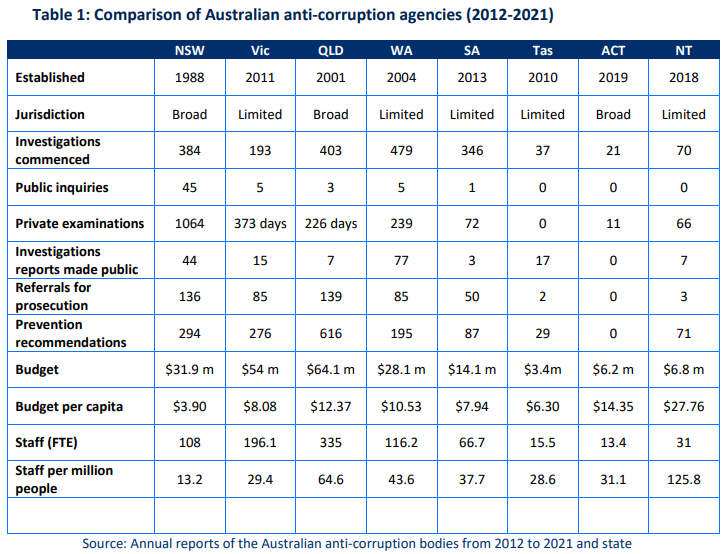
- Tasmanian integrity commission has held fewer investigations than any other state anti-corruption body
According to the research, the Commission has a limited jurisdiction, cannot investigate matters covered by parliamentary privilege and can only investigate ‘public officers’. This, combined with limited resourcing, has led to other integrity bodies in Australia having completed between 3.6 and 12.4 times as many investigations per year as Tasmania’s Commission.
“There has never been a more important time for transparency and accountability in Tasmanian politics, but our research reveals the Integrity Commission Tasmania is all bark and no bite,” said Eloise Carr, Director of the Australia Institute Tasmania.
“In contrast with other integrity bodies around Australia, the Commission has never held a public inquiry or public hearing.
“In the wake of Ministerial resignations and a growing distrust in politics, Tasmanians deserve the same standards of integrity and accountability as the rest of Australia.
“For Tasmanians to have confidence in our Integrity Commission we recommend a broader jurisdiction, that the Commission hold public hearings and boosted funding.”
Read the full report here: https://australiainstitute.org.au/wp-content/uploads/2022/03/Still-Toothless-Integrity-Commission-Tasmania.pdf

Summary
The Integrity Commission Tasmania is failing in its mission to ensure public confidence that misconduct is being appropriately dealt with in the state’s public sector. Australia Institute research has found that nearly one in two (48.5%) Tasmanians distrust the Commission’s ability to uncover and prevent misconduct in public administration. Significant reform is needed for the Commission to once again have public confidence that it can prevent and investigate misconduct.
This has been evident since at least 2016, when an Independent Review of the Commission recommended 55 changes to improve the body. Only six of these recommendations have been adopted. Implementing these recommendations would be a good place to start in strengthening the Commission.
The Commission has a limited jurisdiction. It cannot investigate matters covered by parliamentary privilege and can only investigate public officers. The definition of public officers is particularly limited and has resulted in complaints about the last two state elections not being investigated. Along with limited resourcing, this may contribute to the relatively low number of investigations completed. All other integrity bodies in Australia have completed between 3.6 and 12.4 times as many investigations per year as Tasmania’s Commission. The Commission has never held a public hearing. This culture of secrecy is in contrast to other integrity bodies around Australia, particularly NSW, where regular public hearings have been important in exposing high-profile cases of misconduct. The recent investigation into allegations of misconduct by the Work Health and Safety Regulator, Government Ministers and ministerial staff provides an example of why public hearings are important.
Despite there being no findings of misconduct, the Commission did identify a number of high risk areas, a public perception that misconduct had occurred, and that the case was a lesson for public officers. Despite a recent modest increase in funding, the Commission’s budget remains the second lowest in Australia on a per capita basis.
This report draws on recommendations of the National Integrity Committee, a group of prominent judges and lawyers convened by The Australia Institute. The report compares the Commission with other integrity bodies around Australia. Tasmania performs poorly by comparison across a range of measures including the number of investigations launched and completed, the number of public hearings, and the number of referrals for prosecution (see table below). This is despite many other jurisdictions’ integrity bodies being established more recently than Tasmania’s. We conclude the reasons for this, and Tasmanians’ lack of confidence in their integrity body, are likely to lie in the limited jurisdiction, transparency and resourcing of the Commission.
The Australia Institute recommends that:
1. The recommendations from the 2016 Independent Review of the Integrity Commission Act 2009 be implemented.
2. The Commission’s jurisdiction be expanded to enable the investigation of any person that adversely affects or could adversely affect, directly or indirectly, the honest or impartial exercise of public administration.
3. The Commission undergo structural and cultural changes so that its design is improved and existing powers, including holding full inquiries with public hearings, are utilised.
4. The Commission be adequately funded.


Media release – Andrew Wilkie MP, 10 March 2022
STATEMENT ON TASMANIA’S USELESS INTEGRITY COMMISSION
The latest Australia Institute report on Tasmania’s Integrity Commission is being kind to call the Commission ‘weak’. More accurate would be ‘completely useless’. It sure ain’t any kind of watchdog at a time the state needs a rottweiler, not a shih tzu.
This report is a stark reminder that the State Government still isn’t being held to account. The regrettable fact is that we have no lack of serious claims of misconduct in dire need of scrutiny. The public has lost trust in the Government and it’s more important than ever that we now have transparency from our state leaders. It’s essential that the community has faith in the institutions of Government and key to that is an effective, well-resourced anti-corruption watchdog.
But, sadly, Tasmania’s Integrity Commission has limited power, funding and staff to assess and investigate matters when compared to other jurisdictions across Australia. Alarmingly, it hasn’t even held a public inquiry or hearing and has only ever referred two people for prosecution. Making the current situation even more worrying is that the Australia Institute and I raised the same issues more than four years ago and nothing has changed since. A copy of my media release at the time is attached.
It’s beyond time for the State Government to broaden the investigative powers and provide more funding to the Integrity Commission if they’re to garner even an inkling of public trust. We need more bite.


Rebecca White MP, Labor Leader, 10 March 2022
Integrity Commission needs teeth
The Gutwein government won’t get away without being reminded there is a big void where their integrity should be.
Their failure to progress recommendations from an independent review of the Tasmanian Integrity Commission, conducted six years ago by the Honourable William Cox AC, highlights the government’s aversion to prioritise integrity in government.
The Australia Institute Report confirms that the Commission is one of the weakest in the nation, it reinforces the need for better funding and the implementation of recommended improvements to uphold integrity in public office.
This report reveals the Commission receives the second lowest funding per capita of all integrity bodies in the country.
Not only that, but the report also shows that the government has implemented just six of the 55 recommendations from the 2016 review.
The report suggests that, as a result, the Integrity Commission is completing less than 10 per cent of the number of investigations completed by other integrity bodies on the mainland.
The Commission’s investigative capacity and timeliness in delivering outcomes are limited by its inability to adequately fund its operations and it is vital that the government delivers the resources it needs to uphold integrity in public office.
Peter Gutwein had the opportunity in Question Time today to guarantee adequate resourcing for the Commission and the implementation of the remaining recommendations.
Instead, he boasted about the measly six recommendations that have been adopted and gave no timeframe for when the remaining recommendations would be implemented.
Tasmanians can have no trust in a government that does not value integrity.


Media release – Dr Rosalie Woodruff MP, Greens Justice spokesperson, 10 March 2022
Integrity Body Tamed to be Ineffectual
The Australia Institute report on Tasmania’s Integrity Commission, released today, outlines a culture of secrecy and an addiction to timidity like no other comparable body in the country. This means Tasmanians are exposed to corruption that is not investigated, allowing it to spawn and degrade our democracy.
The Australia Institute’s “Still Toothless” report is a damning update on the Commission’s continued failure to hold public hearings, and its small number of investigations. The report charges the Gutwein Government with hobbling the Commission by starving it of resources and stalling the recommended necessary legislative changes from a six-year old review.
The preconditions for the current Integrity Commission’s weak defence of democratic institutions were laid out by the Honourable Murray Kellam AO, it’s first Chief Commissioner, in 2015. He pointed to the Liberal Government’s 20% funding cut, and its refusal then to amend the “manifestly inadequate legislative framework” the Commission has laboured under since 2010.
Attorney General, Elise Archer has only legislated 6 of 55 recommendations made by the Cox Review in 2016. Many of these essential legislative changes had been recommended to the Liberals when they came to Government in 2014.
While the Liberals attempted to catch up some of the early cuts they made to the Commission in last year’s State Budget, our integrity body’s resourcing still lags other jurisdictions.
At every opportunity, the Liberals have kept our investigatory body on a tight leash.
Abuses of fraud, bribery, misuse of resources cannot be punished when there is no ability to prosecute public officers for corruption.
The Greens supported previous Commissioner Kellam’s call to amend the Criminal Code to include an offence of ‘misconduct in public office’, but the Government voted against our 2015 bill, and have steadfastly refused subsequent calls for this offence.
The Government also blocked our Bill to ensure incumbent Members of Parliament can be investigated by the Commission for their conduct during election campaigns.
The overwhelming majority of Tasmanians want to have transparency and strength in their integrity body, and corruption in public dealings uncovered and prosecuted. Without full funding and independence of the Integrity Commission, Tasmanians’ confidence in our Government and public bodies risks turning into cynicism and mistrust.

Media release – Greg Melick AO SC Chief Commissioner, 10 March 2022
Statement from the Chief Commissioner
The Integrity Commission notes the public debate surrounding its functions, powers and jurisdiction.
Public trust in the Commission impacts public trust in Government and the broader public sector, given our crucial role in preventing and investigating misconduct.
As an independent statutory authority, the Commission works within the powers of the Integrity Commission Act, and we agree that the majority of recommendations from the 2016 Independent Review should be implemented. The Commission has provided the Government with its suggested priorities and seeks to work with Government to identify the best outcomes.
Legislative changes and reforms to the Commission’s jurisdiction and powers lie exclusively with Parliament, not the Board of the Commission, the Chief Commissioner or the CEO.
The Commission would expect that any changes or expansion in scope, powers or jurisdiction passed by Parliament would be accompanied by commensurate resourcing. The recent 3-year increase in funding provided the Commission with the resources it requested, and has enabled the Commission to increase its activities in education, prevention and compliance. It is important for the Commission to increase its capacities at a sustainable rate, and for such increases to be based on organisational priorities.
Integrity Tribunals, already enabled in the Commission’s legislation, provide a pathway to progress findings of fact from investigations to findings of misconduct, though not to apply sanctions. The Board does not believe that additional power is required in this area. To date, the Board has been satisfied that our investigations have been sufficient to deal with matters, and that such a tribunal has not been required. To hold tribunals and public hearings where they do not assist an investigation may not only be an unnecessary use of resources but open them to be perceived as ‘show trials’.
Public hearings are one mechanism of Integrity Tribunals; they offer public insight into the machinery of justice, and allow for more robust public debate. This must be balanced with considerations of procedural fairness and the wellbeing of individuals involved in investigations. The Board is very aware of the potential for adverse, and occasionally tragic, personal outcomes that may arise from public inquiries into alleged misconduct.
It is difficult to directly compare interstate integrity and anti-corruption bodies. For example, the Commision has powers of oversight with Tasmania Police, unlike NSW ICAC. The WA CCC and QLD CCC hold dedicated functions to investigate crime, and particularly organised crime, unlike the Tasmanian Integrity Commission. Each of these powers and responsibilities require different structures and resourcing models; it is not possible to directly compare each entity.
The Centre for Public Integrity report released in 2021 ranked the Commission’s functions on par with Victoria’s IBAC and the NT ICAC, using different methods of comparison. To clarify the current reporting, the Commission has commenced 52 investigations since 2012, and as the Australia Institute reports, publicly released 17 investigation reports.