Article
Our Best Friend is an Island … Huon Island

Truly our best friend is an island, a little island off Verona Sands, a little beach down the south of Tasmania. Huon Island is a 47 hectare island, which sits in the Huon estuary at the confluence of the D’entrecasteaux Channel, the Huon River, and the mighty Southern Ocean at Latitude: 43o 17’S, Longitude: 147o 08’E.
Like any best friend she needs to be looked after.
The island’s shoreline is of rocky dolerite, and slopes steeply upwards for 15-20m before flattening out approximately 30m above sea level. It is rated most highly for both vegetation and fauna significance – with the north-east side of the island being rated most highly in the ‘rare’ category. Most of the site is listed as a sea bird rookery complex (SRC) and under TasVeg; a threatened vegetation community within Tasmania.
The island boasts inhabitants and species such as wedgetail eagles, hawks, a couple of humans, a wide selection of birds and swift parrots, even a whip snake pops it head out now and then.
Whilst research into the history of Huon Island is ongoing, as yet little is known of the island’s indigenous history. We do know that in 1792/93, Bruny d’Entrecasteaux sighted and named Huon Island in the D’Entrecasteaux Channel, Tasmania after his second in command Huon de Kermadec.
Following on in 1802, Captain Nicolas Baudin described Huon Island; a small island at the entrance to the port (Port Cygnet) in these terms:
“All its surface was overgrown with vegetation, trees and shrubs, which gave the appearance of a beautiful grove.”
And Another French explorer described Huon Island as: “…. an isle of tall trees”
In 1803, Lieutenant Governor Collins, en route from Hobart to Cygnet in the company of the Reverend Knopwood, noted; “I see a beautiful island…in the mouth of the river, an island thickly wooded”
And in this day many a person who sails past wonders and asks of the island’s history. One thing we know for sure is that a hundred and eighty years of European habitation and agricultural use have altered Huon Island’s vegetation significantly. The island has been subjected to intensive agricultural activities, and an associated influx of invasive animals and plants, and little of the original vegetation cover remains.

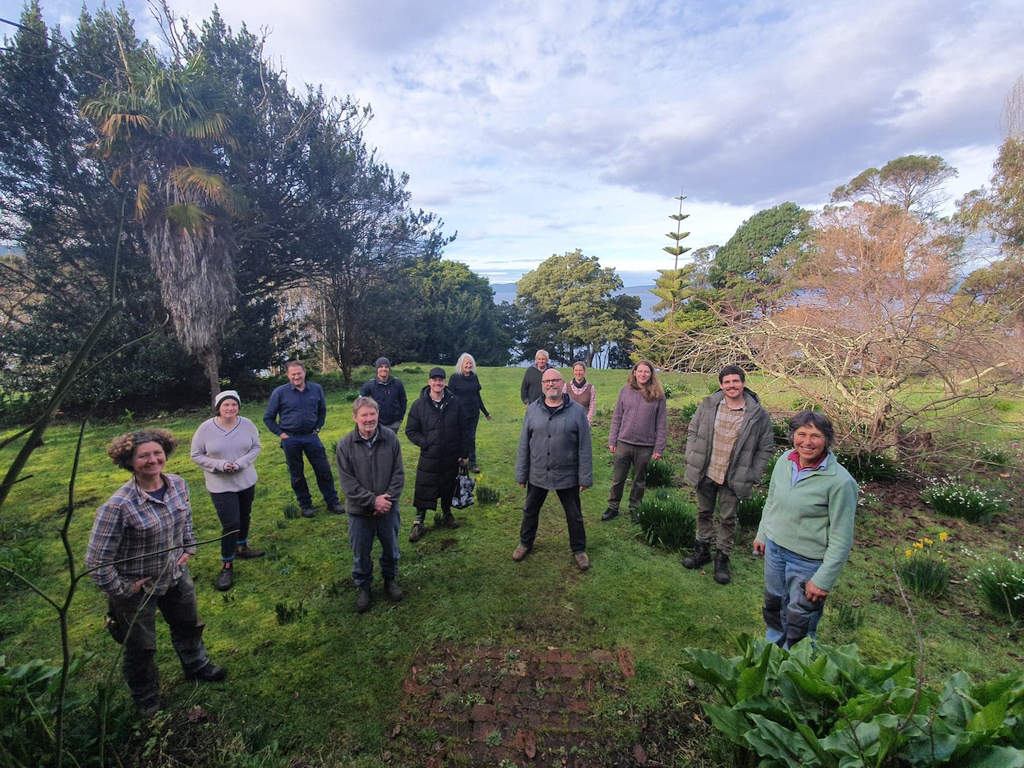
Friends of Huon Island.
As a result the unique coastal habitat is under ecological pressure. A group of dedicated people – some with connections to the island and some as friends – established the Friends of Huon Island. These friends have begun to systematically and sensitively restore the island’s landscape as habitat and a rich, bio-diverse breeding sanctuary.
The members of Friends of Huon Island are committed to its long-term restoration as valuable, secure habitat for the island’s threatened flora, fauna, marine and terrestrial habitats in accord with its original flora and fauna profiles and with respect to its Indigenous cultural heritage.
We maintain previous years plantings, undertake fire management activities and conduct foreshore clean-ups. We monitor the health (or otherwise) of the marine environment and seek to highlight threats to mammals, fish, and marine vegetation.
The project is big and builds on experience gained by the Friends over successive years, informed by engaging with relevant authorities and experts including from DPIPWE, the ANU, SETAC, NRM South, pakana Services, Huon Valley Council and local native plant experts Desley Kippax and Nicholas Alexander.
The island provides habitat for nesting shorebirds, including short, tailed shearwaters and little penguins in burrows and rock crevices, swift parrots, and the white bellied sea eagles. It is also recognised as remnant habitat for the forty spotted pardalotes.
Six vegetation communities occur on the island: Rookery halophytic herbland, Dry blue gum forest and woodland, White gum grassy forest and woodland, Bracken fernland, Residential zones and Pasture. Of these, two are recognised as threatened; Rookery halophytic herbland and Dry blue gum forest and woodland. Sixty-nine (69) plants were identified; forty (40) native and twenty-nine (29) introduced. This represents very low native plant diversity, in particular low native understorey diversity and cover. There was one threatened plant identified: Poa poiformis var. ramifer (island purple grass). Populations were found on both east and west coasts with a total of about 550 plants with an area of 500 m2.
Birdlife Tasmania have conducted surveys and song monitoring, detailing the birdlife resident or visiting the island, noting that the island is a breeding ground for shorebirds, including short-tailed shearwaters (approximately 1000 pairs) and little penguins (upwards of 400 pairs surveyed) in burrows and rock crevices and the white bellied sea eagle (one or two nesting pairs). It is also remnant habitat for the forty spotted pardalote and is currently visited by swift parrots. The Friends have established nesting boxes for parrots and penguins.
Over fifty bird species have been identified and verified on the island through on-going bird surveys. It is also recognised as a key steppingstone for many mobile faunas traversing between the Channel area/Bruny Island/coastal areas further south.
Each year we seek funds and undertake restoration activities. However, this year we have decided to run a raffle with prizes up to $700 worth and a limit of 300 tickets. We would love you to be involved .
One of the prizes is an invitation to spend a day on Huon island at our next tree planting where you will meet with the Friends and be treated to a sumptuous meal prepared by the Friends of Huon island.
Our focus is on annual tree, understory and native grass plantings utilising seedlings native to the island (seed collected on the island is germinated by volunteers), in corridors adjacent to remnant eucalyptus stands and previous plantings, along fence lines and by boundaries on private land the plantings reflect the original vegetation community as recorded in our Vegetation Condition Assessment report.
Click on the link to purchase your ticket https://www.landcaretas.org.au/store?~~mode=product&~~id=419533476#!/Raffle-Ticket-Friends-of-Huon-Island-Habitat-Restoration-Raffle/p/419533476
Author Kirsten Bacon, Researcher Michael Foley.