Media release – BirdLife Tasania, 2 December 2021
Three new Tasmanian birds identified as Threatened
Analyses of monitoring and surveys spanning more than 20 years by BirdLife Tasmania has identified three species of woodland birds that meet the criteria for listing as Threatened Species.
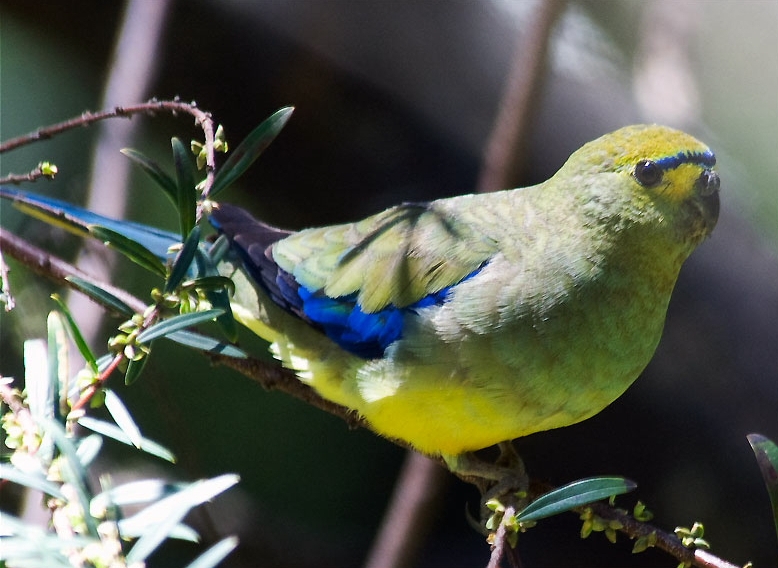
The species are Strong-billed Honeyeater and Dusky Robin, both endemic woodland birds, and Blue-winged Parrot, a migratory species that nests in Tasmania.
Monitoring efforts by BirdLife Tasmania since the late 1990s have detected population decreases in all three species, with the Dusky Robin’s population decreasing most rapidly.
The results of these studies have been incorporated into the Action Plan for Australian Birds 2020, published by BirdLife Australia and CSIRO that was released today.
“This is another worrying signal about the state of Tasmania’s biodiversity” Dr Eric Woehler, Convenor of Birdlife Tasmania said today.
Habitat loss from land clearing and fire are believed to be the factors responsible for the robin and honeyeater decreases, while sugar gliders, predators of other parrot species in Tasmania, may also be a factor for the parrot’s decrease.
“Nationally, the Action Plan identified that for one third of Australia’s already threatened species, their conservation status had deteriorated in the last 10 years.”
“Sadly, the situation is getting worse, not better,” Dr Woehler noted with concern. “It’s a reflection of our poor land management practices throughout Australia, including Tasmania” he added.
“Australia is a wealthy nation – we can afford to protect our Threatened Species before their conservation status requires urgent intervention to prevent their extinction. These last-minute efforts are always much more expensive than had efforts been made earlier.”
“Australia is currently experiencing an extinction crisis – we know the problems, we know the solutions. How will future generations judge us when we fail to protect Australia’s most remarkable birds?” Dr Woehler concluded.

Media release – BirdLife Australia, 2 December 2021
Action Plan for Australian Birds released
Many Australian birds faring badly, but conservation action works
A worrying number of Australia’s birds are closer to extinction than they were a decade ago, according to a landmark new report which was launched today. But the new Action Plan for Australian Birds 2020 shows the situation could have been much worse, if not for conservation efforts across Australia which have prevented further declines for many species.
Last released in 2011, the wholly updated and revised Action Plan — a collaboration between Charles Darwin University and BirdLife Australia — provides an overview of the risk of extinction of all birds occurring in Australia and our territories. Written by more than 300 experts, the book was edited by Professor Stephen Garnett and Dr Barry Baker and published by CSIRO Publishing.
Climate change and fire are the biggest threats to Australian birds. In the rainforests of Queensland’s Wet Tropics birds such as Fernwren and Golden Bowerbird are being forced to move towards mountains tops as rising temperatures impact their cool upland rainforest habitat.
Among the 77 birds threatened by increases in fire frequency, 26 were made more threatened by the 2019–20 Black Summer bushfires. This includes 16 on Kangaroo Island alone, such as the tiny Kangaroo Island Southern Emu-wren.
Many of these are among the 91 birds affected by more frequent and severe droughts and heatwaves. Among them is what may be Australia’s rarest bird, the Mukarrthippi Grasswren of central-western NSW, of which they may be only two or three pairs left.

“The Action Plan for Australian Birds 2020 reports on a decade of monitoring and assessment of the populations of Australian birds,” said report author Professor Stephen Garnett.
“The results tell us clearly that without changes, many species will continue to decline or to be lost altogether.”
“However, within our report we also have some clear instructions on how to avoid these outcomes. The 2020 report also illustrates how conservation action can turn things around when well-resourced and implemented.”
Birds such as the Norfolk Island Green Parrot, Albert’s Lyrebird and Bulloo Grey Grasswren have an improved conservation status thanks to direct conservation efforts to protect against threats and safeguard crucial habitat in conservation reserves such as national parks.
The report also describes how declining populations of several key species have been stabilised or increased following intensive conservation efforts. These include the Eastern Hooded Plover, Kangaroo Island Glossy Black-Cockatoo and Eastern Bristlebird.
“Our Action Plan is a measure of our performance as a society, of how we treat the birds in our collective care,” said BirdLife Australia CEO, Paul Sullivan.
“Many accounts in this Action Plan document successes in protecting our most threatened birds. This could easily have been a book of the dead, a compendium of species obituaries. That it is not is a testament to the efforts of those who love Australian nature.”
“Species with well-resourced conservation efforts have held the line. With proper investment, more populations will increase by the next Action Plan.”
You can purchase a copy of the Action Plan by clicking here.